Potential Exomoon Being Studied by JWST

Image (Credit): Artist’s rendering of WASP-39b. (NASA, ESA, CSA, Joseph Olmsted (STScI))

We hear plenty about all the exoplanets being studies at the moment, but we hear very little about exomoons, though several astronomers are eager to find them and learn more about them.

This time last year I highlighted a paper that discussed a possible exomoon circling an exoplanet called WASP-49Ab located about 635 light-years away . It was spotted by the European Southern Observatory’s Very Large Telescope in Chile.

Well, now the James Webb Space Telescope (JWST) has provided data related to another possible exomoon orbiting a hot Jupiter-like exoplanet called WASP-39b. It is located about 700 million light-years away.

In a Scientific American article titled “Have Astronomers Finally Found an Exomoon?” we learn that a paper is being released shortly outlining the argument for this potential “hypervolcanic exomoon.” This presumed IO-like exomoon is being cooked by the parent sun.

The paper accepted for publication, Volcanic Satellites Tidally Venting Na, K, SO2 in Optical & Infrared Light, states the following:

Recent infrared spectroscopy from the James Webb Space Telescope (JWST) has spurred analyses of common volcanic gases such as carbon dioxide (CO2), sulfur dioxide (SO2), alongside alkali metals sodium (Na I) and potassium (K I) surrounding the hot Saturn WASP-39 b. We report more than an order-of-magnitude of variability in the density of neutral Na, K, and SO2 between ground-based measurements and JWST, at distinct epochs, hinting at exogenic physical processes similar to those sourcing Io’s extended atmosphere and torus. Tidally-heated volcanic satellite simulations sputtering gas into a cloud or toroid orbiting the planet, are able to reproduce the probed line-of-sight column density variations. The estimated SO2 flux is consistent with tidal gravitation predictions, with a Na/SO2 ratio far smaller than Io’s. Although stable satellite orbits at this system are known to be < 15.3 hours, several high-resolution alkali Doppler shift observations are required to constrain a putative orbit. Due to the Roche limit interior to the planetary photosphere at ~ 8 hours, atmosphere-exosphere interactions are expected to be especially important at this system.

It is a dense summary, but also a hopeful finding that may lead to more focused searches for exomoons.

The addition of exomoons to the list of new discoveries will only increase the chances that some form of life can be found among he many solar systems we can study. Interestingly enough, we are still probing our own solar system’s moons with the same hope.

NASA Cuts Endanger Mars Rover Missions

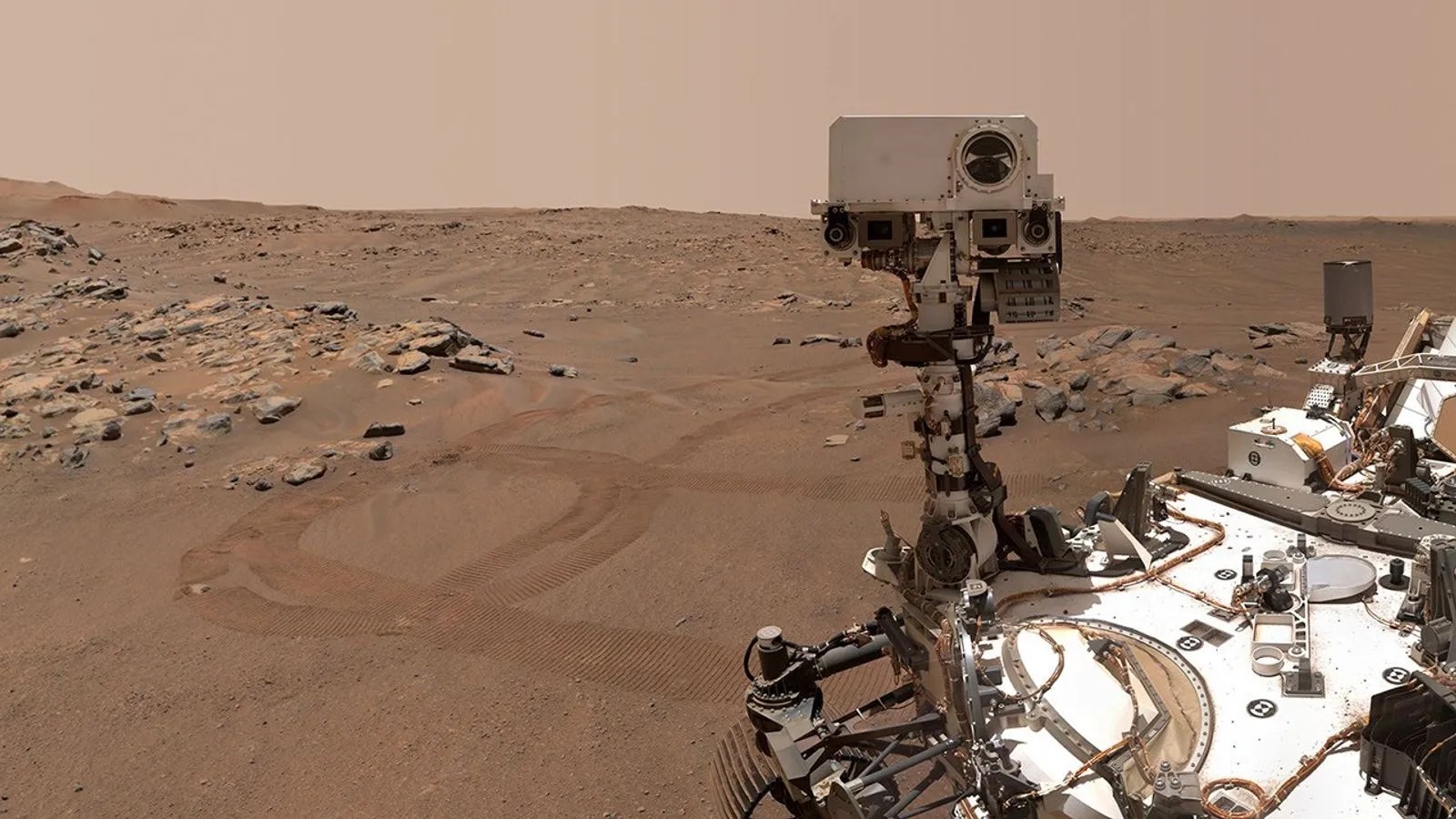
Image (Credit): Selfie by NASA’s Perseverance Mars rover taken on September 10, 2021. (NASA/JPL-Caltech)

First the White House dropped the idea of retrieving soil samples from Mars. Now it is going after the rover collecting those samples.

This week NASA’s Jet Propulsion Laboratory (JPL), which manages the rovers on Mars, announced the layoff of 550 workers, stating:

In order to best position JPL going forward, we are taking steps to restructure and establish an appropriate size to ensure future success. As part of this effort, JPL is undergoing a realignment of its workforce, including a reduction in staff. This reduction — part of a reorganization that began in July and not related to the current government shutdown — will affect approximately 550 of our colleagues across technical, business, and support areas.

One of the employees at JPL who formerly operated rovers noted that the White House cuts is reducing the funding for the Perseverance Mars rover, which collected the soil samples, by two-thirds. He was quoted as saying that they cuts are “…just enough to technically keep it going and not get the full PR backlash of canceling a working rover.”

We only have two rovers left on Mars, the Perseverance rover and the Curiosity rover. Are we going to see these rovers go dark in the near future as they continue to look for life on the planet? And what does it say that we are hoping to put humans on Mars when we cannot even find a way to properly fund the robots that are already there? Would you be your life on this government?

None of this give the US public any confidence, nor does it give bright students much hope for a NASA career when the roles they want to fill are being eliminated.

We are treading water nowadays rather than reaching for the stars. It will have repercussions that may be long-lasting.

Space Stories: Layoffs at NASA’s JPL, Rocky Giants in our Solar System, and New Findings from Apollo 17

Here are some recent space-related stories of interest.

NBC News: NASA’s Jet Propulsion Laboratory Lays Off 550 Workers

NASA’s Jet Propulsion Laboratory announced Monday that it will cut around 550 jobs — around 10% of its staff. In a statement posted online, the lab’s director, Dave Gallagher, said the layoffs are part of a broad “realignment of its workforce” and not a result of the government shutdown. The cuts will affect positions across the NASA center’s technical, business and support areas, he said.

Space.com: Uranus and Neptune May Not Be ‘Ice Giants’ After All, New Research Suggests

Astronomers have long called Uranus and Neptune the “ice giants” because models suggested that these outer planets’ interiors are largely made of mixtures of water, ammonia and other ices — compounds that freeze easily in deep space. But new research reveals that we actually know very little about what’s going on inside these planets, causing researchers to propose that Uranus and Neptune be called “rocky giants” instead.

Brown University: “With New Analysis, Apollo Samples Brought to Earth in 1972 Reveal Exotic Sulfur Hidden in Moon’s Mantle

In a study published in JGR: Planets, researchers report a sulfuric surprise in rock samples taken from the Moon’s Taurus Littrow region during Apollo 17. The analysis shows that volcanic material in the sample contains sulfur compounds that are highly depleted of sulfur-33 (or 33S), one of four radioactively stable sulfur isotopes. The depleted 33S samples contrast sharply with sulfur isotope ratios found on Earth, the researchers say.

Is Jared Isaacman Back?

Image (Credit): Jared Isaacman. (PolarisProgram.com)

It has been a few months since the blowup between President Trump and Elon Musk, which also led to the removal of billionaire Jared Isaacman as the nominee to be NASA administrator. In the meantime, Sean Duffy has been in the role of acting administrator while also trying to run the Department of Transportation.

Well, that may be ending soon as it appears Mr. Isaacman may have another chance at the NASA job, as reported by CNBC. President Trump is said to have met with Mr. Isaacman last month to discuss his return as a nominee.

It is not clear if this means Mr. Isaacman is forgiven for donating to democratic causes or the White House is very short on capable people to run NASA, or both. Whatever the case, it is quite a turn of events, possibly helped along by Musk’s hat-in-hand approach after the scuffle.

Mr. Isaacman is being offered a much diminished agency from the one offered earlier this year, with the White House planning severe cuts in the Fiscal Year 2026 budget. Talks of more layoffs and firings during the current shutdown also threatens to make the situation worse.

These are fickle times with the White House flipping its positions on issues almost daily, so the news could change. For now, it’s a matter of wait and see.

Pic of the Week: Tropical Cyclones Imelda and Humberto

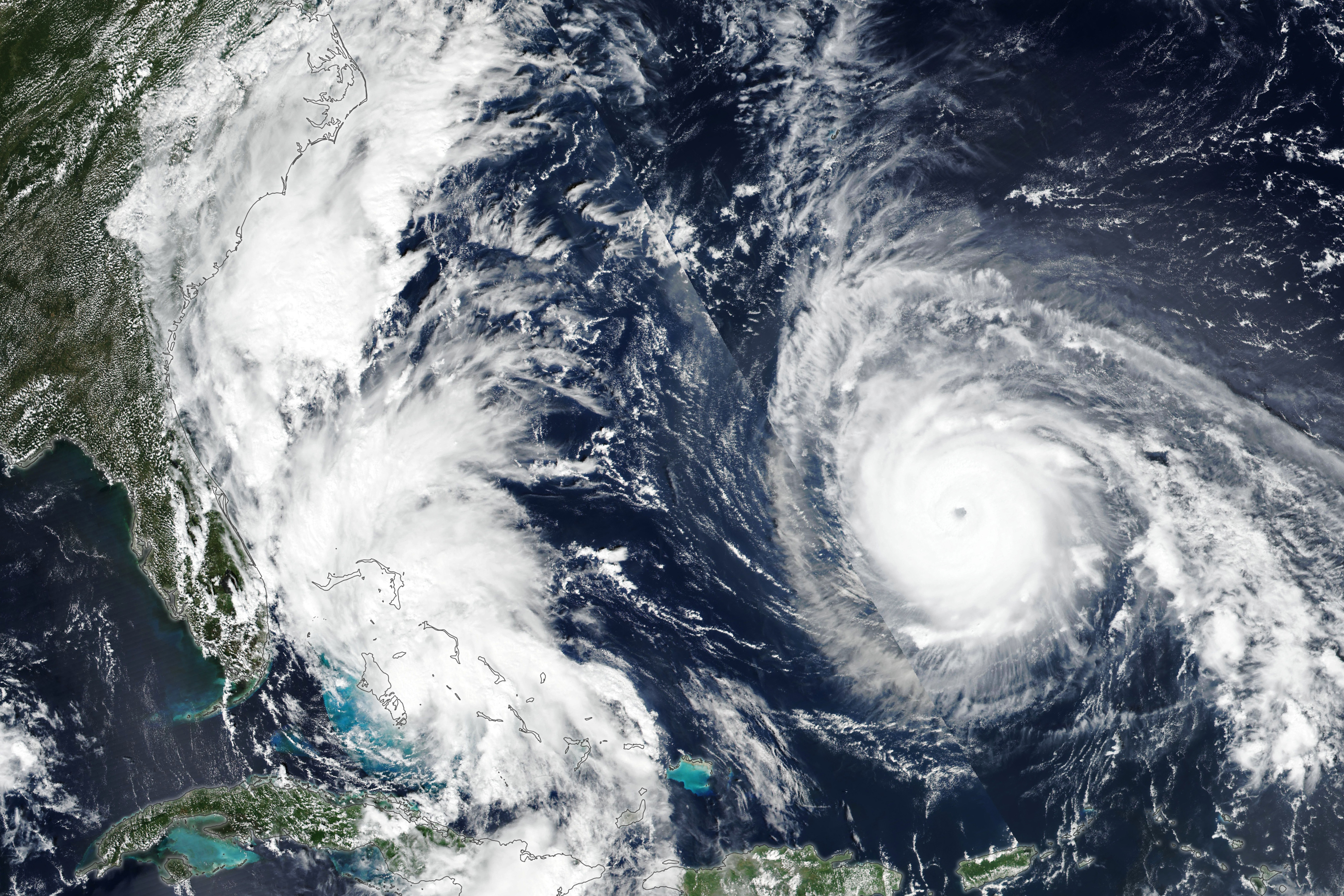
Image (Credit): Tropical Storm Imelda (left) and Hurricane Humberto off the eastern coast of the United States on September 28, 2025. The image also shows the outlines of the areas covered by clouds in North America and Caribbean. (NASA Earth Observatory image by Lauren Dauphin, using VIIRS data from NASA EOSDIS LANCE, GIBS/Worldview, and the Suomi National Polar-orbiting Partnership)

This week’s image comes from NASA’s Earth Observatory. It caught two tropical cyclones stirring up the Atlantic Ocean in late September. Both Tropical Storm Imelda and Hurricane Humberto caused plenty of problems off of the east coast of the United States without ever making landfall.

Here is more on the two storms from NASA:

Imelda had already brought tropical storm conditions to portions of the central and northwestern Bahamas. Prior to becoming a named storm, the system also lashed Puerto Rico and eastern Cuba with heavy rain. In the coming days, Imelda could intensify and cause flash and urban flooding along the coast of the Carolinas, according to the National Hurricane Center.

Although Humberto lurked farther from land, its effects still reached coastlines due to its massive size. Dangerous surf conditions affected beaches in the northern Caribbean, the Bahamas, and Bermuda, as well as much of the U.S. East Coast. Mid-Atlantic and even some Northeast states could see large swells and rip currents stemming from the storm, forecasters warned.