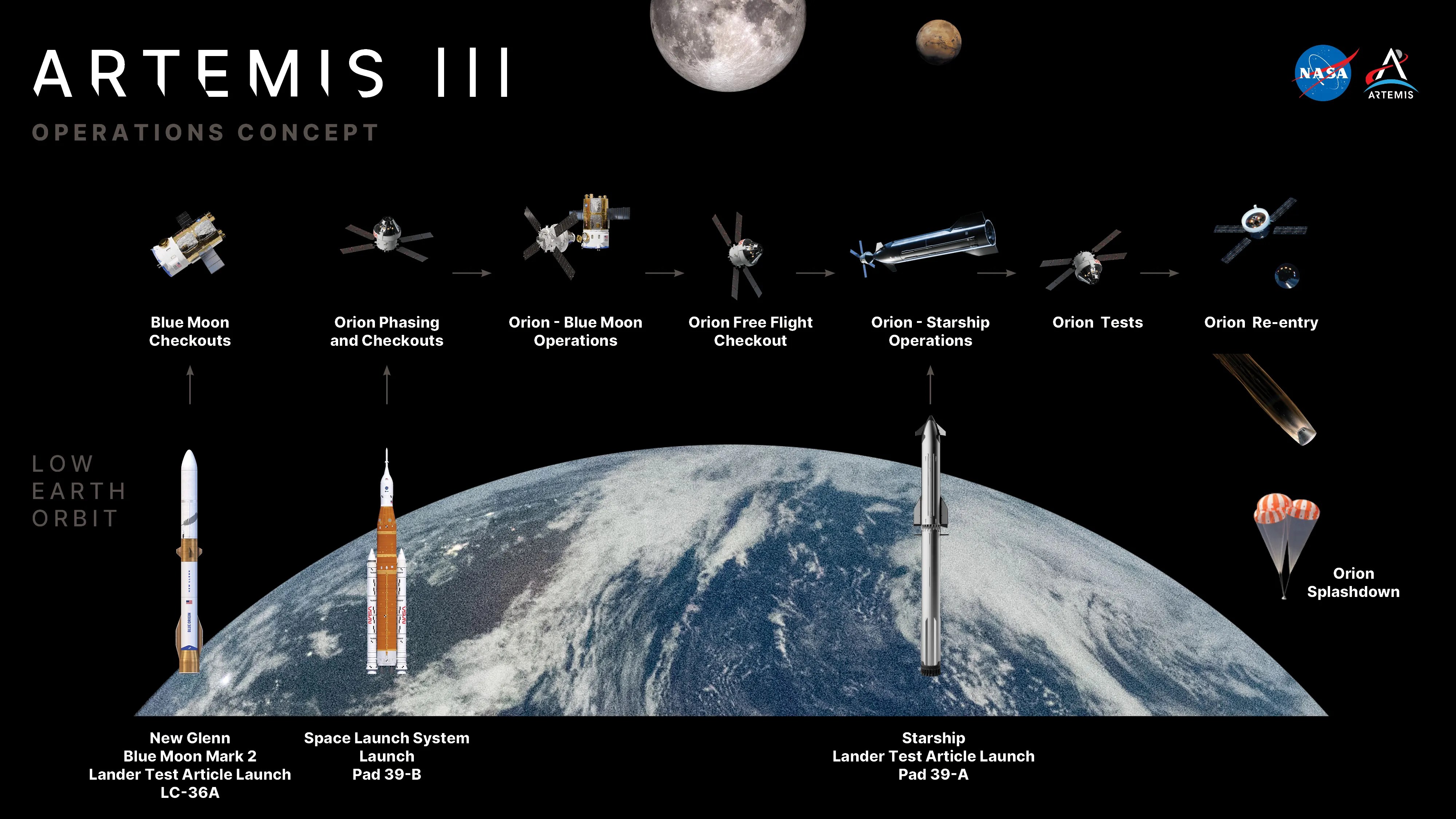
“Every piece of this mission in Earth orbit is designed to reduce risk before we put astronauts back on the Moon…We’re launching three spacecraft on three different rockets and testing how they operate together — something NASA has never attempted. Every lesson we learn here gets us closer to landing on the Moon in 2028.”
–Statement by Jeremy Parsons, NASA’s Artemis program manager, regarding a planned 14-day test in 2027 of Blue Origin’s Blue Moon, SpaceX’s Starship, and NASA’s Orion capsule using three different rockets (Blue Origin’s New Glenn, SpaceX’s Starship, and NASA’s Space Launch System). See the NASA image above to understand the complexity of what is planned. You can also find more information about the mission here.
“Well, I don’t know if it was anybody, because it wasn’t me, and I don’t think it was Elon, and from what I understand, it’s the same as it’s always been.”
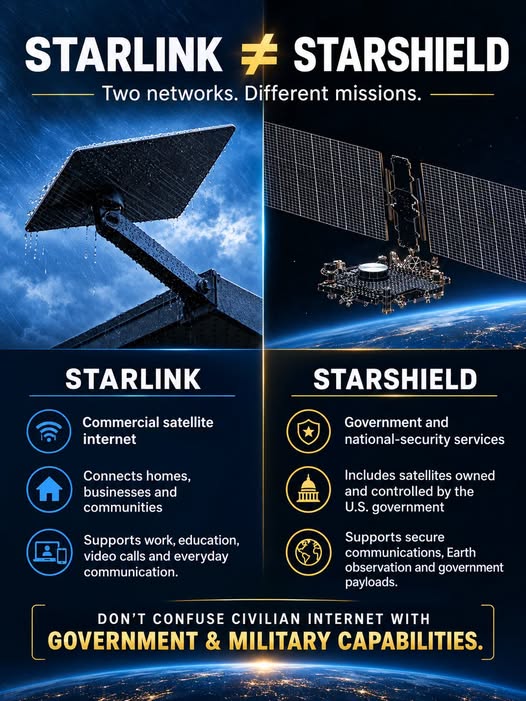
–Statement by President Trump after being asked about interference with the Starlink system used by the Ukrainians to defend their country against Russian attacks. Elon Musk and the US Government operate the Starlink and Starshield systems, respectively, over Ukraine. The New Republic is now reporting that Mr. Musk approached President Trump about “slowing down” the satellite service while the White House touts a false ceasefire between Russia and Ukraine for the purpose of obtaining Russian diesel fuel to replace fuel lost as a result of the war with Iran. The planned deal between Russia and the US would violate US law while also harming Ukraine. The White House is blaming Ukraine for attacking Russian energy assets while saying nothing about how Russia continues to violate international law as well as a treaty between Ukraine, the US, and Russia. Mr. Musk should probably figure this out quickly since the Ukrainian uncertainty is already impacting SpaceX stock, the only thing he seems to care about these days.
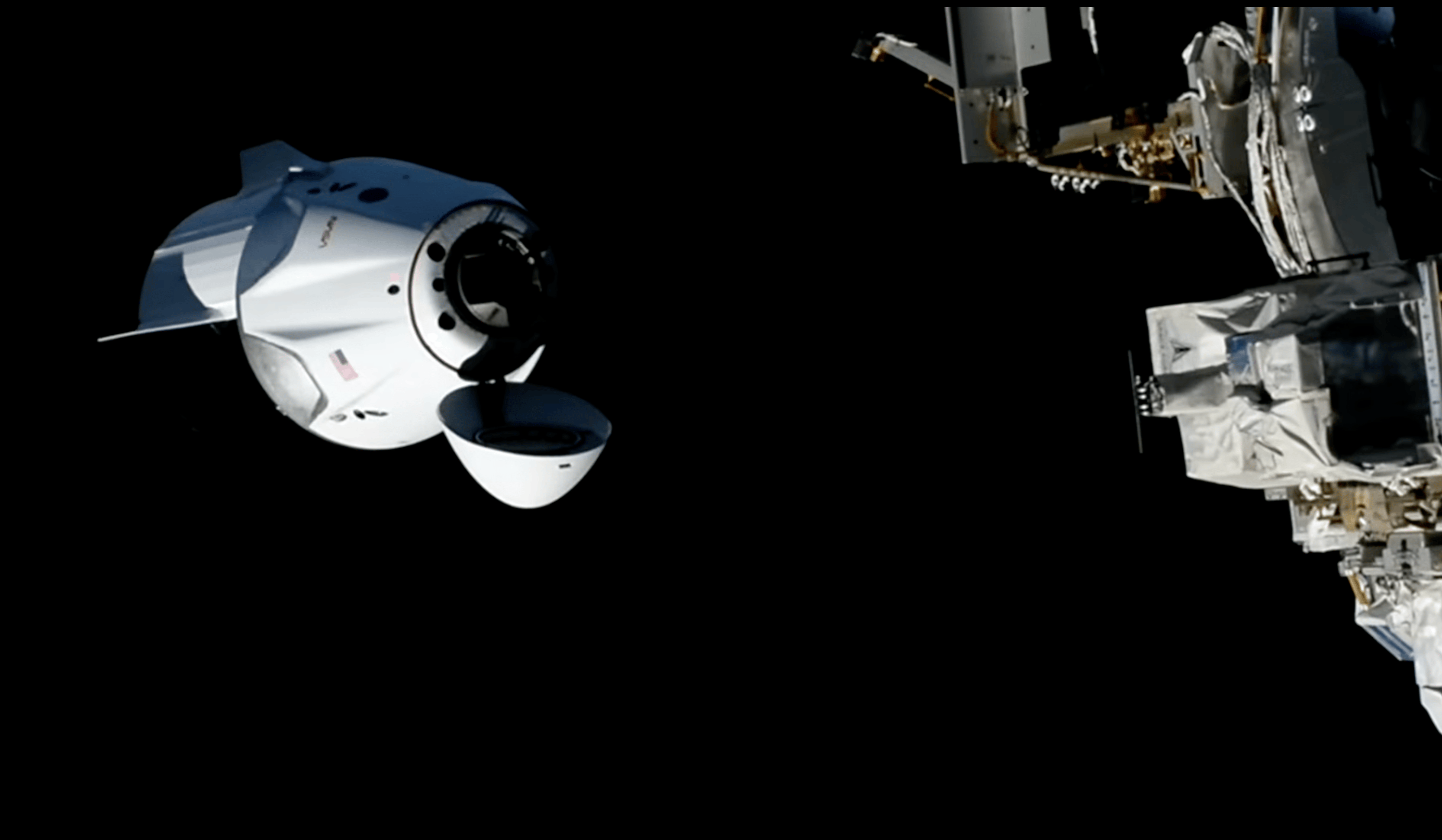
Image (Credit): The SpaceX Dragon, with its nose cone open and carrying four Crew-13 members, approaches the International Space Station for a docking yesterday evening. (NASA)
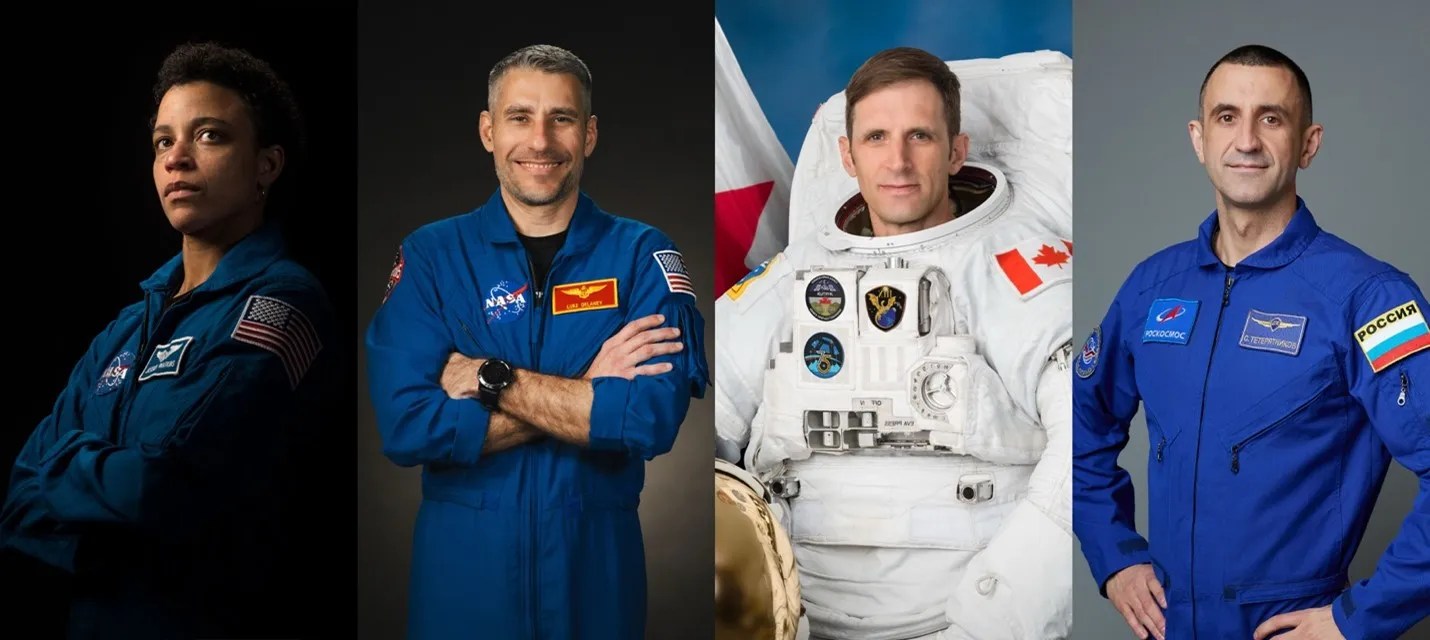
A new ISS crew was launched from Cape Canaveral at 11:10 a.m. EDT Thursday, October 1, 2026 . Crew-13, consisting of NASA astronauts Jessica Watkins and Luke Delaney, Canadian Space Agency (CSA) astronaut Joshua Kutryk, and Roscosmos cosmonaut Sergey Teteryatnikov. The ride to the space station was scheduled to be about 8 hours. The SpaceX Dragon capsule carrying the crew safely docked with the ISS at 9:19 p.m. EDT.
The new crew will replace Crew‑12 consisting of NASA astronauts Jessica Meir and Jack Hathaway, European Space Agency astronaut Sophie Adenot, and Roscosmos cosmonaut Andrey Fedyaev. These four crew members will be returning to Earth as soon as Monday, weather permitting.
Image (Credit): From left to right, Crew-13 NASA astronauts Jessica Watkins and Luke Delaney, CSA astronaut Joshua Kutryk, and Roscosmos cosmonaut Sergey Teteryatnikov. (NASA)
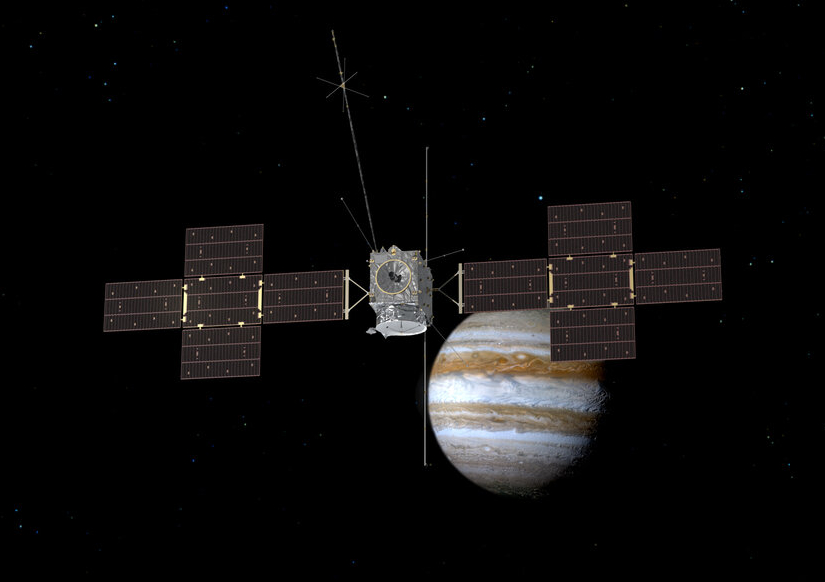
The European Space Agency’s Jupiter Icy Moons Explorer (Juice) skimmed the very outer edge of Earth’s atmosphere on 28 September, using the gravity of our home planet to alter its route to Jupiter using very little fuel. The flyby deflected Juice by an angle of 20° compared to its pre-flyby path and increased its velocity by 3.5 km/s. In the four weeks before the flyby, spacecraft operators only had to give Juice one tiny nudge (out of six opportunities set aside) to put it on exactly the right approach trajectory to make the most of Earth’s gravity. They have been tracking the spacecraft extra carefully since 17 August, and will continue to do so until 10 October.
SpaceX’s massive Starship rocket blasted off from Texas Monday morning on its most ambitious test flight yet, aiming for a roughly 10-hour mission that would have sent the spacecraft around Earth six times, though the company ultimately decided to end the flight earlier than planned…The launch marks Starship’s 14th test flight and its first attempt to reach orbit, a major step beyond previous suborbital missions that ended with splashdowns about an hour after liftoff.
NASA is working with Boeing to launch an unpiloted Starliner capsule in the December-to-January time frame to test upgrades and improvements ordered in the wake of a 2024 mission that suffered multiple propulsion system failures, stranding two astronauts on the space station for more than nine months. If the unpiloted test flight goes well, NASA and Boeing hope to launch a piloted Starliner flight in the mid-2028 time frame, officials said Monday, incorporating redesigned propulsion system valves, more robust subsystems and other modifications expected to prevent the sort of failures that occurred in 2024. Veteran astronaut Warren “Woody” Hoburg will command the mission.
It’s a question that has perplexed planetary astronomers for decades: Why does Venus — so similar in size to Earth and not all that far from Earth’s orbit — have no moon, while our planet has such a relatively large one? Earth’s Moon likely formed after a massive collision early in solar system history. But according to calculations, Venus should have been even more likely than Earth to have experienced such a catastrophic crash during its formative years. Yet today it has no moon at all. Now, a series of simulations published in the September 20th Astrophysical Journal, have demonstrated that Venus might once have had a moon — but the planet’s relative proximity to the Sun and its massive atmosphere both created conditions under which no moon could have survived. If there ever was a moon, it would have disintegrated and fallen back to the surface long ago.
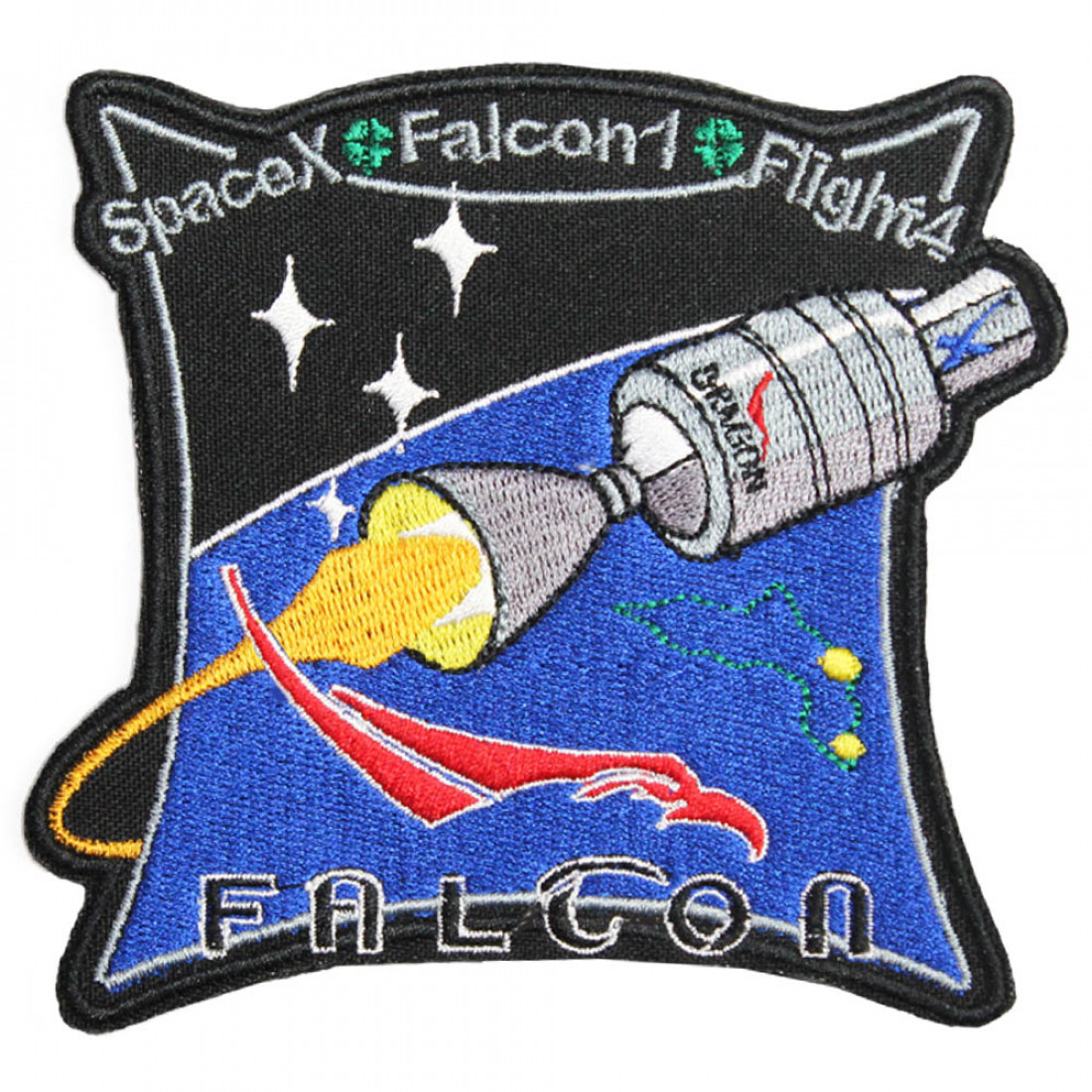
On this day in 2008, SpaceX had a successful launch of its Falcon 1 rocket after three earlier failures. Launched from Omelek Island in the Marshall Islands, the rocket would fly only one more mission before being retired. It was replaced by the Falcon 9, which is still in service today.
After the third failure of the Falcon 1 in August 2008, Elon Musk stated:
The most important message I’d like to send right now is that SpaceX will not skip a beat in execution going forward. We have flight four of Falcon 1 almost ready for flight and flight five right behind that. I have also given the go ahead to begin fabrication of flight six. Falcon 9 development will also continue unabated, taking into account the lessons learned with Falcon 1. We have made great progress this past week with the successful nine engine firing.