Space Quote: Houston, We Have Glitter on the Moon

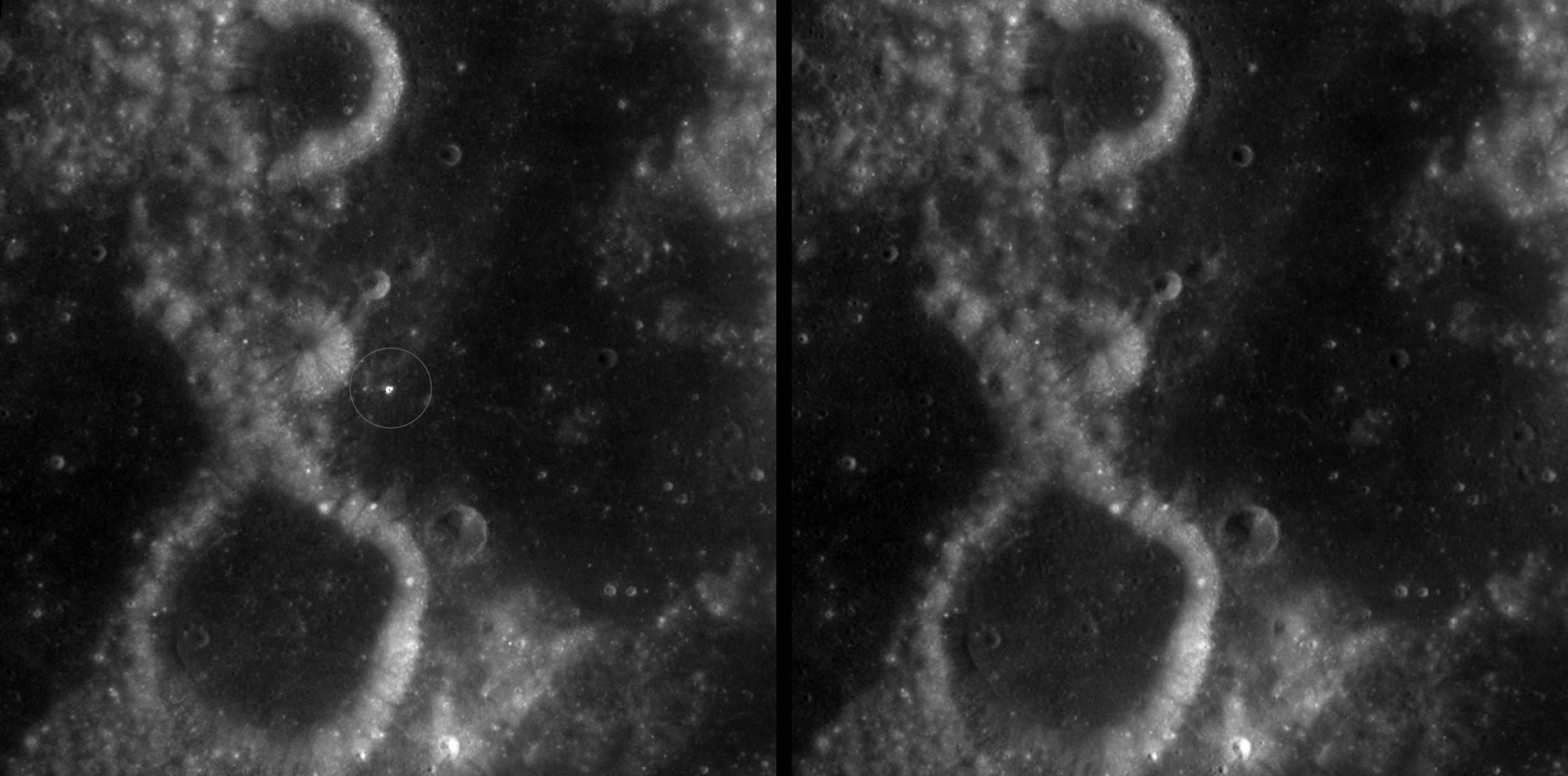
Image (Credit): Image of the three dots NASA’s Apollo 17 crew reported seeing during their lunar visit. (NASA)

“Now we’ve go a few very bright particles or fragments or something that go drifting by as we maneuver.”

“There’s a whole [bunch] of big ones on my window down there – just bright. It looks like the Fourth of July out of Ron’s window.”

-Statements by Apollo 17 Command Module Pilot Ronald Evans and Lunar Module Pilot Harrison Schmitt, respectively, per a recently released Department of Defense document that is part of information being released that may apply to UFOs. Of course, as you read more of the transcript, you will find that the astronauts casually discuss how these particles look like “jagged, angular fragments” that may be ice chunks or paint chips. The media is certainly playing up the various sightings and issues, but I recommend reading of the transcripts to get a better feel for what was said and the various explanations proposed.

Pic of the Week: The Crescent Earth

Image (Credit): A look back at Earth by the Artemis II crew. (NASA)

This week’s image is one of more than 12,000 from the Artemis II mission recently released by NASA. This particular shot of the crescent Earth is a whole new way to look at our world from afar.

These images are currently available via the Gateway to Astronaut Photography of Earth website, but they are not easy to locate. NASA also maintains a multimedia website with many images, videos, wallpapers, and more (shown below).

Space Stories: New Artemis II Photos, JWST Studies Exoplanet Surface, and Japanese Space Sake for Sale

Image (Credit): One of the new photo from the Artemis II mission recently released by NASA. (NASA)

Here are some recent space-related stories.

ABC News: “NASA Releases More Than 12,000 Images from Historic Artemis II Moon Mission

Over the weekend, NASA made public more than 12,000 photos from the historic Artemis II lunar mission…Over the course of the mission, NASA released dozens of images of the astronauts, Earth, the moon and even a total solar eclipse. However, the new trove reveals some never-before-seen photos as well as new angles of objects in space, primarily using Nikon cameras and iPhone 17s.

ZME Science: Astronomers Determine the Surface of a Rocky Planet Beyond Our Solar System for the First Time

A rocky planet nearly 50 light-years away appears to be airless, dark, and covered in volcanic or weathered rock, according to new observations from the James Webb Space Telescope. This is the first time that astronomers have obtained details about the surface of a rocky planet outside our solar system. The planet, LHS 3844 b, is not habitable. It is about 30 percent larger than Earth, orbits its star every 11 hours, and has one side permanently pointing towards the Sun, baked at about 725°C.

The Korean Times: Space-fermented Sake by Japanese Brewer Dassai Sells for $700,000

Japanese brewer Dassai has sold a 100-milliliter bottle of sake fermented on the International Space Station for 110 million yen ($700,000). Dassai partnered with Mitsubishi Heavy Industries to ferment sake ingredients in space, the Yomiuri Shimbun newspaper reported Monday. Using the space-fermented mash, or moromi, the brewery finished brewing the sake on Earth, yielding 116 milliliters. Dassai sold a 100-milliliter bottle of the final product to an unnamed Japanese buyer. The company plans to donate the proceeds to Japan’s space program.

Space Quote: NASA Budget Hearing and Artemis

Credit: Image by Mila Okta Safitri from Pixabay

“But for all the Artemis II mission accomplished, how we arrived at it was far from perfect, and the decisions of previous administrations that led to these deficiencies deserves careful reflection. Almost the entirety of [the Space Launch System is repurposed decades-old Space Shuttle hardware. I understand why, the Shuttle program was ending, and it was important to look after the industrial base. I will also say that was at a time when we did not have a geopolitical competitor challenging America in the high ground of space, but perpetuating the past does not help us realize a better future. Even after over $100 billion of taxpayer funding to date, and this most recent and successful Artemis II mission, we would not have launched again until late 2028 with the aim of putting astronauts on the Moon under the previous plan. A plan with no hope of achieving this national imperative. You do not fly rockets like this every three plus years and expect success. Further, you do not make each vehicle a work of art by materially changing the configuration. You also do not build a base in orbit above the Moon, when the scientists, the engineers, the astronauts, and certainly the space-loving community want to be on the surface of the Moon, which is hard enough to achieve.”

-Statement by NASA Administrator Jared Isaacman at his hearing before the Senate Committee on Appropriations, Subcommittee on Commerce, Justice, Science, and Related Agencies, earlier this week. He was justifying his revamping of the Artemis schedule and elimination of the Lunar Gateway. He also defended the White House’s cuts to his budget, though not everyone in the room was convinced. Ranking Member Senator Chris Van Hollen (D-MD) was not happy with the planned cuts to the Science Mission Directorate, stating:

I think everyone in this room knows that without space science, there is no space exploration. Without space science, there is no new planetary discovery. Without space science, there is no NASA

Television: Star City

Credit: Apple TV

We are only one month away from the premiere of Apple TV’s Star City.

Premiering on May 29th, the series is a spin-off from For All Mankind, which is an alternative history showing the race to the Moon and then Mars among the Americans, Soviet, and North Koreans. Star City will focus on the Soviet program, just as For All Mankind focused primarily on the American program.

Apple TV describes the new series in this way:

A bold new chapter inspired by the critically acclaimed space-race drama, “For All Mankind,” “Star City” is a propulsive paranoid thriller that takes us back to the key moment in the alt-history retelling of the space race — when the Soviet Union became the first nation to put a man on the moon. But this time, we explore the story from behind the Iron Curtain, showing the lives of the cosmonauts, the engineers and the intelligence officers embedded among them in the Soviet space program, and the risks they all took to propel humankind forward.

While For All Mankind was mostly a bombastic show with plenty of American daredevil fun, the Star City promises to be a much darker view of another space program that we only saw in quick glimpses during the first series. Keeping the show interesting and not too bleak may be a challenge.

Will we ever see another spin-off covering the North Korean version of the space race? It is doubtful, yet it would be both fascinating and bleak as well.

I imagine Star City can be a stand-alone series for those who missed For All Mankind, but I think half the fun in watching the new series will be watching where the two stories interweave and discovering what was really happening on the Soviet side.

If history has multiple perspectives, even alternative history, then I look forward to understanding more of the story through more voices.

Credit: Apple TV