Artemis Rocket Launch Planned for August

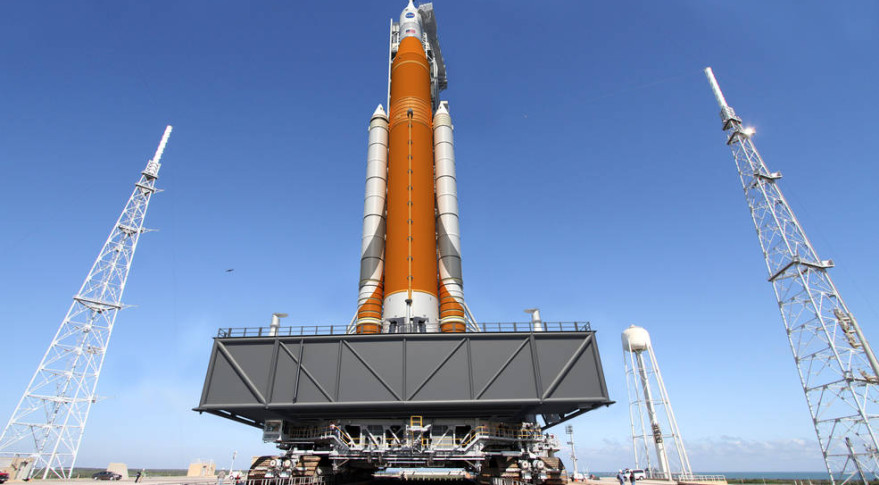
Image (Credit): NASA’s Space Launch System rocket. (NASA)

NASA said it is ready for a real test of the Space Launch System (SLS) and Orion capsule after multiple dry-runs. Of course, the tests were not perfect, but NASA said it is ready for the next phase. The latest test was on June 20th. Following that, Tom Whitmeyer, deputy associate administrator for common exploration systems at NASA Headquarters, stated:

During the wet dress rehearsal activities, we have incrementally added to our knowledge about how the rocket and the ground systems work together, and our teams have become proficient in launch procedures across multiple sites. We have completed the rehearsal phase, and everything we’ve learned will help improve our ability to lift off during the target launch window…The team is now ready to take the next step and prepare for launch.

The uncrewed launch itself could be as early as late August. Under this phase of the project, called Artemis 1, the rocket, capsule, and ground control will get a rigorous test. As NASA explains:

During this flight, the spacecraft will launch on the most powerful rocket in the world and fly farther than any spacecraft built for humans has ever flown. It will travel 280,000 miles from Earth, thousands of miles beyond the Moon over the course of about a four to six-week mission. Orion will stay in space longer than any ship for astronauts has done without docking to a space station and return home faster and hotter than ever before.

NASA has come a long way to get this this step. The various problems along the way is why you have such tests. And now the first phase is about ready. Fingers crossed…

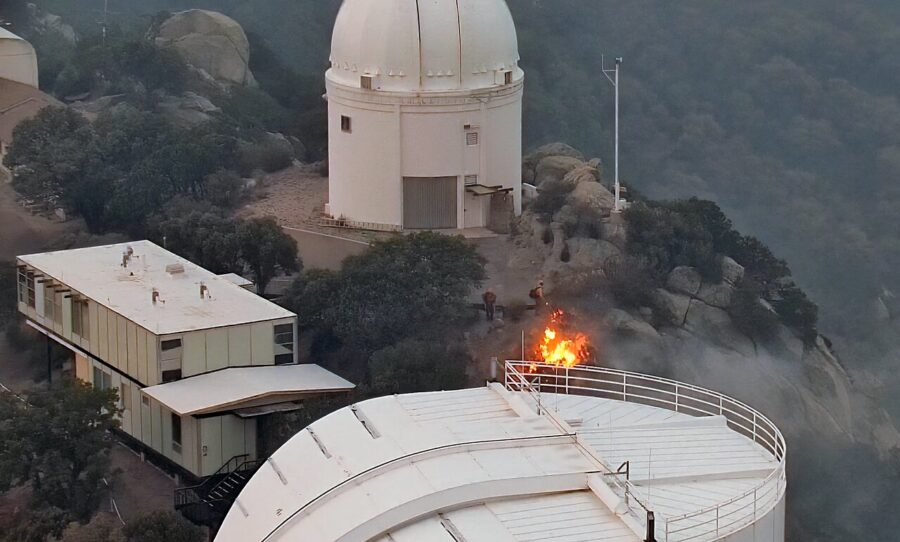
Image (Credit): Artemis 1 mission map. (NASA)

Fire Damages Kitt Peak National Observatory Buildings

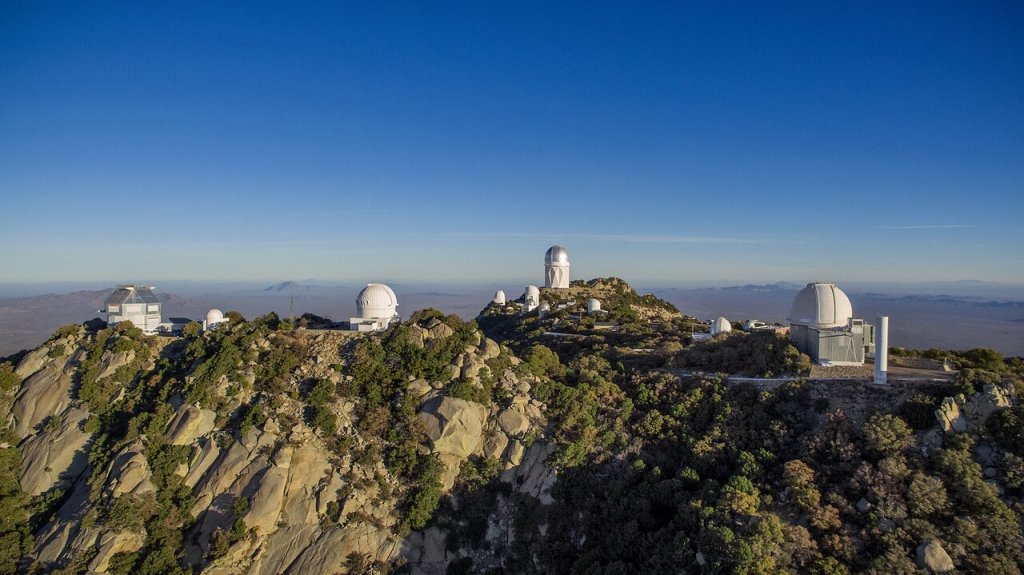
 Image (Credit): View from the Nicholas U. Mayall 4-meter Telescope showing the Contreras Fire burning near the summit of Kitt Peak on Thursday 16 June 2022. (KPNO / NOIRLab / NSF / Aura)

Earlier this month, a lightening strike led to a fire in Baboquivari Mountains in southern Arizona, home of the Kitt Peak National Observatory (KPNO). According to news reports, the telescopes themselves are fine, but four “non-scientific” buildings were lost in the fire. Pro-active fire crews were able to prevent greater damage in the area.

This is the latest summary from the blog of the National Science Foundation’s (NSF) NSF’sNational Optical-Infrared Astronomy Research Laboratory (NOIRLab):

Update 21 June pm: 

Today the area affected by the Contreras fire increased by 4,401 acres to a total of 24,761 acres. Containment increased to 50% according to the Eastern Area Incident Management Team.

The Team reports that fire around the eastern flank of the summit of Kitt Peak National Observatory is now controlled and they expect to have the northern flank controlled today. The fight is not over for our Tohono O’odham neighbors and we are keeping these communities in our thoughts...

According to the NOIRLab site, the site hosts the Nicholas U. Mayall 4-meter Telescope on behalf of the Dark Energy Spectroscopic Instrument (DESI) survey, the WIYN 3.5-meter Telescope, and the facilities of consortia that operate between them more than a dozen optical telescopes and two radio telescopes. Since the start of COVID, the KPNO has been closed to visitors, so the threat to people in the area reduced.

While the mountains of Arizona offer plenty of benefits for observatories, seasonal fires are also part of the deal. Luckily, the fire crews were there in time to keep Mother Nature in check.

Image (Credit): The Kitt Peak National Observatory in Tucson, AZ, (NSF telescopes from left to right) showing the WIYN 3.5-meter Telescope, the Visitor Center Levine 0.4-meter Telescope, 0.9-meter, Nicholas U. Mayall 4-meter Telescope, and KPNO 2.1-meter Telescope.  (NOIRLab)

Pic of the Week: Dwarf Starburst Galaxy Henize 2-10

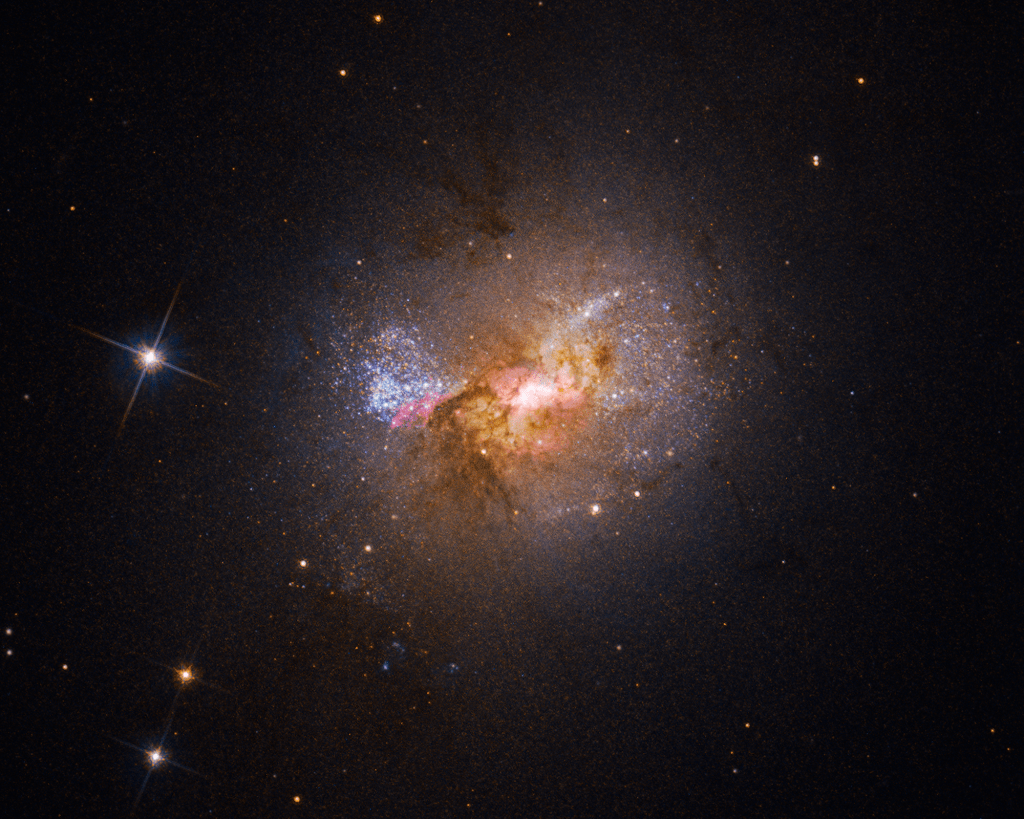
Image (Credit): Dwarf starburst galaxy Henize 2-10. (NASA, ESA, Zachary Schutte (XGI), Amy Reines (XGI), Alyssa Pagan (STScI))

This week’s photo is from the Hubble Space Telescope. It shows the Dwarf starburst galaxy Henize 2-10, which lies 34 million light years away. NASA notes that “The bright region at the center, surrounded by pink clouds and dark dust lanes, indicates the location of the galaxy’s massive black hole and active stellar nurseries.”

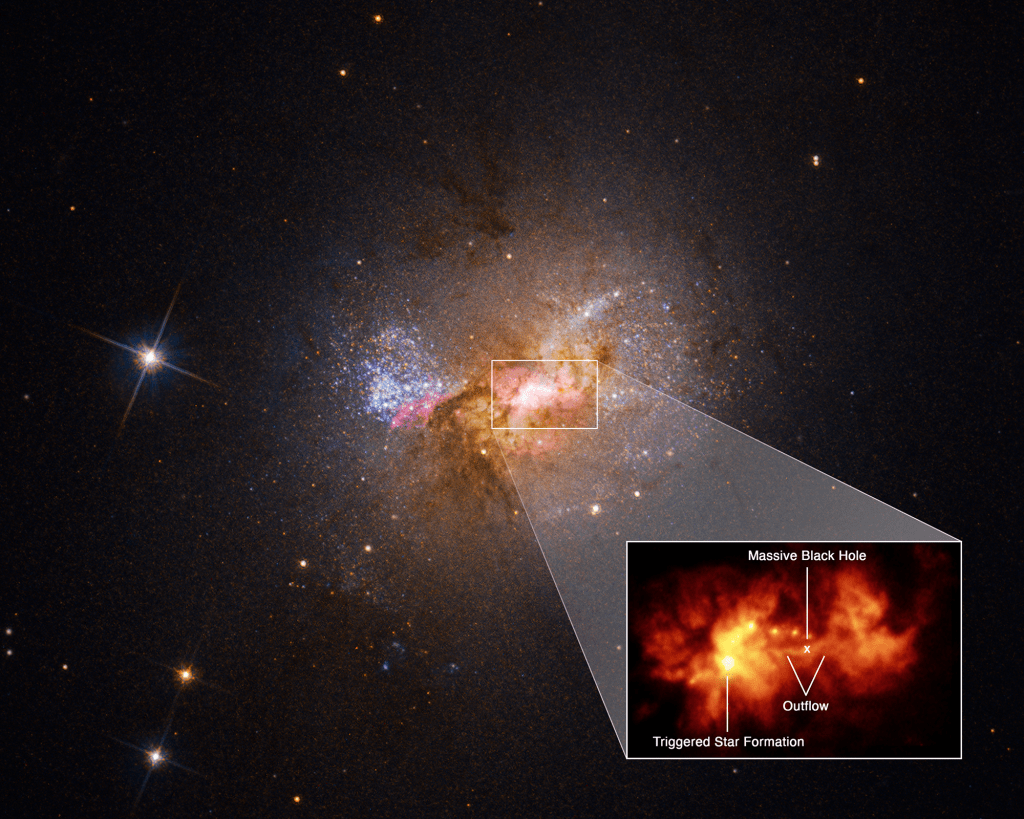
The image below better illustrates the link between the massive black hole and the related star formation. NASA explains:

A pullout of the central region of dwarf starburst galaxy Henize 2-10 traces an outflow, or bridge of hot gas 230 light-years long, connecting the galaxy’s massive black hole and a star-forming region. Hubble data on the velocity of the outflow from the black hole, as well as the age of the young stars, indicates a causal relationship between the two. A few million years ago, the outflow of hot gas slammed into the dense cloud of a stellar nursery and spread out, like water from a hose impacting a mound of dirt. Now clusters of young stars are aligned perpendicular to the outflow, revealing the path of its spread.

Image (Credit): Dwarf starburst galaxy Henize 2-10 with a pullout showing the black hole and related star formation. (NASA, ESA, Zachary Schutte (XGI), Amy Reines (XGI), Alyssa Pagan (STScI))

Podcast: Lori Garver on NASA and Commercial Space

Credit: Amazon

This week’s StarTalk podcast with Neil deGrasse Tyson included an interview with former Deputy Administrator of NASA, Lori Garver. She is author of a new book, Escaping Gravity: My Quest to Transform NASA and Launch a New Space Age, which has a number of reviewer quotes, including the one from Elon Musk below.

In addition to the dialog about her time with NASA and the growing role of commercial space providers, the dialogue also gets into specific projects, including potential plans to mine asteroids. One asteroid in particular, Psyche (located in the asteroid belt), was cited as an asteroid of special interest because it contains what some believe to be the core of a failed planet, which means plenty of expensive metals.

NASA currently has plans to launch a spacecraft later this year to visit Psyche. The objectives are to:

  • Determine whether Psyche is a core, or if it is unmelted material.
  • Determine the relative ages of regions of Psyche’s surface.
  • Determine whether small metal bodies incorporate the same light elements as are expected in the Earth’s high-pressure core.
  • Determine whether Psyche was formed under conditions more oxidizing or more reducing than Earth’s core.
  • Characterize Psyche’s topography.

I recommend you listen to the full podcast story and also stayed tuned for the upcoming asteroid adventure.

Image (Credit): Quote regarding Ms. Garver’s latest book. (Amazon)

Update: The Psyche mission has been delayed. NASA noted:

Due to the late delivery of the spacecraft’s flight software and testing equipment, NASA does not have sufficient time to complete the testing needed ahead of its remaining launch period this year, which ends on Oct. 11.

A launch is possible as early as next year, but NASA is now going over all the options.

First Photos from James Webb Space Telescope to be Released on July 12th

Image (Credit): Artistic image with the JWST mirrors. (NASA)

NASA recently announced, in partnership with the European Space Agency and the Canadian Space Agency, that the first photos from the James Webb Space Telescope will be released from NASA’s Goddard Space Flight Center via a televised broadcast beginning at 10:30 a.m. EDT on Tuesday, July 12, 2022. The first images will also be posted here.

All of this follows the recent micrometeroid incident. NASA has been pretty quiet since reporting on the initial damage, though the pictures appear to be arriving as expected, so that is good news.

In terms of any future repairs to the JWST, a NASA Q&A with Paul Geithner, the deputy project manager – technical for James Webb Space Telescope, gives us some idea about the difficulties of such a mission:

​Q: Webb was not designed to be serviced, but could it eventually be repaired or refueled during a robotic service mission?

Paul: Conceivably, some robotic servicing of Webb could be possible. A robot could grapple Webb at the same place where it was attached to the Ariane launch vehicle, which is the launcher interface ring on the Sun-facing spacecraft bus, and then add fuel to its propulsion tank. Given that Webb is an exquisitely sensitive infrared observatory, and much of it is at cryogenic temperatures, opportunities and benefits of servicing are limited.

Image (Credit): JWST mission quick facts. (NASA)