House Report: Budget Issues at NASA

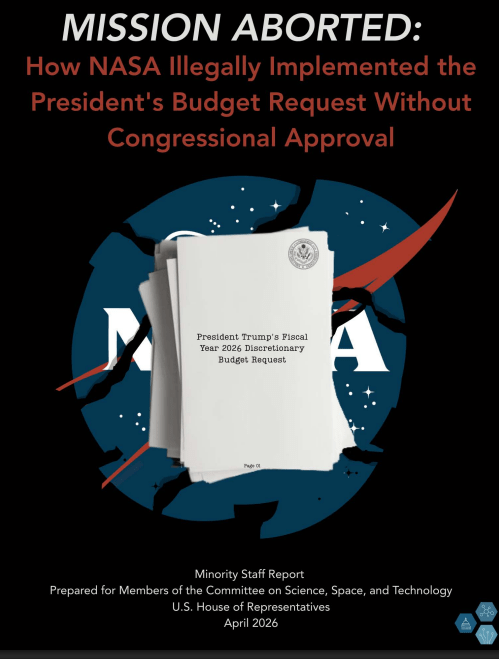
A new released minority staff report from the House Committee on Science, Space, and Technology, titled MISSION ABORTED: How NASA Illegally Implemented the President’s Budget Request Without Congressional Approval, has a few issues with the budget process at NASA.

Here is the main point from the report’s executive summary:

In 2025, NASA implemented the President’s Budget Request for Fiscal Year 2026 instead of the laws duly enacted by Congress. NASA leaders denied this fact repeatedly during the summer and fall of 2025. But the evidence gathered by Committee Staff says otherwise. Without authorization or direction from Congress, and in violation of the basic separation-of-powers framework set forth by the Constitution, NASA put into effect an executive branch proposal as if it were the law of the land. The consequences of that decision – for the agency, its workforce, and American leadership in science and space – were adverse to the agency’s mission.

The 38-page report gives plenty of examples about the various missions delayed or thwarted by NASA management, such as the Electrified Powertrain Flight Demonstration project and the Advanced X-ray Imaging Satellite mission.

Last year was a pretty horrible year overall for government programs, but we can all be thankful that DOGE did not get too far past the destruction of the US Agency for International Development before it steered into the rocks and eventually sunk. Besides, Mr. Musk would not want to attack an agency that keeps him in business.

With Jared Isaacman as NASA’s administrator, and Congress basically ignoring White House cuts, the overall damage has been contained. With that said, the scars left on agency programs and personnel will be long-lasting.

Congress will need to remain vigilant and continue to investigate and highlight any budgetary abuses at NASA should they still occur, even if it is only the minority party paying attention at the moment (though that minority status seems likely to change with elections later this year).

We will see many more such reports in the years to come, but for too many it will be too little, too late.

Space Quote: More Space Cuts, This Time in the United Kingdom

Credit: Image by Sibling Yonten Phuntsok from Pixabay

“The UK punches above its weight in scientific impact and in space-related industry. This should be a national success story, but instead we are facing the possibility of unsettling and destabilizing threats to funding for cutting-edge science. STFC, the research council responsible for astrophysics, along with particle physics and nuclear physics, is expecting future budgets supporting facilities like our observatories to be just 70% of the current level, a potentially devastating cut at a time where costs are increasing. The resulting loss of jobs and reduction in roles could easily amount to hundreds of roles, spread around the country, let alone the loss of scientific opportunity as telescopes, missions and laboratories are shut down. These harms will last decades, but are imposed to make short-term budgets balance.”

-Statement by Chris Lintott, Professor of Astrophysics at Oxford’s Department of Physics, in a University of Oxford publication. This follows actions last year that folded the independent UK Space Agency back into the government bureaucracy. None of this portends well for the future of the space industry in Europe. However, similar planned cuts to the US space program – in particular the space science programs – were later reversed by Congress. One can only hope down the line the UK might similarly reverse some of these draconian cuts.

Some Good News for NASA

Credit: Image by Prawny from Pixabay

Today the House and Senate came together to agree on NASA’s FY 2026 budget, and the news could not have been better. Overall, NASA is looking at basically a flat budget (compared to a threatened 24 percent cut) with only a 1 percent cut in science funding from last year’s level (compared to the threatened 47 percent cut). The only thing left on the table – or should we say on the Martian surface – is the sample return.

Of course, all of this came after the Agency gutted its personnel, threatened the remaining employees, and demoralized everyone down to the janitors. After you add to that the cancelling of science conferences, the end of student programs, and trashing of libraries and data, you can imagine the cheers are present but weak due to exhaustion.

Credit certainly goes to a House and Senate that showed bipartisan support for the maintenance of NASA and its missions. This should make the new NASA Administrator very happy as he tries to sort through the muck from earlier this year and find a path forward.

Now we just has to hope that this bill can get through the White House. Given that foreign policy is the preferred policy these days, and DOGE is MIA, it may actually happen.

Vote Scheduled for Next Week on NASA Nominee Jared Isaacman

After almost a year of rudderless leadership, NASA may be getting an administrator before the end of the calendar year. Maybe.

On December 8, the Senate plans to vote on Jared Isaacman’s nomination to become NASA’s administrator. But first, Mr. Isaacman needs to attend a December 3rd nomination hearing with the Senate’s Committee on Commerce, Science, and Transportation, Yes, this will be a repeat of the April 9th nomination hearing that was part of Mr. Isaacman’s initial White House nomination.

In his April testimony before the Senate, Mr. Isaacman emphasized three main points:

  • First—American astronauts will lead the way in the ultimate ‘high ground’ of space;
  • Second—We will ignite a thriving space economy in low Earth orbit; and
  • Third—NASA will be a force multiplier for science.

As part of the third point, he stated:

We will leverage NASA’s scientific talent and capabilities to enable academic institutions and industry to increase the rate of world-changing discoveries. We will launch more telescopes, more probes, more rovers and endeavor to better understand our planet and the universe beyond.

That task will be all the more difficult with the departure of more than 4,000 talented NASA employees. He and the agency would have been in a better position if he had come on board before all of the efforts to downsize and diminish the “scientific talent and capabilities” at NASA. However, political temper tantrums intervened.

Given that Acting Administrator Sean Duffy’s recommended that NASA should be a sub-component of the Department of Transportation, as if it was another roads or airport project, NASA is now on a better path with outside leadership. We can only hope that Mr. Isaacman is given the budget and tools to stem the losses and start repairing the mess that DOGE and other brought to NASA.

One thing is clear – Mr. Isaacman’s good friend Elon Musk crippled NASA like many other agencies, making the job of NASA administrator that much harder.

We Need Mr. Musk to Concentrate on Starship

Credit: Image by mariocus from Pixabay.

Now that Mr. Musk is done with his misadventures in Washington, DC, everyone was hoping he would start to focus more on SpaceX and the Starship tests that are critical to NASA’s Artemis mission. That may be too reasonable.

First, we see that Mr. Musk is getting involved in British politics again. That has never been a good thing for the Brits or his ignored companies. I agree with the UK’s Energy Secretary Ed Miliband when he states,

We have a message for Elon Musk. Get the hell out of our politics and our country.

And now we read that the Russians are interested in a rail tunnel between Alaska and Russia, with Musk’s Boring Company taking the lead. President Trump said he is considering it.

It sounds like a ruse to me. President Putin is ten times smarter than Mr. Musk when it comes to foreign affairs, so it is likely this is something he can dangle in front of Musk to distract him and maybe even bring him over to his side on the Ukranian issue where Starlink is still a critical resource. President Putin’s Chinese friends will also be very happy for the distraction if it delays U.S. ambitions related to the Moon.

None of this makes a lot of sense. Russia’s main export is energy, which is more economical by ship (and Alaska is not looking for any competition with its oil industry). Plus, the Russian side of the tunnel is underdeveloped and not ready for the inflows the tunnel would bring. Besides, I thought we were trying to restrict Russian trade.

It all sounds like a pipe dream (or tunnel dream) with no real purpose other than to play the trade card for Trump while making Musk feel like an important piece of the puzzle.

Both President Trump and Mr. Musk have trouble focusing unless they see themselves personally benefiting, and the Russians know this.

NASA needs to drum up a Moon tunnel real quick for Mr. Musk’s company if it wants to regain his attention.