The Smithsonian Museum’s New Exhibits

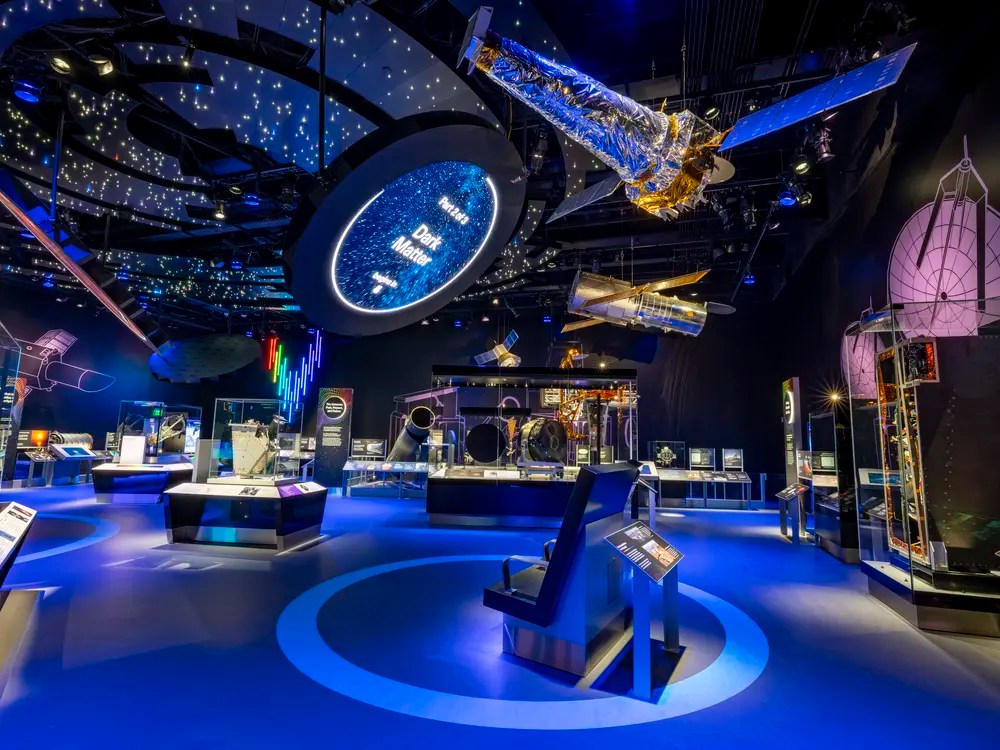
Image (Credit): The “Discovering Our Universe” gallery at the National Air and Space Museum. (NASM)

If you are looking for something to do this summer inside an air-conditioned building, you may want to visit the Smithsonian Institute’s National Air and Space Museum in Washington, DC to enjoy some of its new exhibits.

On July 1st, a new exhibit called “Discovering Our Universe” opened to the public. It covers the tools used to understand the universe, from early land-based telescopes to the great space telescopes, such as the Hubble Space Telescope. As a result of these tools, the exhibit shares what we have already learned about what it out there as well as the plans to gather even greater amounts of data.

Other space-related exhibit openings include:

  • Living in the Space Age Hall: The display provides insight into space technologies and infrastructure that are largely invisible to the public but have a profound impact on our daily lives.
  • The Art of Air and Space: Interpretations of Flight: The display explores the relationship between art and the transformative power of the experience of flight through the display of the Museum’s permanent collection.

Of course, there is plenty more to see at the National Air and Space Museum as well as others along the National Mall. And it should be easier to get around now that the Fourth of July crowds have departed. And if you still have time, you may want to visit the Steven F. Udvar-Hazy Center in Chantilly, VA where more aircraft and spacecraft are on display.
Carnegie Astronomy Lecture Series

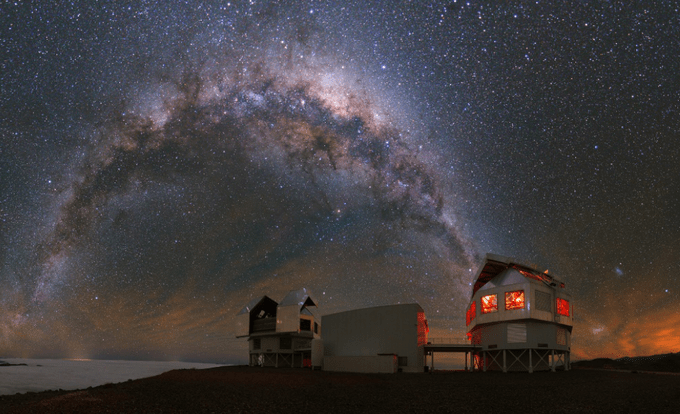
Image (Credit): Las Campanas Observatory in Chile. (Carnegie Science)

If you are stuck inside with the winter weather and looking for something to do, you can either head to sunny California to attend the March Carnegie Astronomy Lectures Series at The Huntington in San Marino or watch them on YouTube. This will be a series of four lectures.

On March 2nd, the first lecture of the series is titled “Ultraviolet Suspects: Using Galaxies to Shed Light on the Early Universe.” It is a free event, but you do need to register.

Here is a little more about this upcoming lecture:

One of the universe’s last phase changes, reionization, took place within the first billion years of its cosmic history. Today, astronomers can use the ultraviolet signals from distant galaxies to investigate the “who,” “when,” and “how” of that critical period. In this talk, Carnegie Science Observatories postdoc Tony Pahl will present his research on the high-energy radiation leaking from galaxies, which leverages data collected with a combination of instruments, including NASA’s JWST, the Keck Observatory telescopes in Hawaii, and Carnegie’s own twin Magellan telescopes at our Las Campanas Observatory in Chile.

The other March astronomy lectures are:

  • March 16: Planetary Habitability: The Origin of Water
  • March 30: Shining a Light on Dark Matter
  • April 13: How To Look Inside An Exoplanet

Information on the upcoming March Astronomy Lecture Series will be posted on the Carnegie Science site.

You can also watch a variety of earlier lectures at the Carnegie Science YouTube link.

If You Happen to be in Kentucky…

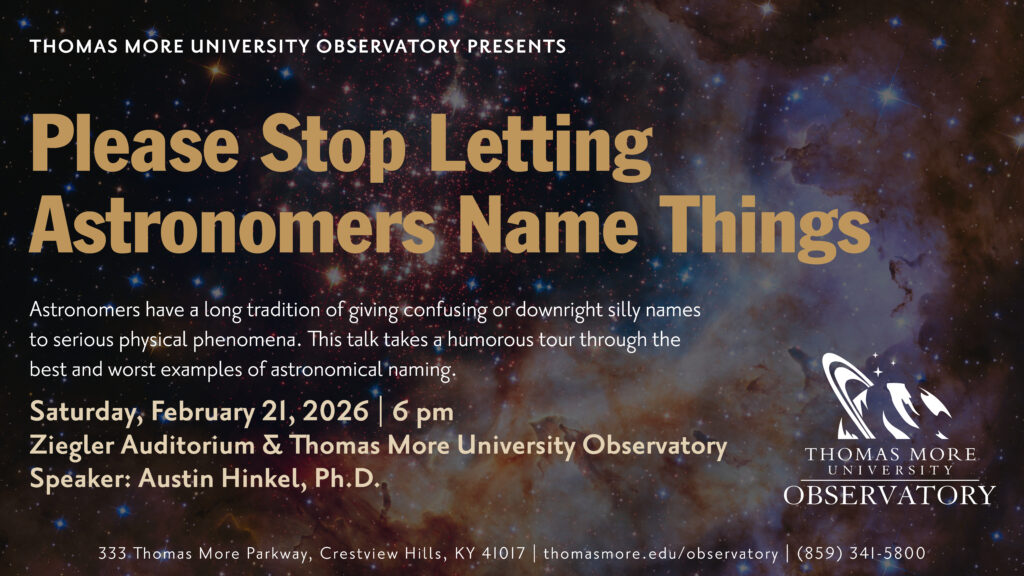
If you happen to be in Kentucky in late February, you may want to visit Thomas More University’s Observatory for a special lecture on astronomy. The lecture is titled “Please Stop Letting Astronomers Name Things,” and it will occur on Saturday, February 21st at 6pm.

Here is the write up for the talk:

From planetary nebulae to spaghettification, astronomers have a long tradition of giving confusing, misleading, or downright silly names to serious physical phenomena. This talk takes a humorous tour through the best and worst examples of astronomical naming. Along the way, we’ll see how names can clarify ideas, confuse students, and occasionally make astronomers cringe.

Maybe the lecturer will discuss oddly named objects such as the star named Gomez’s Hamburger or the Spirograph Nebula.

It sounds like an interesting lecture, and additional lectures are scheduled through the spring.

A Comet You Will Not See for Another Millennium

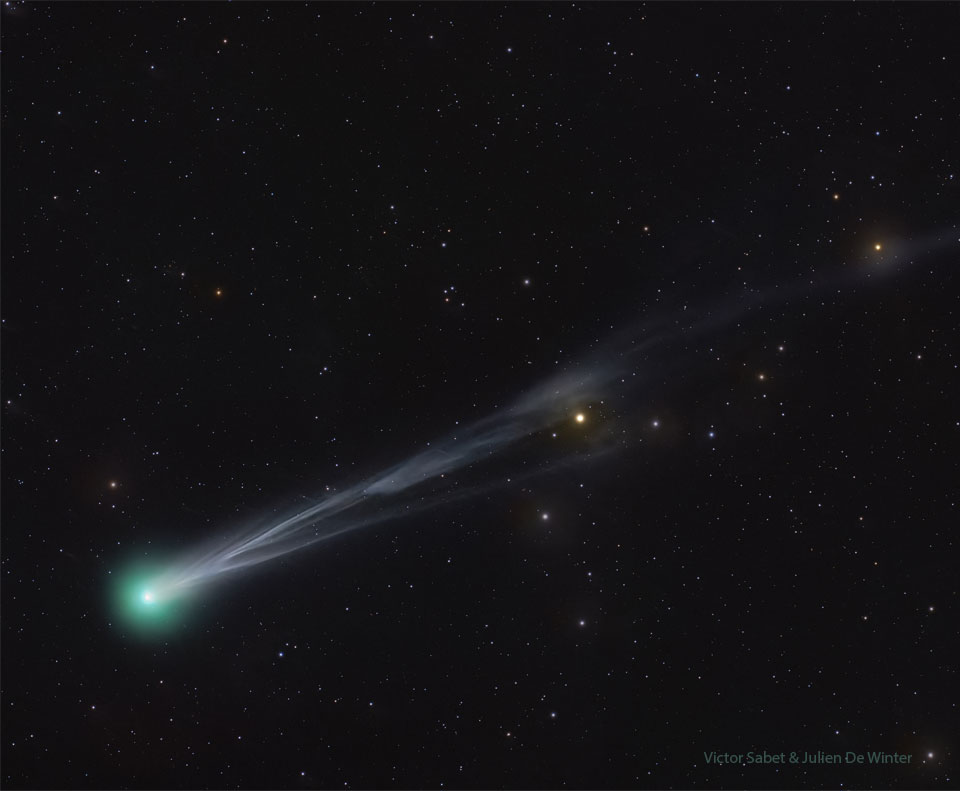
Image (Credit): Comet Lemmon shared via NASA’s Astronomy Picture of the Day. (Victor Sabet & Julien De Winter)

Now is your chance to view Comet Lemmon before it cycles its way though the solar system over the course of 1,350 years. You might even be able to view it over the next few weeks with the naked eye if you are lucky.

Wired magazine has a story about this comet that tells you all you need to know. It also provides some helpful guidance for spotting it in the night sky:

As of early October, Comet Lemmon can be found slightly below the handle in the Big Dipper (or the Plough, as it’s known in the UK), which forms part of the Ursa Major constellation. If you look up at the northern sky, you will be able to trace its path. In the northern hemisphere, it is predicted to appear in the northwestern-to-western sky after sunset from mid-October onward. It will be at a low altitude above the horizon and is expected to emit a faint glow in the twilight just after the sun has set.

Look up and observe this time capsule from 4.6 billion years ago.

Upcoming Conference: Space Settlement Summit

If you are interested in seeing humanity spread into space, you might want to attend the upcoming Space Settlement Summit hosted by the National Space Society (NSS) and scheduled for November 3 and 4 in Orlando, Florida.

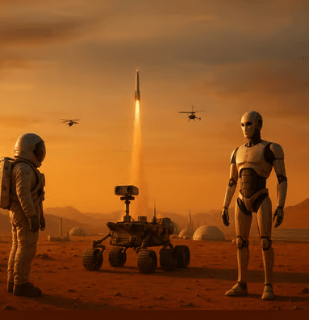
The federal government may be backing out of conferences, and science in general, but that need not stop you from learning more. Do you want to know more about the difficulties of settling on Mars, the role of robotics and AI in space travel, or some of the approaches being pursued by the big space industry players?

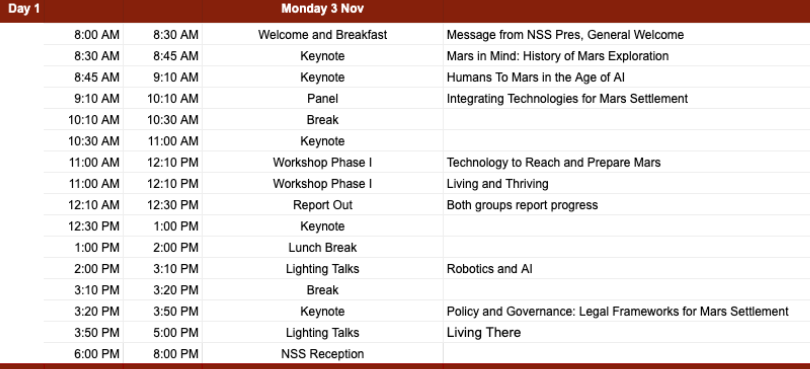
Some of the sessions already posted on the schedule for the first day are shown below:

You should also check out the range of presenters from industry, academia, and the non-profit center. It will take superior hardware, software, and brain power to eventually settle on Mars and elsewhere. You can be part of the discussion now.

The Early Bird prices end this coming Friday, so you need to make up your mind soon.

Credit: NSS