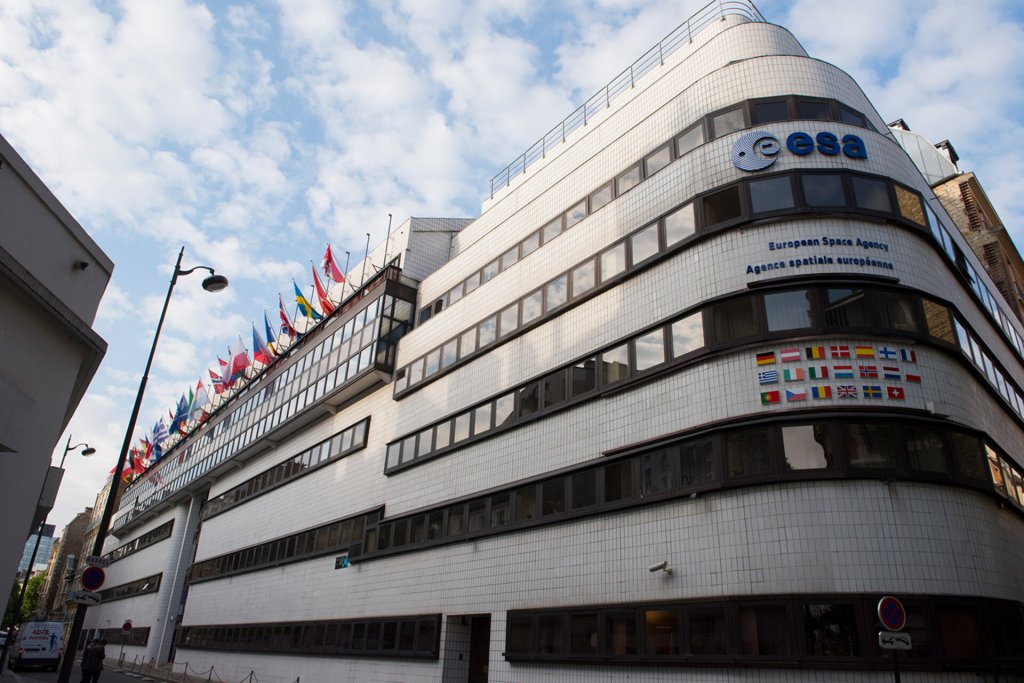
Image (Credit): European Space Agency (ESA) headquarters in Paris. (ESA)
“From understanding our changing planet to exploring Mars, I hugely value the cooperation we have with NASA…By contributing key European hardware and services to exciting programmes such as Artemis and Mars Sample Return, we are building Europe’s autonomy while also being a reliable partner.”
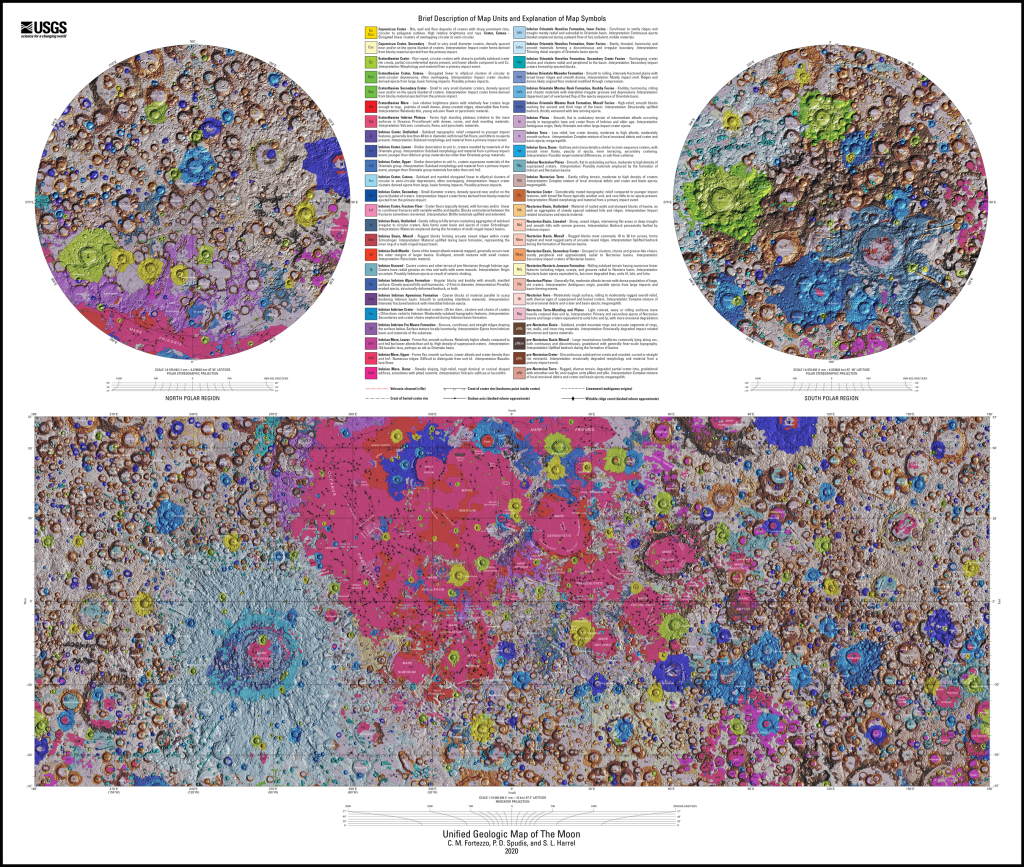
Image (Credit): Map of the Moon’s surface. (NSSDC Space Science Article Data Repository)
Earlier this month, China released a geological map of the Moon’s surface. It is to a scale of 1:2,500,000. Here is the accompanying description of the map:
Geologic maps of the Moon provide comprehensive information about the geologic strata, structural features, lithologies, and chronology of the lunar crustal surface, which reflect the evolution of the lunar crust under igneous processes, catastrophic impacts, and volcanic activities. The map in this repository is the first 1:2,500,000-scale lunar global geologic map, which incorporates the most comprehensive knowledge about the Moon by taking advantage of the latest exploration results and scientific findings. An updated lunar time scale is employed in this map to better reflect the dynamic evolution of the Moon. The map provides a state-of-the-art illustration of impact basins and craters of different periods, the distributions of 17 types of rocks and 14 types of structures.
With numerous countries considering lunar bases, greater details about the Moon’s surface could be very useful. I would have liked an overlay showing the various lunar mission remains already sitting on the Moon’s surface.
By the way, while the press is calling this the first comprehensive lunar map, there have been others, including the map below released two years ago by the U.S. Geological Survey’s (USGS) Astrogeology Science Center in Flagstaff, Arizona. I say the more maps the better for everyone.
Image (Credit): This new work represents a seamless, globally consistent, 1:5,000,000-scale geologic map derived from the six digitally renovated geologic maps. (USGS)
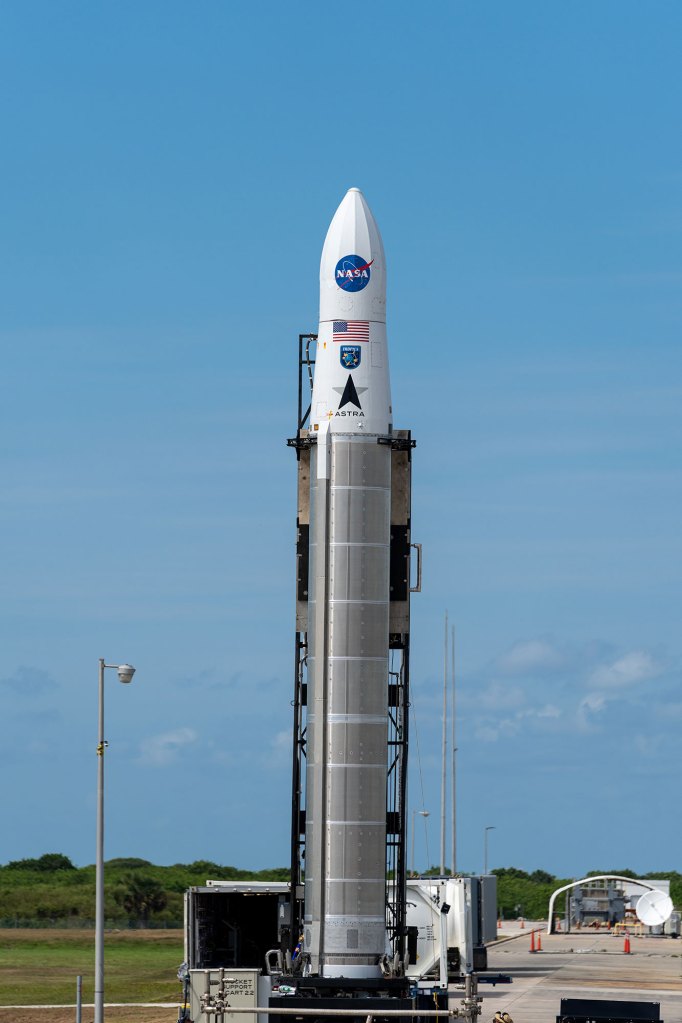
Image (Credit): Astra rocket for the TROPICS satellites. (Astra)
This weekend we witnessed another example that space operations are risky. On Sunday, Astra’s Rocket LV0010 launched from Cape Canaveral but was unable to place two satellites into orbit. The satellites were part of NASA’s TROPICS-1 mission. The main issue was the engine on the upper portion of the rocket.
As described by Astra on its website, the launch of the Time-Resolved Observations of Precipitation structure and storm Intensity with a Constellation of Smallsats (TROPICS) mission was awarded to Astra in February of this year and “consists of a constellation of six small satellites that will observe tropical cyclones, aiming to improve the scientific community’s understanding of these dangerous weather events.” This was the first of three such launches, leaving four satellites untouched and ready to go once Astra, NASA, and the Federal Aviation Administration figure out what happened this weekend.
This is not the first NASA mishap. Back in February, Rocket LV0008 (also launched from Cape Canaveral) suffered an in-flight anomaly during stage separation. As a result, NASA’s Educational Launch of Nanosatellites (ELaNa 41) mission to place CubeSats into orbit failed. CubeSats are miniature satellites designed to provide a low-cost platform for NASA missions.
Astra is a relatively new entrant to in the commercial space industry having been founded in 2016. Let’s hope the lessons learned from this mishap and persistence will allow the company to thrive in this competitive and risky industry.
Image (Credit): Artist’s impression of the spacecraft carrying the eROSITA (highlighted) and ART-XC space telescopes. (Max Planck Institute)
Remember all those sanctions and cancelled projects following Russia’s invasion of Ukraine and how we hoped scientists would rise above it? Well, the Russians will have none of it. They have decided to switch on Germany’s eROSITA space telescope.
Built by the Max Planck Institute and launched in 2019 together with the Russian ART-XC space telescope, the eROSITA was placed in sleep mode back in February shortly after the Russian invasion. Both the German and Russian telescopes are designed to work in tandem to study Dark Energy.
The main scientific goals of eROSITA are
to detect the hot intergalactic medium of 50-100 thousand galaxy clusters and groups and hot gas in filaments between clusters to map out the large scale structure in the Universe for the study of cosmic structure evolution,
to detect systematically all obscured accreting Black Holes in nearby galaxies and many (up to 3 Million) new, distant active galactic nuclei, and
to study in detail the physics of galactic X-ray source populations, like pre-main sequence stars, supernova remnants and X-ray binaries.
In a recent Gizmodo article, Roscosmos chief Dmitry Rogozin stated:
They—the people that made the decision to shut down the telescope—don’t have a moral right to halt this research for humankind just because their pro-fascist views are close to our enemies.
Neither German nor Russian scientists are happy with this political decision. It is likely to have implications for future joint Russian missions.
Whether it is politics or micrometeroids, astronomers have plenty of outside factors messing up well-planned missions.
Have you read about the Chinese car company with space ambitions? In a June 2 press release, we learn that a unit of the Chinese automaker Geely (owner of Volvo, Polestar, and Group Lotus) already sent 9 communications satellites into orbit this year, with plans for a total of 240 such satellites in a constellation that will assist car drivers with autonomous driving.
Of course, automaker Elon Musk is also launching satellites into space as part of the Starlink program, but that is about the end of the similarities for now. In addition to planning to launch fewer satellites with a more restricted mission, Geely will depend upon Chinese government rockets to launch these satellites. Mr. Musk has his own SpaceX rockets to assist Starlink.
That does not mean Geely lacks in ambition elsewhere. In the same press release, Geely stated:
With the successful launch and operation of Geespace’s first satellites, the company will become one of the world’s first providers of combined commercial Precise Point Positioning and Real-Time Kinematic services (PPP-RTK)…
Tony Wang, CEO and Chief Scientist of Geespace said: “Many favourable factors such as policy support and market demand is accelerating the growth of the commercial aerospace sector...new opportunities to develop have been opened in various sectors including smart mobility, consumer electronics, unmanned systems, smart cities, and environmental protection.”
And while Geely is not building rockets at this time, it is building satellites:
Early in September 2021, Geely’s Intelligent Satellite Production and Testing Centre began mass production of commercial satellites with an annual production capacity of 500 units. Through intelligent modular manufacturing, Geespace is able to produce high-quality, easily customizable satellites to meet the growing global demand for commercial satellites. The GeeSAT-1 is only the first of many new satellite models from Geespace and its successful launch into orbit is just the first of many to come.




 Our Awesome Universe