Image (Credit): Artist’s impression of UFOs. (iStock)
“NASA believes that the tools of scientific discovery are powerful and apply here also…We have access to a broad range of observations of Earth from space – and that is the lifeblood of scientific inquiry. We have the tools and team who can help us improve our understanding of the unknown. That’s the very definition of what science is. That’s what we do.
– Statement by Thomas Zurbuchen, associate administrator for science at NASA Headquarters in Washington, DC. This was part of NASA’s statement committing to a 9-month study of Unidentified Aerial Phenomena, also known as UFOs. You can read the full press release from NASA here.
The image this week is from the NASA/ESA Hubble Space Telescope. It shows a cluster of old and young stars in the globular cluster Liller 1 located within the bulge of the Milky Way Galaxy. Here is a full explanation from NASA:
The muted red tones of the globular cluster Liller 1 are partially obscured in this image by a dense scattering of piercingly blue stars. In fact, it is thanks to Hubble’s Wide Field Camera 3 (WFC3) that we are able to see Liller 1 so clearly in this image, because the WFC3 is sensitive to wavelengths of light that the human eye cannot detect. Liller 1 is only 30 000 light-years from Earth — relatively neighbourly in astronomical terms — but it lies within the Milky Way’s ‘bulge’, the dense and dusty region at our galaxy’s centre. Because of that, Liller 1 is heavily obscured from view by interstellar dust, which scatters visible light (particularly blue light) very effectively. Fortunately, some infrared and red visible light are able to pass through these dusty regions. WFC3 is sensitive to both visible and near-infrared (infrared that is close to the visible) wavelengths, allowing us to see through the obscuring clouds of dust, and providing this spectacular view of Liller 1.
Liller 1 is a particularly interesting globular cluster, because unlike most of its kind, it contains a mix of very young and very old stars. Globular clusters typically house only old stars, some nearly as old as the Universe itself. Liller1 instead contains at least two distinct stellar populations with remarkably different ages: the oldest one is 12 billion years old and the youngest component is just 1-2 billion years old. This led astronomers to conclude that this stellar system was able to form stars over an extraordinary long period of time.
Image (Credit): Artist’s image of the James Webb Space Telescope. (NASA)
NASA reports that the James Webb Space Telescope (JWST) was hit by a micrometeroid last month. The tweet from NASAWebb stated:
In late May, Webb sustained a dust-sized micrometeroid impact to a primary mirror segment. Not to worry: Webb is still performing at a level that exceeds all mission requirements.
A second story explained how NASA tested the JWST for just such instances, though the final sentence was a little more worrisome:
Webb’s mirror was engineered to withstand bombardment from the micrometeoroid environment at its orbit around Sun-Earth L2 of dust-sized particles flying at extreme velocities. While the telescope was being built, engineers used a mixture of simulations and actual test impacts on mirror samples to get a clearer idea of how to fortify the observatory for operation in orbit. This most recent impact was larger than was modeled, and beyond what the team could have tested on the ground.
And this sentence is also worrisome:
Since launch, we have had four smaller measurable micrometeoroid strikes that were consistent with expectations and this one more recently that is larger than our degradation predictions assumed.
The $10 billion space telescope, which is still working to become operational, is not expected to share images until mid-July. Unlike the Hubble Space Telescope, NASA cannot send astronauts out to the JWST to make periodic repairs. The JWST currently sits in the L2 Lagrange point about 1 million miles away. All NASA can do now is try to compensate for the damage as best it can.
Take a look at the image above. Can you determine where this image originated? Take a guess and then check your answer by going to the menu and selecting the “Where is this?” page.
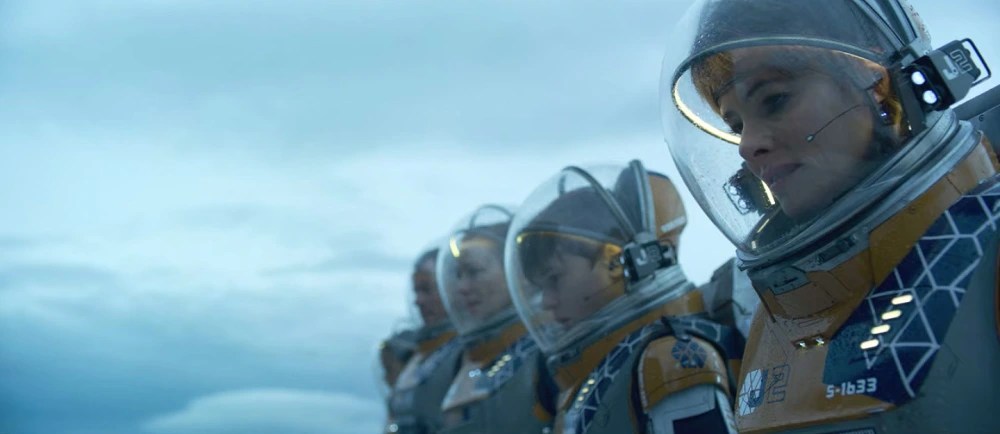
Image (Credit): Space suits in the television series Lost in Space. (Netflix)
U.S. companies Axiom Space and Collins Aerospace have been tasked to build new suits for NASA’s astronauts. The suits will be worn as part of the Artemis Program returning astronauts to the Moon. First, the new suits will be tested and used on the International Space Station (ISS).
While both companies are still in the early stages of developing the next space suite, the $3.5 billion Extravehicular Activity Services (xEVAS) Contract will support this development and production.
In a press release, Mark Kirasich, deputy associate administrator of NASA’s Artemis Campaign Development Division, stated:
Our commercial partnerships will help realize our human exploration goals…We look forward to using these services for NASA’s continued presence in low-Earth orbit and our upcoming achievement of returning American astronauts to the Moon’s surface. We are confident our collaboration with industry and leveraging NASA’s expertise gained through over 60 years of space exploration will enable us to achieve these goals together.
You may recognize the name Axiom Space. It was the company that worked with SpaceX to put private citizens on the ISS with its Axiom Mission 1 (Ax-1). It is also developing the world’s first commercial space station, the Axiom Station.
Collins Aerospace, part of Raytheon Technologies, has plenty of experience with space suits. The company designed the spacesuit used by the Apollo mission astronauts who landed on the moon. It also designed the space suits currently in use for missions outside the ISS.


 Our Awesome Universe