Space Stories: Stargazing Apps, Ringless Jupiter, and Detecting Exoplanets

Image (Credit): This enhanced color view of Jupiter’s south pole was created by citizen scientist Gabriel Fiset using data from the JunoCam instrument on NASA’s Juno spacecraft. (NASA/JPL-Caltech/SwRI/MSSS/Gabriel Fiset)

Here are some recent stories of interest.

Mashable.com:The Best Astronomy Apps for Stargazing This Summer

Thanks to these astronomy apps, you can use your phone to see which stars and constellations are above you in real time, day or night. Whether you’re planning on stargazing, are curious about which constellations are in your location, or simply want to flex on your family and friends around the campfire, the following apps can show you what you’re seeing in the sky.

Technology.org:Why Jupiter Doesn’t Have Rings Like Saturn

To understand the reason Jupiter currently looks the way it does, Kane and his graduate student Zhexing Li ran a dynamic computer simulation accounting for the orbits of Jupiter’s four main moons, as well as the orbit of the planet itself, and information about the time it takes for rings to form. Their results are detailed here, soon to be published in the Planetary Science journal.

ScienceDaily.com:A New Method to Detect Exoplanets

In recent years, a large number of exoplanets have been found around single ‘normal’ stars. New research shows that there may be exceptions to this trend. Researchers suggest a new way of detecting dim bodies, including planets, orbiting exotic binary stars known as Cataclysmic Variables (CVs).
More JWST Priorities

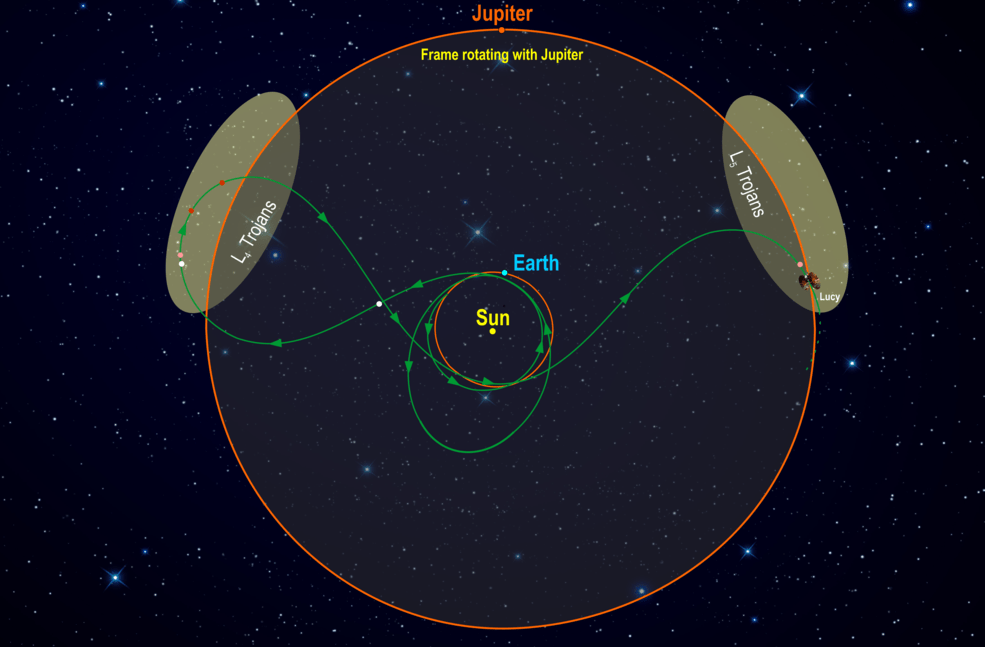
Image (Credit): This diagram shows Lucy’s orbital path in green after her October 2021 launch to visit the Trojan asteroids. (Southwest Research Institute)

Last week I noted some of the mission priorities in the James Webb Space Telescope’s (JWST) first year. Those priorities were listed under “Exoplanets and Disks.” I thought I would highlight a few more, this time from the “Solar System Astronomy” list. Here are five more priorities:

  • Pluto’s Climate System with JWST;
  • The Moons of Uranus: A NIRSpec Investigation of Their Origins, Organic Constituents, and Possible Ocean World Activity;
  • A Pure Parallel Survey of Water in the Asteroid Belt;
  • DiSCo-TNOs: Discovering the Composition of the Trans-Neptunian Objects, Icy Embryos for Planet Formation; and
  • JWST Observations of Lucy Mission Targets.

Each of these priorities come with an explanation of the mission. For example, here is a little more about NASA’s Lucy mission from the JWST proposal:

The Lucy spacecraft – to be launched at approximately the same time as JWST – will perform the first ever in situ exploration of the Jupiter Trojan asteroids. Trojans are the largest population of solar system bodies currently unvisited by spacecraft, and revealing their composition and formation history is the key to untangling disparate hypothesis for the early dynamical evolution of the entire solar system.

Understanding these enigmatic bodies requires not just the high spatial resolution imagery and spectroscopy that will be afforded by Lucy, but also the superb near- and mid-infrared spectroscopy of which JWST is uniquely capable. The high signal-to-noise, high spectral resolution, and extended wavelength coverage beyond the capabilities of Lucy will allow JWST to sensitively probe the organic, carbonate, and silicate components of the surfaces of the Trojans. Meanwhile, the Lucy spectra and images will place these observations into their geological and historical context, greatly extending the scientific utility of both the JWST observations and the Lucy visit. Together these observations will paint a rich picture of this population, allowing us to trace connections with other bodies studied remotely and in situ across the solar system.

Lucy was launched last October and is expected to encounter its first Trojan asteroid until August 2027. You can find the full mission timeline here.

Profile: China’s Xuntian Space Telescope

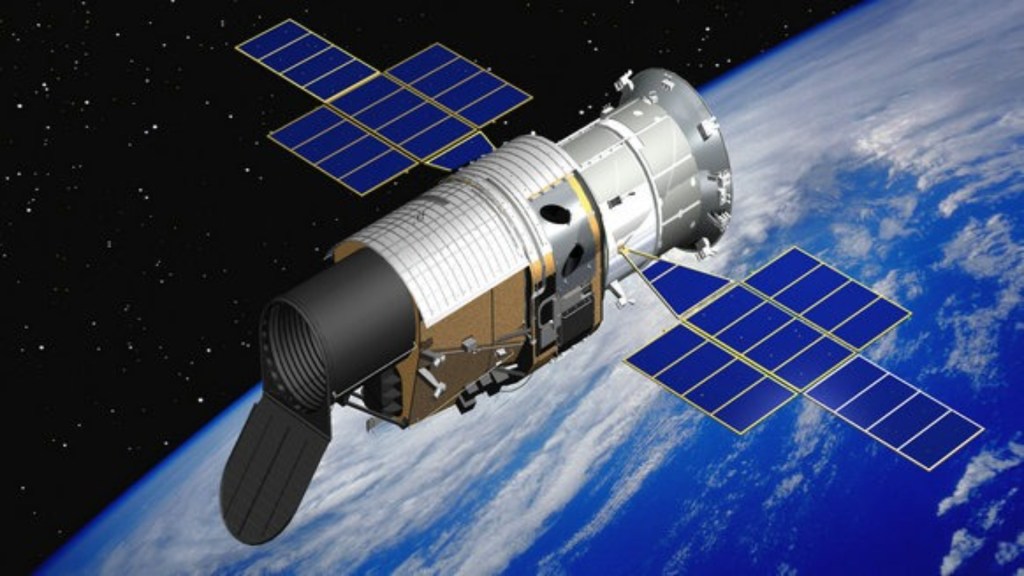
Image: Artist’s impression of the Xuntian Survey Space Telescope.

Next year China plans to launch the Xuntian (Chinese for “survey to heavens”) Survey Space Telescope that will orbit near China’s space station. Like the Hubble Space Telescope, it will be easier to service from this location. Unlike the Hubble, it will have a greater field of view – about 300-350 times greater. This field of view will allow the telescope to observe about 40 percent of the sky within its 10 year lifespan. If it last 30+ years like the Hubble, it will capture even more of the sky.

In terms of the space telescope’s planned mission, a Chinese news story stated:

It will observe well over one billion galaxies and measure their positions, shapes and brightness which may help explain how those galaxies evolve

The telescope will also be able to help determine the upper limit of neutrino mass and shed light on the mysterious dark matter and dark energy. They’re believed to account for the majority of mass-energy content of the universe.

The versatile telescope can undertake many more intriguing studies such as drawing galactic dust map of the Milky Way, observing how super-massive blackholes are gobbling up surrounding materials, exploring exoplanets and discovering new peculiar celestial bodies.

The Xuntian should be launched later next year and be fully operational in 2024.

As long as scientists around the world can share in these observations, this type of space race benefits everyone. The more eyes on the sky, the better.

Searching for Water on a Planet Near You

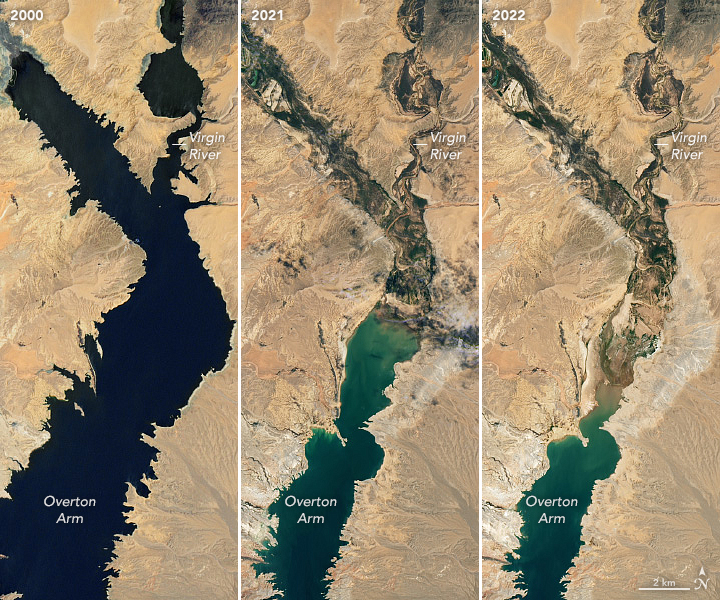
Image (Credit): Water levels in the Overton Arm, which is the northern portion of Lake Mead. (NASA)

While we get excited about NASA discoveries of water on exoplanets, NASA is also monitoring water levels here on Earth, and it is scary in some areas. The images above from NASA’s Near Earth Observatory show water loss in the Overton Arm of Lake Mead. The lake is currently filled at 27 percent of capacity, threatening the availability of drinking water, electricity from the Hoover dam, and recreational boating. You can read more about water projections in the region here.

Luckily, we have plenty of water covering the majority of our planet, so alien civilizations will still be able to pick up on water signatures as we do elsewhere. However, the loss of drinking water is something we need to resolve, be it overdrawing on such resources or pushing the climate into a direction that threatens this resource. If we hope to keep our civilization intact as we look to the stars, we need to make some changes as soon as possible. We want to travel to Mars, not mimic its dried-up river beds.

Space Quote: China is Not Seizing the Moon

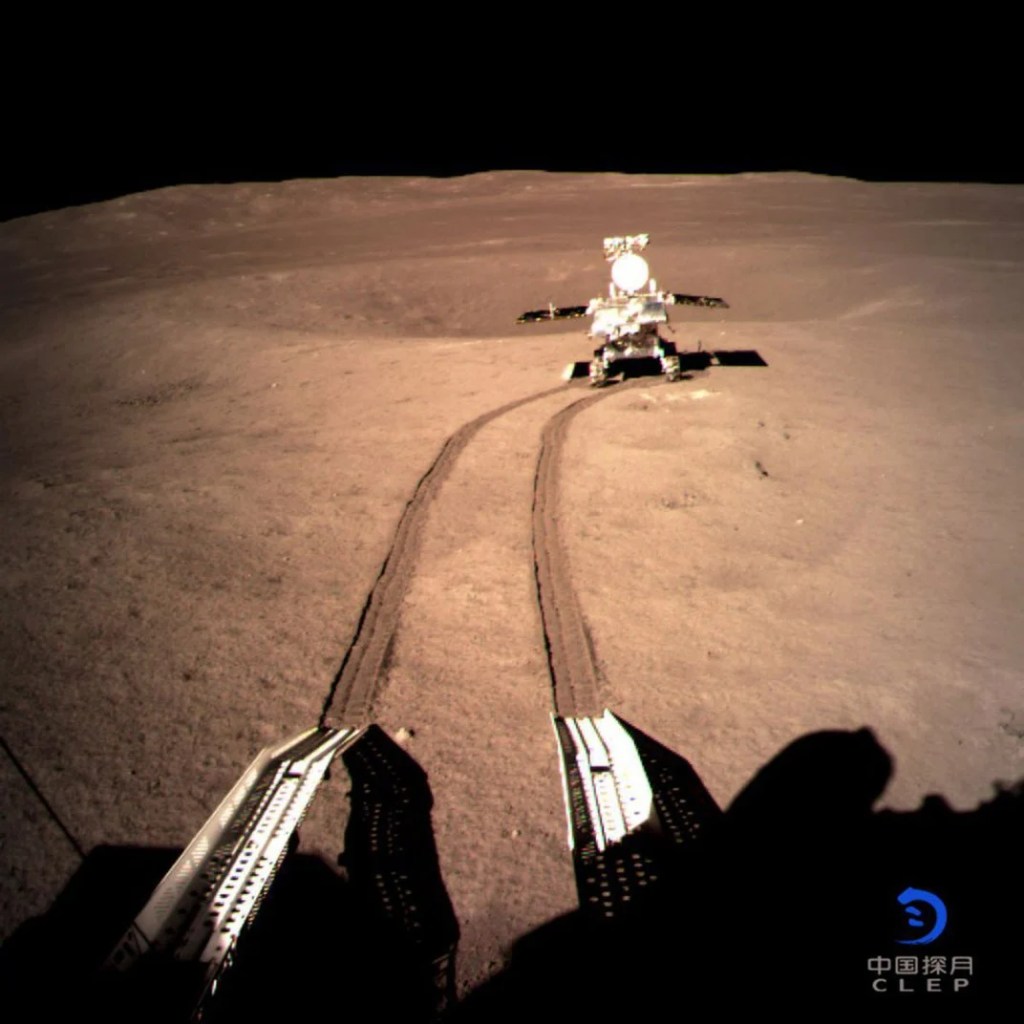
Image (Credit): China’s Yutu 2 rover explores the far side of the moon shortly after its Jan. 2, 2019, touchdown. (China National Space Administration)

“As two scholars who study space security and China’s space program, we believe that neither China nor any other nation is likely to take over the Moon in the near future. It is not only illegal, it is also technologically daunting – the costs of such an endeavor would be extremely high, while the potential payoffs would be uncertain.”

-Statement by Svetla Ben-Itzhak, Assistant Professor of Space and International Relations, Air University and R. Lincoln Hines, Assistant Professor, West Space Seminar, Air University in the Astronomy magazine article “Why China is unlikely to claim the Moon anytime soon.” It follows an earlier statement by NASA Administrator Bill Nelson, who said, “We must be very concerned that China is landing on the Moon and saying: ‘It’s ours now and you stay out.‘”