Space Stories: Black Holes, X-Rays, and Exploding Stars

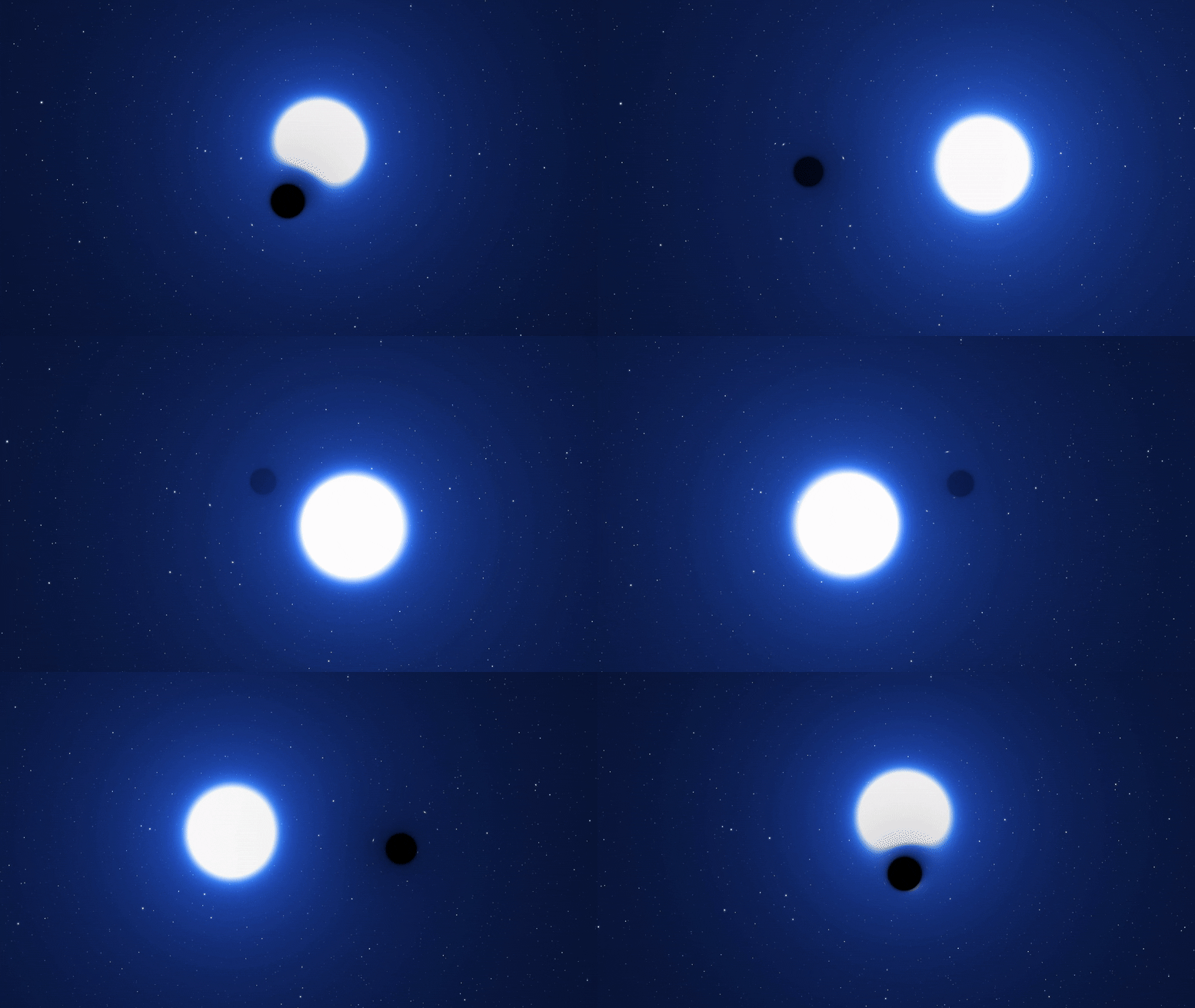
Image (Credit): Animation showing a binary system of a large, hot blue star and a black hole orbiting each other. (ESO/L.Calçada)

Here are some recent stories of interest.

SciTechDaily.com:Astronomers Have Discovered an Especially Sneaky Black Hole

VFTS 243 is a binary system, which means it is composed of two objects that orbit a common center of mass. The first object is a very hot, blue star with 25 times the mass of the Sun, and the second is a black hole nine times more massive than the Sun. VFTS 243 is located in the Tarantula Nebula within the Large Magellanic Cloud, a satellite galaxy of the Milky Way located about 163,000 light-years from Earth.

SpaceNews.com: ESA Scaling Back Design of X-ray Astronomy Mission

Faced within increasing costs, the European Space Agency is looking for ways to revise the design of a large X-ray space telescope, an effort that could have implications for NASA’s own astrophysics programs…That effort will involve potential changes to its instrument configuration as well as creation of a science “redefinition” team to reconsider science objectives. The goal will be to develop a revised concept, called a minimum disrupted mission, that will cost ESA no more than 1.3 billion euros but still perform science expected of a flagship-class mission.

NASA.gov:NASA Rocket Mission Using ‘Astronomical Forensics’ to Study Exploded Star

A NASA-funded sounding rocket mission will observe the remnants of an exploded star, uncovering new details about the eruption event while testing X-ray detector technologies for future missions. The High-Resolution Microcalorimeter X-ray Imaging, or Micro-X, experiment will launch Aug. 21 from the White Sands Missile Range in New Mexico. The mission’s target of study is some 11,000 light-years away from Earth, off the edge of the W-shaped constellation known as Cassiopeia. There, a massive bubble of radiant material known as Cassiopeia A, or Cas A for short, marks the site of a brilliant stellar death.
JWST Image: Swirling Galaxy

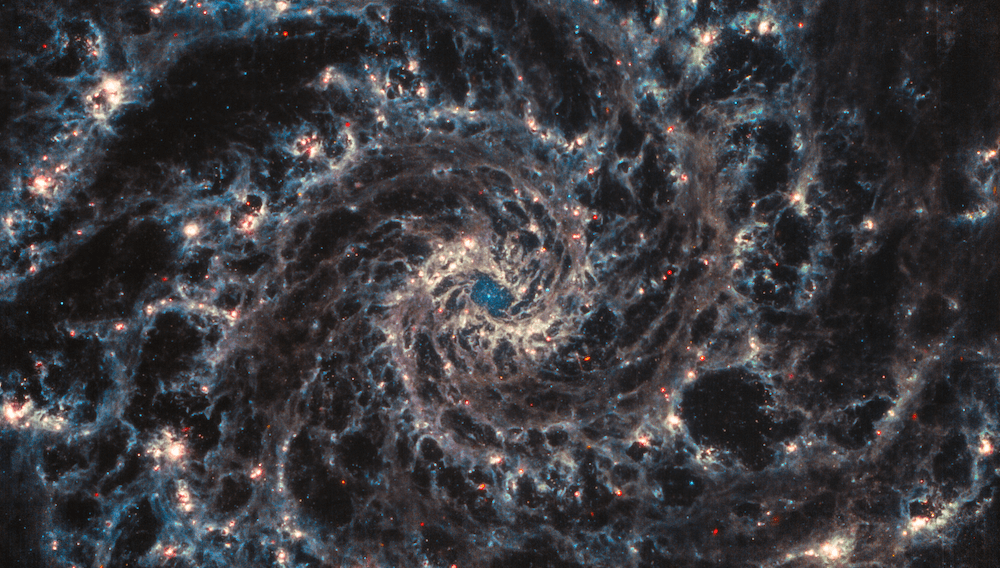
Image (Credit): View from above the spiral galaxy NGC 628. (NASA/ESA/CSA/Judy Schmidt)

Here is another recent images from the James Webb Space Telescope (JWST). This one is a unique close-up view of a spiral galaxy looking from above (or below) rather that from the side. It is NGC 628, which is about 32 million light years away.

You can see more such JWST images by visiting the Physics at High Angular resolution in Nearby GalaxieS (PHANGS) Survey site. The site also includes images from the Hubble Space Telescope, the Spitzer Space Telescope, the Atacama Large Millimeter/submillimeter Array (ALMA), and other sources.

Space Mission: Preparing for a Launch to Europa in 2024

Image (Credit): Artist’s rendering of Europa orbiting Jupiter. (NASA)

Earlier this year, NASA’s Jet Propulsion Laboratory started assembling the Europa Clipper spacecraft so it is ready for its launch in 2024 (you can find the latest update here). Once it arrives at Jupiter, the spacecraft will have at least 50 flybys to study the Jovian moon and learn more about its inside, outside, and atmosphere.

Why Europa? NASA explains it this way:

Extraterrestrial life might exist under all sorts of conditions that humans would struggle to imagine. But we know of one set of conditions in which life flourishes in a multitude of shapes and sizes: the conditions found on Earth. Because we know Earth has the right conditions for life, humans can then sharply narrow down the search for extraterrestrial life by searching only in places that have the conditions that Earth life requires: a source of energy, the presence of certain chemical compounds, and temperatures that allow liquid water to exist. Jupiter’s icy moon Europa seems to be just such a place.

And water exists in abundance, as the NASA graphic shows below.

The Europa Clipper will not make it to Jupiter until 2030, so we have a long wait ahead of us. It also gives us plenty of time to guess about what we will find.

You can follow the status of the Europa Clipper here.

Image (Credit): Illustration comparing water on the Earth and Europa. (NASA)

Pic of the Week: Artemis I Heads for the Launchpad

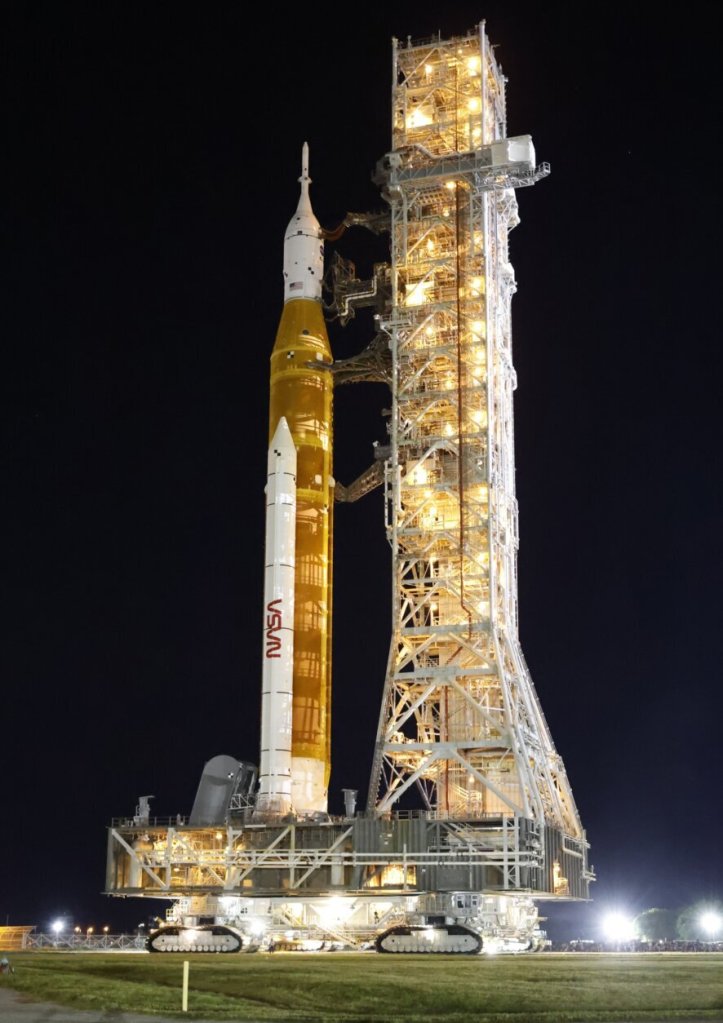
Image (Credit): NASA’s Space Launch System moving from the Vehicle Assembly Building to the launch pad at Cape Canaveral, Florida, on August 16, 2022. (NASA)

This week’s image highlights NASA’s actions to launch the first phase of the Artemis Mission. The image shows the Space Launch System and Orion capsule moving towards launch pad 39B at the Kennedy Space Center. The launch of the six-week unmanned mission around the Moon is planned for August 29th. The full mission for this first phase, or Artemis I, is shown below.

Image (Credit): Artemis I mission map. (NASA)

A Young Exoplanet Spotted

Image (Credit): ALMA telescope image of AS 209 (ALMA (ESO/NAOJ/NRAO), A. Sierra (U. Chile))

Last week’s news that a young exoplanet has been spotted has generated quite a bit of interest. The discovery was reported in the journal The Astrophysical Journal Letters. Of course, if you read the abstract of the study itself, you may be confused with all the scientific jargon:

We report the discovery of a circumplanetary disk (CPD) candidate embedded in the circumstellar disk of the T Tauri star AS 209 at a radial distance of about 200 au (on-sky separation of 1.4 from the star at a position angle of 161°), isolated via 13CO J = 2−1 emission. This is the first instance of CPD detection via gaseous emission capable of tracing the overall CPD mass. The CPD is spatially unresolved with a 117 × 82 mas beam and manifests as a point source in 13CO, indicating that its diameter is ≲14 au… 

We could not fund the space program if this is what we shared with taxpayers. Fortunately, the accompanying press release was better:

Scientists using the Atacama Large Millimeter/submillimeter Array (ALMA)— in which the National Radio Astronomy Observatory (NRAO) is a partner— to study planet formation have made the first-ever detection of gas in a circumplanetary disk. What’s more, the detection also suggests the presence of a very young exoplanet. The results of the research are published in The Astrophysical Journal LettersWhile studying AS 209— a young star located roughly 395 light-years from Earth in the constellation Ophiuchus— scientists observed a blob of emitted light in the middle of an otherwise empty gap in the gas surrounding the star. That led to the detection of the circumplanetary disk surrounding a potential Jupiter-mass planet. Scientists are watching the system closely, both because of the planet’s distance from its star and the star’s age. The exoplanet is located more than 200 astronomical units, or 18.59 billion miles, away from the host star, challenging currently accepted theories of planet formation. And if the host star’s estimated age of just 1.6 million years holds true, this exoplanet could be one of the youngest ever detected. Further study is needed, and scientists hope that upcoming observations with the James Webb Space Telescope will confirm the planet’s presence.

My first point is that communication matters, and we need both the scientists and the communicators if the public is to learn anything about what is being funded.

My second point relates to information found later in the press release about the new planet being 200 astronomical units from its sun. Pluto is only 39 astronomical units away from our Sun, so this is quite a difference. Which makes me wonder about our solar system and its various components. Even the hazy image above is more than we have of our own solar system as we guess about a ninth planet out there somewhere and hypothesize about the Oort Cloud. Should a civilization many light years away focus its best telescopes on our solar system , what could they tell us?

We seem to be explorers looking out over the sea at far-away islands not even understanding the components of the island we stand on. We certainly learn more every day as we pick and probe at the objects around us, yet it is clear that our knowledge of our own home has plenty of gaps. Maybe the solar system images from afar should be seen as weak reflections from our own solar system.

Given that the James Webb Space Telescope has yet to turn its attention to AS 209, we can expect even more surprises related to this distant solar system, and maybe our own.