China Also Has a Secret Space Plane

Image (Credit): USAF’s X-37B Orbital Test Vehicle at Vandenberg AFB, California in June 2009. (USAF)

You may have heard of the U.S. Air Force’s (USAF) X-37B unmanned mini-space shuttle that has been sent into orbit many times in the past. It performed secretive missions for the USAF, yet it now falls under the U.S. Space Force. The X-37B is currently orbiting the Earth and has been doing so since May 2020. While it has been said to carry various NASA experiments, this is probably cover for its other work (given that the International Space Station is more than able to carry out these experiments).

So while we are still trying to figure out the real mission of the X-37B, China is experimenting with its own secret space plane and saying even less. On August 4th, China launched its space plane aboard a Long March 2F rocket for a spin around the globe. This is part of continuing experimental flights.

And just in case you might think Russia is falling behind, it already has spacecraft in orbit that seem to be tracking some U.S. satellites.

What are these nations up to? The role of the U.S. Space Force relates to:

…organizing, training, and equipping Guardians to conduct global space operations that enhance the way our joint and coalition forces fight, while also offering decision makers military options to achieve national objectives.

That does not sound like a scientific mission, which is why the USAF and not NASA owned the spacecraft years back.

More likely than not, while these spacecraft will be able to repair and protect the parent nation’s satellites, they will also be able to block, disable, and destroy the satellites of other nations. Yes, this is the militarization of space and all that means in a time or war – potentially endless debris threatening the missions of the other satellites orbiting the planet.

Like it or not, the space race continues on in many forms.

Note: The U.S. Air Force still has a page on the X-37B that highlights its mission. The page states:

The X-37B Orbital Test Vehicle, or OTV, is an experimental test program to demonstrate technologies for a reliable, reusable, unmanned space test platform for the U.S. Air Force. The primary objectives of the X-37B are twofold; reusable spacecraft technologies for America’s future in space and operating experiments which can be returned to, and examined, on Earth.

Here are the specs for the X-37B:

  • Primary Mission: Experimental test vehicle
  • Prime Contractor: Boeing
  • Height: 9 feet, 6 inches (2.9 meters)
  • Length: 29 feet, 3 inches (8.9 meters)
  • Wingspan: 14 feet, 11 inches (4.5 meters)
  • Launch Weight: 11,000 pounds (4,990 kilograms)
  • Power: Gallium Arsenide Solar Cells with lithium-Ion batteries
  • Launch Vehicles: United Launch Alliance Atlas V (501) and SpaceX Falcon 9
South Korea Shoots for the Moon

Image (Credit): The launch of the South Korean Danuri spacecraft on August 4, 2022 from Florida. (AP)

Last week, South Korea launched a spacecraft towards the Moon via a SpaceX rocket. As with other nations and programs (the U.S., Russia, the European Space Agency, Japan, China, Luxembourg, Israel, and India), South Korea hopes to learn more about the Moon and share it with the scientific community. NASA also has a role in this latest mission, having added instruments to the spacecraft.

The Korea Pathfinder Lunar Orbiter, dubbed the Danuri, will be South Korea’s first foray towards the Moon. It will not reach the Moon until December, and then remain in orbit for about a year. In terms of the overall mission of the spacecraft, NASA noted:

…the objectives are to develop indigenous lunar exploration technologies, demonstrate a ‘space internet,’ and conduct scientific investigations of the lunar environment, topography, and resources, as well as identify potential landing sites for future missions.

In addition to other equipment, NASA added a high-sensitivity camera called ShadowCam, which will look for evidence of ice in the lunar craters.

South Korea is also part of the Artemis Accords, which the U.S. and other nations signed to establish a lunar presence to be followed by travel to Mars. At the time of the signing, South Korea’s Minister of Science and ICT stated:

For successful space exploration, it is critical to implement space development activities transparently and responsibly by collaborating with the international community…With the signing of the Artemis Accords, Korea would be able to strengthen cooperation with nations participating in the Accords in exploring the outer space.

It is encouraging to see more cooperation in the space realm, even if things are rocky with Russia, one the the bigger players to date.

Space Stories: Radioactive Ceres, Moon Clues, and Starlink’s Shine

Here are some recent stories of interest.

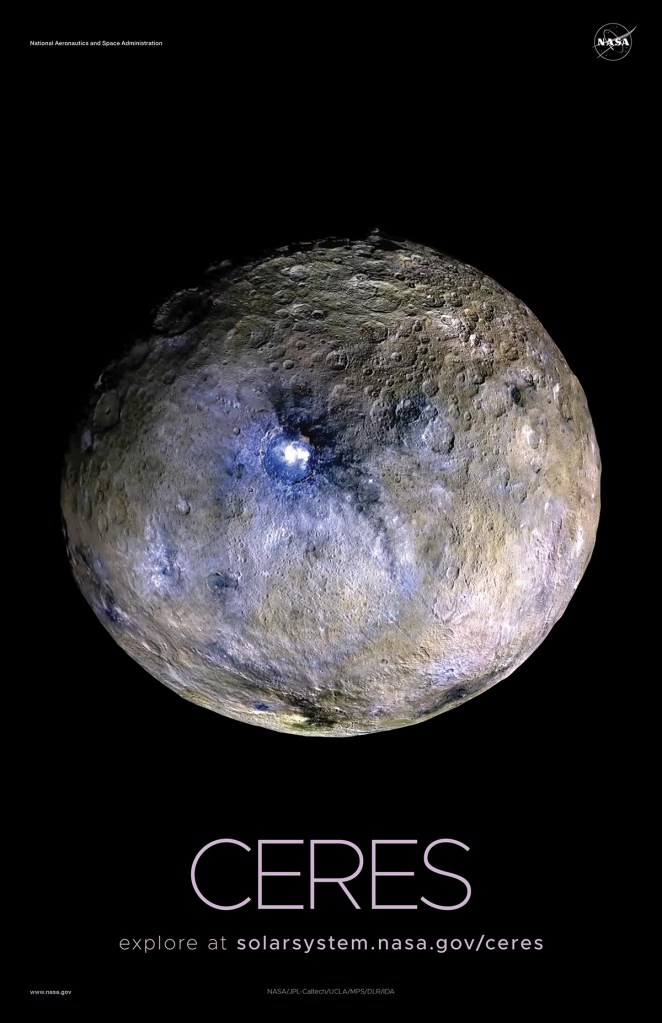
SkyandTelescope.org: “Asteroid Ceres Was Radioactive — And That Could Explain a Lot

A team of U.S. planetary scientists has shown that unexpected surface features on the dwarf planet Ceres can be explained by radioactive decay in its interior long ago. If they are right, their model could explain features not just on other dwarf planets, but also on some of the icy moons in the outer solar system.

ScienceDaily.com: “One More Clue to the Moon’s Origin

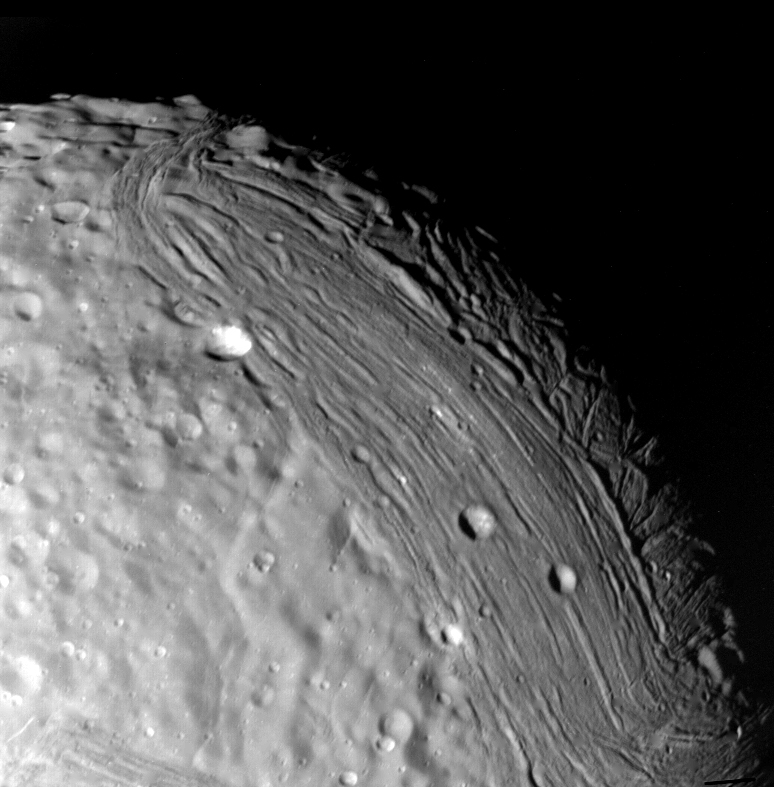
Researchers discover the first definitive proof that the Moon inherited indigenous noble gases from the Earth’s mantle. The discovery represents a significant piece of the puzzle towards understanding how the Moon and, potentially, the Earth and other celestial bodies were formed.

UniverseToday.com: “Starlink Satellites Are Still Bright

The new generation of Starlink satellites remain above the accepted brightness threshold. It’s one of the stranger sights of the modern Space Age. Recently, we found ourselves under the relatively dark skies of southern Spain. Sure enough, within a few minutes, we caught sight of a chain of flashing ‘stars’ winking in and out of view in quick succession.

Space Quote: Studying Exoplanets

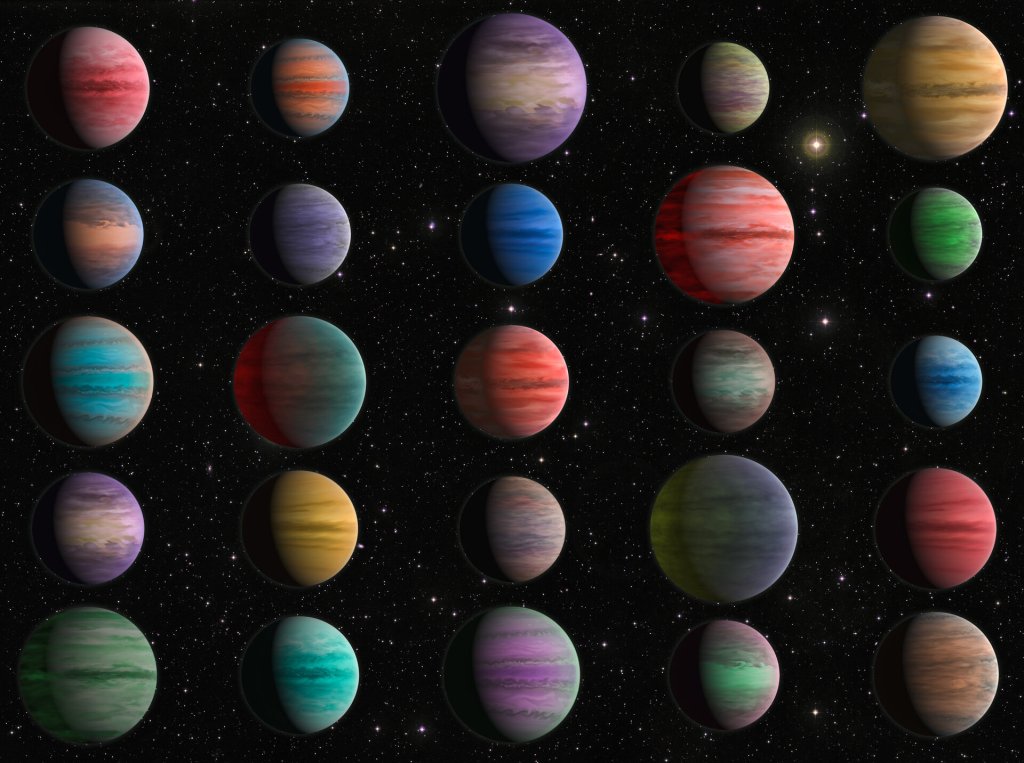
Image (Credit): Artist’s rendering of 25 hot Jupiters captured by the NASA/ESA Hubble Space Telescope that have been analysed by an international team of astronomers, enabling them to answer five open questions important to our understanding of exoplanet atmospheres. (ESA/Hubble, N. Bartmann)

“We are interested in understanding the diversity and atmospheric compositions of planets between the size of Earth and Neptune…“‘Super-Earths’ and ‘mini-Neptunes’ are the most common types of planets in our galaxy. But we only have a few examples of atmospheric measurements from these types of planets.”

-Statement by Johanna Teske, a staff scientist at the Carnegie Institution of Washington who is co-leading a Webb observation team with Natasha Batalha at NASA’s Ames Research Center in Northern California. She was discussing the James Webb Space Telescope’s role to better understand exoplanets. Her comments and more are included in a NASA news article, “Exoplanets: What NASA Will See with the Webb Telescope.”