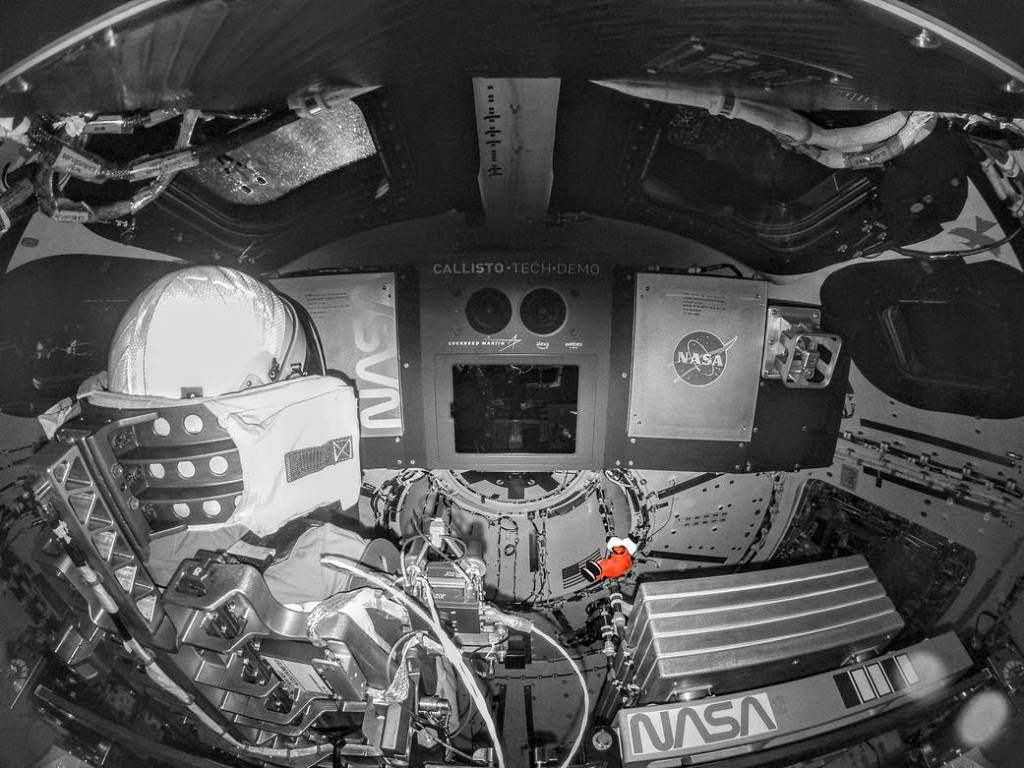
Much has been discussed about the test dummies used on the Orion capsule during the recent Artemis I mission. And stories abound about the snoopy doll (show below) being the “zero-gravity” indicator on the Orion. But have you heard about the four Danish passengers on the capsule?
The Danish company Lego had four toy astronauts on the Orion capsule as well – Kate, Kyle, Julia, and Sebastian. It’s part of an educational series for children. NASA and Lego have been educational partners for a while now.
Are these the first toys in Space? Absolutely not. For instance, space shuttle astronauts have brought a teddy bear and Star Wars light saber into into orbit, among other things. And last year a SpaceX capsule sent to the International Space Station contained a stuffed penguin, which was also used as a “zeroed-gravity” indicator.
I support any endeavors to excite children about the space program. Soon enough we will see what else the Artemis program might have in store for children as well as the kids at heart.
Image (Credit): Snoopy doll floating on the Orion (color adjusted to highlight Snoopy). (NASA)
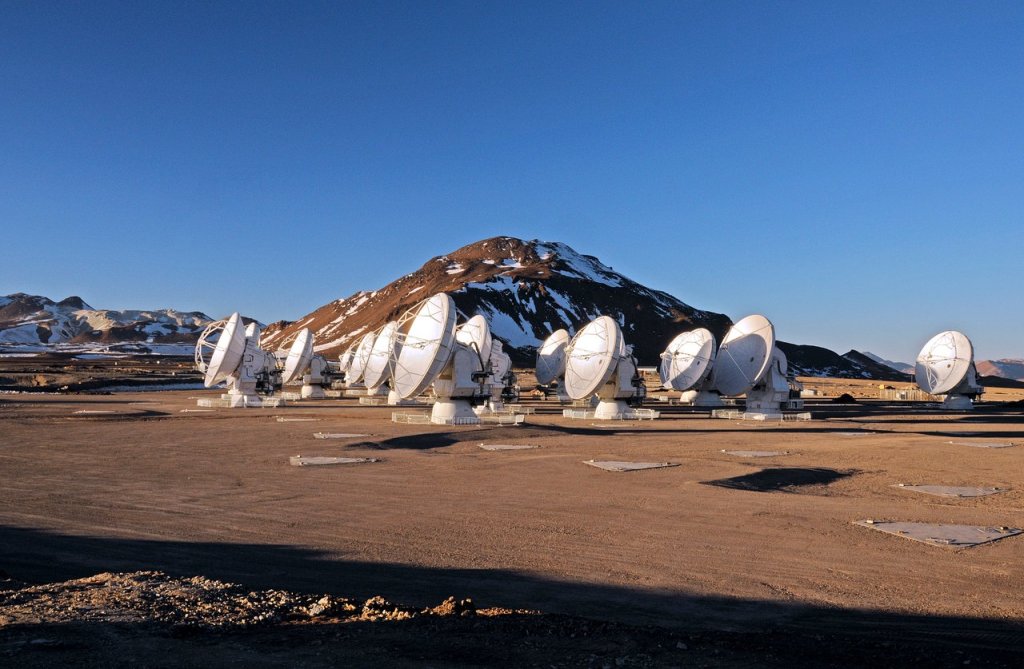
Image (Credit): The ALMA antennas on the Chajnantor Plateau in northern Chile. (ESO)
A recent Phyls.org article, “Chile’s ALMA Observatory Resumes Work After Cyberattack,” discusses a recent hacking incident at the European Southern Observatory’s (ESO) Atacama Large Millimeter/submillimeter Array (ALMA). The telescope was offline for about two months after the attack.
The ALMA telescope in northern Chile is a key asset in the search for early galaxies with its 66 antennas spread over 10 miles. Why would someone want to attack it?
When it comes to a cyber attack in the space industry, this has an added level of danger as future travel missions could be left in danger of being hi-jacked – with hackers having the potential to cause inter-space collisions and destroy communication systems, for example, should they be able to penetrate mission-critical, earth-based systems.
While the articles I read on this attack did not discuss the motive or possible attacker, it’s essential this matter be thoroughly investigated and used as an example to harden other scientific locations. We have made too much progress in astronomy for it to derailed by these outside parties.
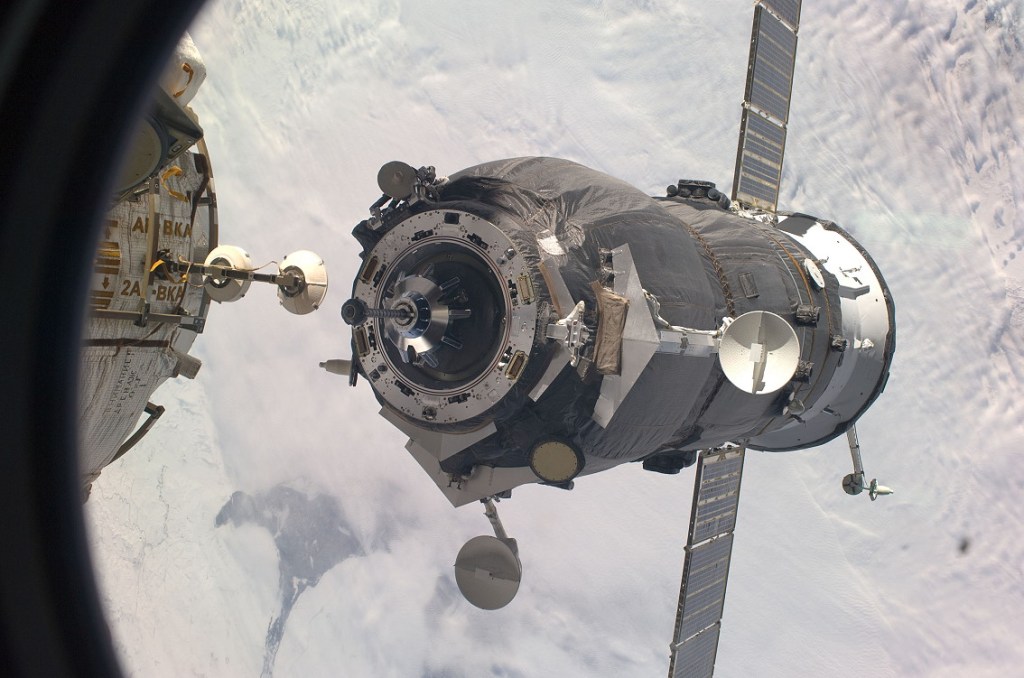
Take a look at the image above. Can you determine where this image originated? Take a guess and then check your answer by going to the menu and selecting the “Where is This?” The Answer Sheet page.
Image (Credit): Russian Soyuz capsule outside the International Space Station. (Spacefacts.de)
Fortunately, we now know the source of the leak in the extra Soyuz Crew Return Vehicle attached to the International Space Station (ISS). However, we do not know the cause of this radiator coolant leak, which creates risk should the capsule be used early next year to bring two cosmonauts and an astronaut back to Earth. Hence, it may be better to bring another capsule up to the ISS for the change in crew and send the damaged one back empty for repairs.
The ISS doesn’t technically have an escape pod. Instead, a Crew Return Vehicle more or less serves this purpose. It has been used more than once to host astronauts and cosmonauts fleeing space junk, so maybe it’s time to think over these procedures again. You would think a $100 billion orbiting space station could ensure the survival of its passengers.
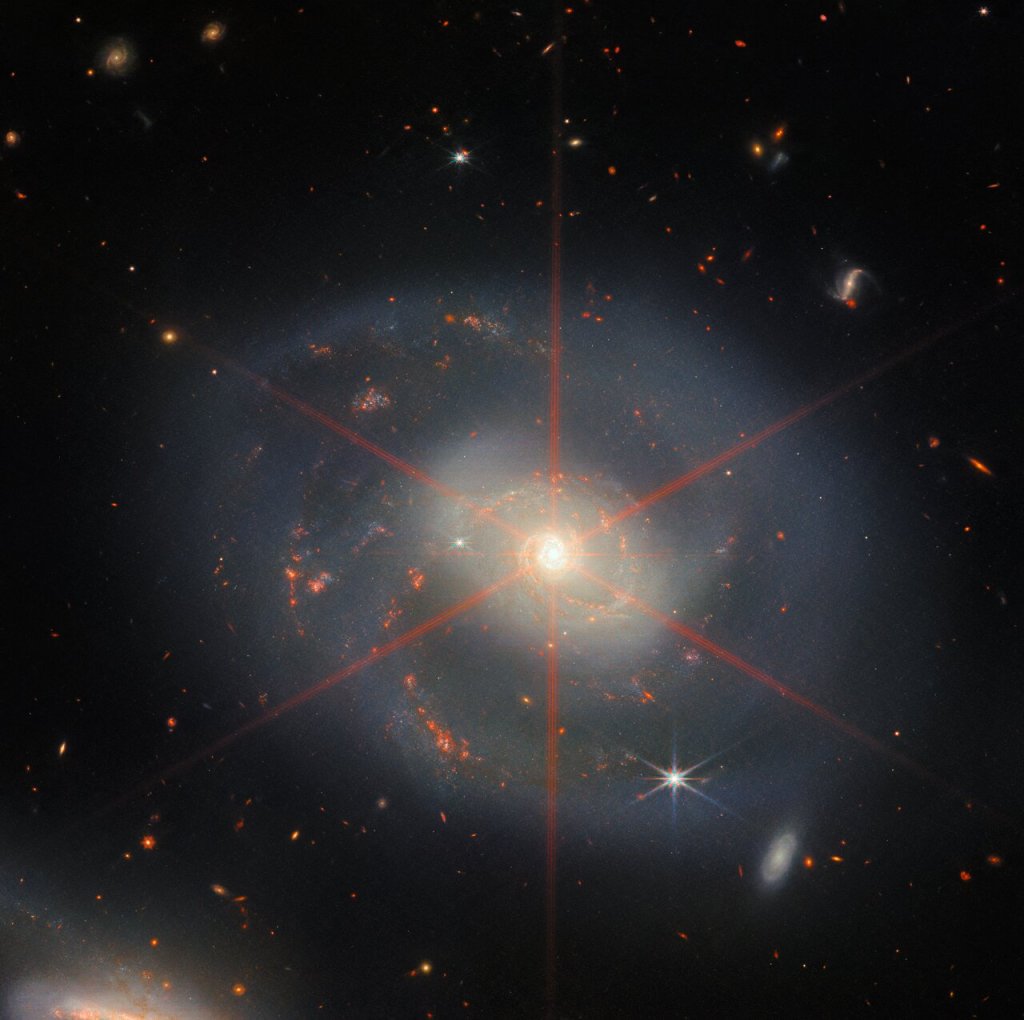
Image (Credit): Spiral galaxy NGC 7469 face-on. (NASA)
This week’s image is from the James Webb Space Telescope (JWST). It is a face-on view of wreath-like spiral galaxy NGC 7469, which is about 220 million light-years from Earth.
While NGC 7469 is one of the best studied AGNs in the sky, the compact nature of this system and the presence of a great deal of dust have made it difficult for scientists to achieve both the resolution and sensitivity needed to study this relationship in the infrared. Now, with Webb, astronomers can explore the galaxy’s starburst ring, the central AGN, and the gas and dust in between. Using Webb’s MIRI, NIRCam and NIRspec instruments to obtain images and spectra of NGC 7469 in unprecedented detail, the GOALS team has uncovered a number of details about the object. This includes very young star-forming clusters never seen before, as well as pockets of very warm, turbulent molecular gas, and direct evidence for the destruction of small dust grains within a few hundred light-years of the nucleus — proving that the AGN is impacting the surrounding interstellar medium. Furthermore, highly ionised, diffuse atomic gas seems to be exiting the nucleus at roughly 6.4 million kilometres per hour — part of a galactic outflow that had previously been identified, but is now revealed in stunning detail with Webb. With analysis of the rich Webb datasets still underway, additional secrets of this local AGN and starburst laboratory are sure to be revealed.
A prominent feature of this image is the striking six-pointed star that perfectly aligns with the heart of NGC 7469. Unlike the galaxy, this is not a real celestial object, but an imaging artifact known as a diffraction spike, caused by the bright, unresolved AGN. Diffraction spikes are patterns produced as light bends around the sharp edges of a telescope. Webb’s primary mirror is composed of hexagonal segments that each contain edges for light to diffract against, giving six bright spikes. There are also two shorter, fainter spikes, which are created by diffraction from the vertical strut that helps support Webb’s secondary mirror.



 Our Awesome Universe