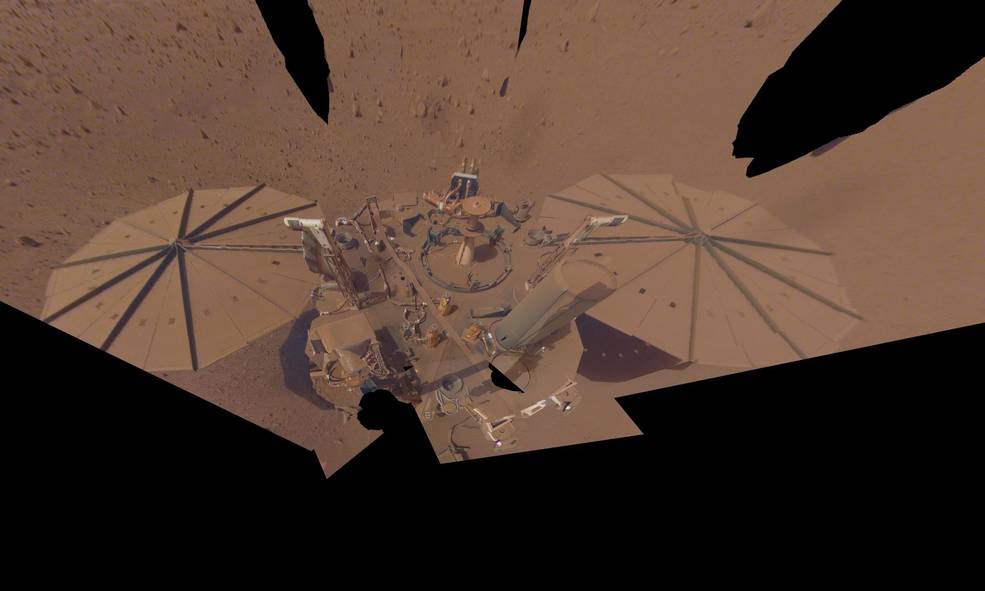
Image (Credit): The final selfie taken by NASA’s InSight Mars lander on April 24, 2022. (NASA)
NASA’s Jet Propulsion Laboratory (JPL) is no longer able to contact the Interior Exploration using Seismic Investigations, Geodesy and Heat Transport (InSight) Mars lander, which has been hard at work on the Red Planet for the past four years detecting more than 1,300 marsquakes. However, the accumulation of dust on the lander’s solar panels has ended its ability to power itself. The last communication from InSight was December 15.
Philippe Lognonné of Institut de Physique du Globe de Paris, principal investigator of InSight’s seismometer, stated:
With InSight, seismology was the focus of a mission beyond Earth for the first time since the Apollo missions, when astronauts brought seismometers to the Moon…We broke new ground, and our science team can be proud of all that we’ve learned along the way.
You can read more about the InSight Mar lander’s findings here.
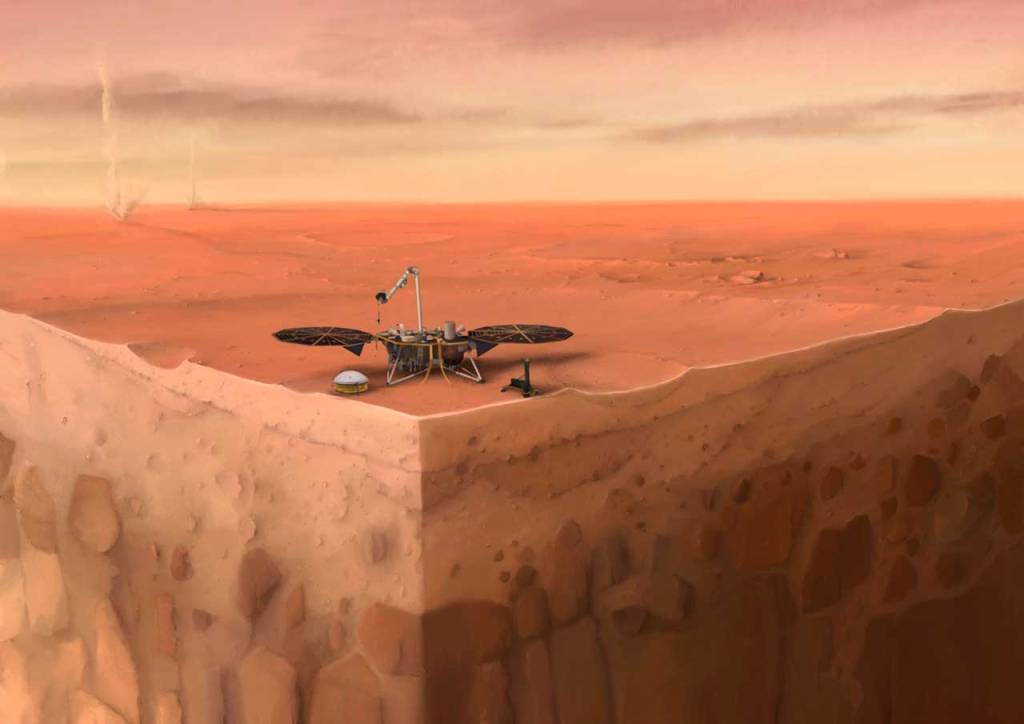
Image (Credit): Artist’s concept of NASA’s InSight lander on Mars, showing layers of the planet’s subsurface below and dust devils on the surface. (IPGP/Nicolas Sarter)
Image (Credit): Roscosmos head Yuri Borisov. (Dogruso.com)
“Say hello to the entire American team. They proved themselves to be very worthy in this situation and lent us a helping hand…You set an example for the whole world on how to work together in the most challenging and difficult situation. Let many politicians learn from you.“
-Statement by Yuri Borisov, head of Russian space agency Roscosmos, on Tuesday praising Russia-U.S. cooperation at the International Space Station (ISS) following a major coolant leak from a Soyuz crew capsule. The transcript was quoted in The Moscow Times. The ISS remains one of the limited areas where the U.S. and Russia are still cooperating given the situation in Ukraine.
Temperatures in a Russian Soyuz crew ferry ship docked at the International Space Station — a lifeboat for three of the lab’s seven crew members — remain within safe limits despite a dramatic overnight leak in the spacecraft’s cooling system, officials said Thursday. The leak developed around 7:45 p.m. EST Wednesday amid preparations for a planned 6-hour and 40-minute spacewalk by cosmonauts Sergey Prokopyev and Dmitri Petelin to move a radiator from the Rassvet module, where the Soyuz MS-22/68S spacecraft is docked, to the new Nauka laboratory module.
The White House announced the new membership of an advisory group of the National Space Council Dec. 16 with wholesale changes in the roster reflecting a new emphasis on climate change and workforce issues. Vice President Kamala Harris, chair of the National Space Council, announced a roster of 30 members of the Users’ Advisory Committee (UAG), the advisory group that supports the council on various space topics. Their membership on the committee is pending a formal appointment by the NASA administrator, a formality linked to NASA’s role in hosting the UAG.
There has long been a dream of building a massive rotating space station to call home, such as the one featured in “2001: A Space Odyssey,” but the challenges of construction are huge, not to mention the logistics of lifting such large quantities of steel and other materials into space. A rotating station would need to be at least hundreds of feet across to make artificial gravity practical The bigger the better. So engineers have proposed spinning up asteroids as a kind of ready-built station. We would need to dig out the interior, but this would give us materials we could use.
On a recent episode of the Clear + Vivid podcast, Alan Alda interviewed NASA engineer Les Johnson about his efforts to develop a solar sail that can take us to the stars. He is the Principal Investigator for the NEA Scout, which was launched into space during the Artemis I mission and is now heading towards a near-Earth asteroid via solar sails (see above).
During the interview, Mr. Johnson discussed the NEA Scout as well as his hopes for future human travel to the stars using solar sails, noting that while slow, the sails can outperform modern rocket engines in the long-run. He also pointed out that a solar sail may be able to get us to Proxima Centauri, the closest neighboring star, in hundreds of years versus the 70,000 years it will take the Voyager spacecraft to travel that same distance. I like how he puts such a mission in perspective, pointing out it took hundreds of years to build some of the great cathedrals.
Messrs. Alda and Johnson also discussed the ethics of space travel considering astronauts will be spending generations in space with many humans never seeing either the Earth or the destination in their lifetime. Mr. Johnson said space lasers may be another option for interstellar travel at some point in the future, reducing the travel time to Proxima Centauri to 40-50 years. Given the time spans, he said it may make sense to initially send robots into space first.
Finally, the podcast covered missions closer to Earth, such as mining asteroids for water and minerals, as well as 3D printing to create what we need in space. It sounded a lot like the situation in find in the science fiction TV series The Expanse.
Overall, it was a great conversation worth a few minutes of your day. Check it out.
Extra: Mr. Johnson is also the author of several books, including the co-authored Saving Proxima. Here is a quick summary of that tale:
2072. At the lunar farside radio observatory, an old-school radio broadcast is detected, similar to those broadcast on Earth in the 1940s, but in an unknown language, coming from an impossible source—Proxima Centauri. While the nations of Earth debate making first contact, they learn that the Proximans are facing an extinction-level disaster, forcing a decision: will Earth send a ship on a multiyear trip to render aid?
Interstellar travel is not easy, and by traveling at the speeds required to arrive before disaster strikes at Proxima, humans will learn firsthand the time-dilating effects of Einstein’s Special Relativity and be forced to ponder ultimate questions: What does it mean to be human? What will it take to share the stars with another form of life? What if I return younger than my own children? The answers are far from academic, for they may determine the fate of not one, but two, civilizations.
Image (Credit): The Electron rocket on the launchpad. (Rocket Lab)
Rocket Lab has big plans for the Mid-Atlantic Regional Spaceport (MARS) where tomorrow it will launch the first of its U.S. based Electron rockets. The December 18th mission from the Virginia spaceport will depart from NASA’s Wallops Flight Facility. While Rocket Lab has been launching the Electron from New Zealand, it is starting up operations in Virginia and may become a big presence on the mid-atlantic coast.
The Electron, a 60-foot rocket, is intended for short turnaround of smaller loads. This sounds ideal to the customer base for satellites in Washington, DC just up the road. If all goes well, the larger Neutron rocket will also be launched from MARS in the near future. Ultimately, the VA facility may host monthly Rocket Lab launches.
In an earlier press release, Rocket Lab noted its going potential with both Launch Complex 1 in New Zealand and the new Launch Complex 2 in Virginia:
While “Virginia Is For Launch Lovers” will be Electron’s first launch from the U.S., Rocket Lab has already conducted 32 Electron missions from Launch Complex 1 in New Zealand, delivering 152 satellites to orbit for customers including NASA, the National Reconnaissance Office, DARPA, the U.S. Space Force and a range of commercial constellation operators. Electron is already the most frequently launched small orbital rocket globally and now with the capacity of the pads at Launch Complex 1 and 2 combined, Rocket Lab has more than 130 Electron launch opportunities every year.
Tomorrow’s launch will be an important test of the company’s new approach. If all goes well, it is good news for the Virginia economy as well as the U.S. commercial space industry.
Update: The launch has been delayed due to weather until Monday, December 19th.
Second Update: The Monday launch was delayed again due to weather. Stay tuned for a new launch date.




 Our Awesome Universe