Image (Credit): Globular cluster M92 captured by the JWST. (NASA, ESA, CSA, A. Pagan (STScI))
This week’s image was captured by the James Webb Space Telescope (JWST) and shows globular cluster M92 located about 27,000 light-years away within our Milky Way galaxy.
Detail of the globular cluster M92 captured by Webb’s NIRCam instrument. This field of view covers the lower left quarter of the right half of the full image. Globular clusters are dense masses of tightly packed stars that all formed around the same time. In M92, there are about 300,000 stars packed into a ball about 100 light-years across. The night sky of a planet in the middle of M92 would shine with thousands of stars that appear thousands of times brighter than those in our own sky. The image shows stars at different distances from the center, which helps astronomers understand the motion of stars in the cluster, and the physics of that motion
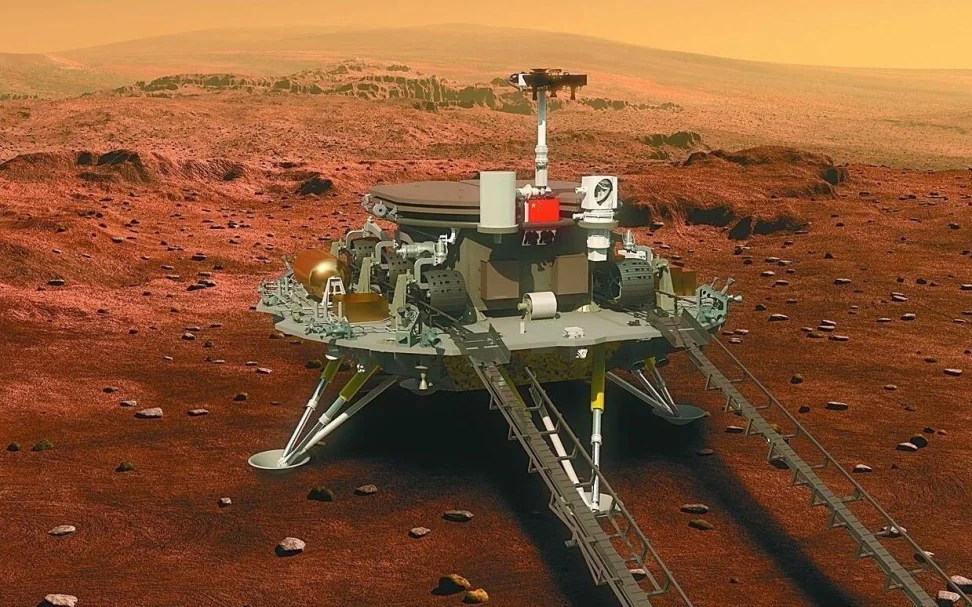
Images from NASA’s Mars Reconnaissance Orbiter reveal that China’s Zhurong rover remains stationary on the Red Planet as China remains silent on the status of its spacecraft. The High Resolution Imaging Science Experiment (HiRISE) camera aboard the Mars Reconnaissance Orbiter (MRO) captured images of the rover on March 11, 2022, a second on Sept. 8, 2022 and finally Feb. 7, 2023. The images were published Feb. 21 by the HiRISE Operations Center.
Astronomers have discovered what appear to be massive galaxies dating back to within 600 million years of the big bang, suggesting the early universe may have had a stellar fast-track that produced these “monsters.” While the new James Webb Space Telescope has spotted even older galaxies, dating to within a mere 300 million years of the beginning of the universe, it’s the size and maturity of these six apparent mega-galaxies that stunned scientists. They reported their findings Wednesday in the journal Nature.
A decades-old Soviet era piece of space junk has crashed back to Earth after over 40 years in orbit, improbably crash landing back in its home country, Russia. The abandoned Soviet Vostok-2M Blok E rocket stage, weighing more than 3,000 pounds, “made an uncontrolled reentry over Novaya Zemlya at 1016 UTC Feb 20 after 42.7 years in orbit,” tweeted Jonathan McDowell, an astrophysicist and group leader at the Chandra X-ray Center Science Data Systems.
I found another episode from The Planetary Society’s podcast Planetary Radio that is worth checking out. In this episode, Are we Alone? The Search for Alien Technosignatures, Professor Jean-Luc Margot and doctoral student Megan Li discuss their project at University of California Los Angeles (UCLA) to identify signals from other civilizations in the galaxy and then extract information encoded in those extraterrestrial signals. This project, called UCLA SETI, was also the winner of a Planetary Society STEP Grant as well as a NASA grant to conduct this work.
As of last week, a volunteer site was set up to assist the UCLA SETI team with this project. Here is some key information from its website:
The video is actually a 55-minute talks, but the key section related to this project starts at the 23:38 minute mark where the downloaded data is discussed.
This is your chance to identify something that no one has every seen before. Put some of that time you might have spent watching The Ark toward something useful.
Image (Credit): Promotion for UFOs: Investigating the Unknown. (National Geographic)
With all the ongoing media chatter about unidentified flying objects (UFO), National Geographic has perfect timing with its new series UFOs: Investigating the Unknown. The new series started on February 13th. You can watch it on Hulu, Disney+, and ESPN+.
National Geographic promises that this new five-part series will explore the government’s decades long investigations into UFOs. It seems those investigations just expanded into new areas with the U.S. Air Force recently firing missiles at objects in Canada and the United States. Maybe the new series can help to explain some of these sightings.
If the whole UFO issue has bored you, then tag along with Captain Picard for the third and last season of Star Trek: Picard. The series returned on February 16th. You get to see some of your old favorites joining the cast this season, including Geordi La Forge, Worf, William Riker, Dr. Beverly Crusher, and Deanna Troi.
Here is the basic plot from Paramount+:
In the epic, thrilling conclusion of Star Trek: Picard, a desperate message from a long-lost friend draws Starfleet legend Admiral Jean-Luc Picard into the most daring mission of his life, forcing him to recruit allies spanning generations old and new. This final adventure sets him on a collision course with the legacy of his past and explosive, new revelations that will alter the fate of the Federation forever.
I know, the plot reads like a cover letter on a resume promising everything. That said, I think I will start with Star Trek: Picard and continue to follow UFOs in the daily news. That will be enough drama for me these days.
Image (Credit): Promotional poster for Star Trek: Picard’s third season. (Paramount+)
Image (Credit): The Progress 82 cargo craft approaches the ISS on October 27, 2022. (NASA)
It appears that we now have two problematic capsules attached to the International Space Station (ISS). Late last year, we learned about a liquid coolant lead in the Russian Soyuz Crew Return Vehicle (Soyuz MS-22 crew ship), and now we have a leak in the second Russian capsule as well (Progress 82 cargo capsule). This is not a good sign for the seven ISS crew members, some of whom were already scheduled to go home.
After inspecting the Progress 82 spacecraft, it was set loose on Friday to burn up over the Pacific Ocean, as noted by NASA:
Loaded with trash, Progress 82 undocked from the space station’s Poisk module at 9:26 p.m. EST Friday, Feb. 17. The Progress deorbit was delayed about 24-hours while Roscosmos engineers analyzed imagery acquired after undocking of the radiator area of the spacecraft, which is the suspected region where a coolant leak occurred on Feb. 11.
As a result of this second incident, the Russian launch of a replacement capsule (Soyuz MS-23), scheduled for this week, may need to be delayed until the issues with both spacecraft are fully discussed and understood. In a discussion about the two leaks, an NPR commentator noted:
Analysts say Russia’s supply chain has been stretched thin due to the war in Ukraine.
This is not good news for anyone. If we cannot rely on the Russian missions, the SpaceX and Northrop Grumman will be doing double duty.





 Our Awesome Universe