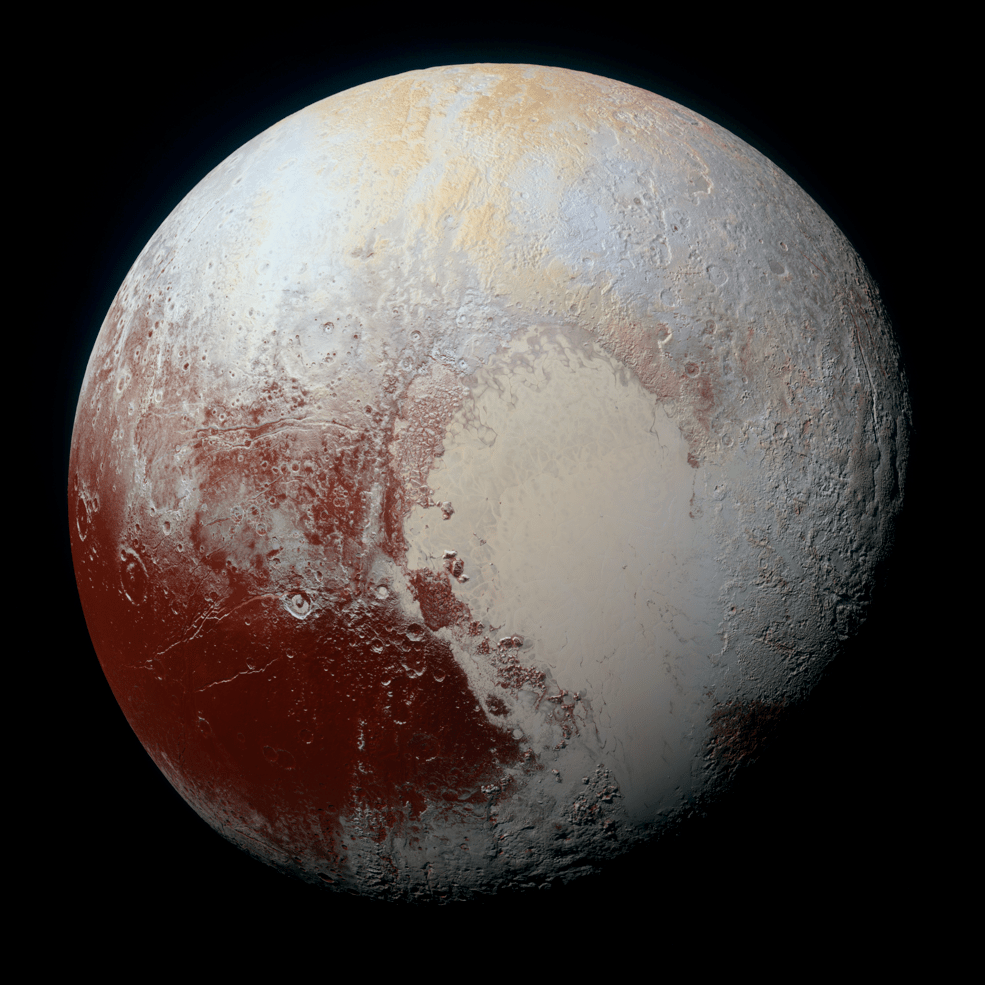
On this day in 1930, Clyde Tombaugh discovered Pluto. The 23-year old astronomer was working for the Lowell Observatory in Flagstaff, Arizona at the time of his discovery.
Pluto, recognized as the ninth planet in our solar system, was demoted to a dwarf planet in 2006 since it was one of many such objects in the Kuiper Belt and did not meet the definition of a planet.
When NASA’s New Horizons spacecraft visited Pluto in 2015, it was carrying some of Clyde Tombaugh’s ashes. The canister with the ashes had the following inscription:
Interned herein are remains of American Clyde W. Tombaugh, discoverer of Pluto and the solar system’s “third zone.” Adelle and Muron’s boy, Patricia’s husband, Annette and Alden’s father, astronomer, teacher, punster, and friend: Clyde W. Tombaugh (1906-1997).
You can learn a number of interesting facts about Pluto here.
Searching through existing data spanning 9 billion years, a team of researchers led by scientists at University of Hawaiʻi at Mānoa has uncovered the first evidence of “cosmological coupling” –a newly predicted phenomenon in Einstein’s theory of gravity, possible only when black holes are placed inside an evolving universe.
UH Mānoa astrophysicists Duncan Farrah, a faculty member at the Institute for Astronomy and the Department of Physics and Astronomy, and Kevin Croker, a professor of physics and astronomy led this ambitious study, combining Hawaiʻi’s expertise in galaxy evolution and gravity theory with the observation and analysis experience of researchers across nine countries to provide the first insight into what might exist inside real black holes.
Chemists have discovered a new form of ice, and their work may have major consequences for our understanding of the outer solar system. We usually encounter three forms of water on the surface of Earth: solid, liquid, and vapor. On our planet, solid ice mainly comes in one variety, where water molecules arrange themselves into an orderly and repeated crystalline structure. But scientists have discovered 19 other varieties of water-ice that may appear throughout the universe.
Using the Five-hundred-meter Aperture Spherical radio Telescope (FAST), Chinese astronomers have detected a new galaxy, which received designation FAST J0139+4328. The newfound galaxy is isolated, has a relatively low stellar mass, and is dominated by dark matter. The discovery was detailed in a paper published February 6 on the arXiv pre-print server.
“We don’t yet know exactly what these three objects were. But nothing — nothing right now suggests they were related to China’s spy balloon program or that they were surveillance vehicles from other — any other country. The intelligence community’s current assessment is that these three objects were most likely balloons tied to private companies, recreation, or research institutions studying weather or conducting other scientific research.”
-Statement by President Biden at a February 16, 2023 press conference regarding the shooting down of three balloons after the destruction of a Chinese spy balloon. The Guardian later reported that an Illinois amateur ballooning club was contacted by the FBI about its $13 weather balloon that was last seen in Canada’s Yukon territory.
Image (Credit): Spiral glaxy LEDA 2046648 as captured by the JSWT. (ESA/Webb, NASA & CSA, A. Martel)
This week’s image is from the James Webb Space Telescope (JWST). It shows a spiral galaxy that appears much like our own (bottom center), though this one is a billion light-years away. Do occupants of that galaxy also see us? Good luck communicating when it will take 2 billion years to receive a response to a message you just sent out.
Here is the full story from the European Space Agency (ESA), which posted this as its Picture of the Month just last month:
A crowded field of galaxies throngs this Picture of the Month from the NASA/ESA/CSA James Webb Space Telescope, along with bright stars crowned with Webb’s signature six-pointed diffraction spikes. The large spiral galaxy at the base of this image is accompanied by a profusion of smaller, more distant galaxies which range from fully-fledged spirals to mere bright smudges. Named LEDA 2046648, it is situated a little over a billion light-years from Earth, in the constellation Hercules.
One of Webb’s principle science goals is to observe distant galaxies in the early universe to understand the details of their formation, evolution, and composition. Webb’s keen infrared vision helps the telescope peer back in time, as the light from these distant galaxies is redshifted towards infrared wavelengths. Comparing these systems with galaxies in the local universe will help astronomers understand how galaxies grew to form the structure we see today. Webb will also probe the chemical composition of thousands of galaxies to shed light on how heavy elements were formed and built up as galaxies evolved.
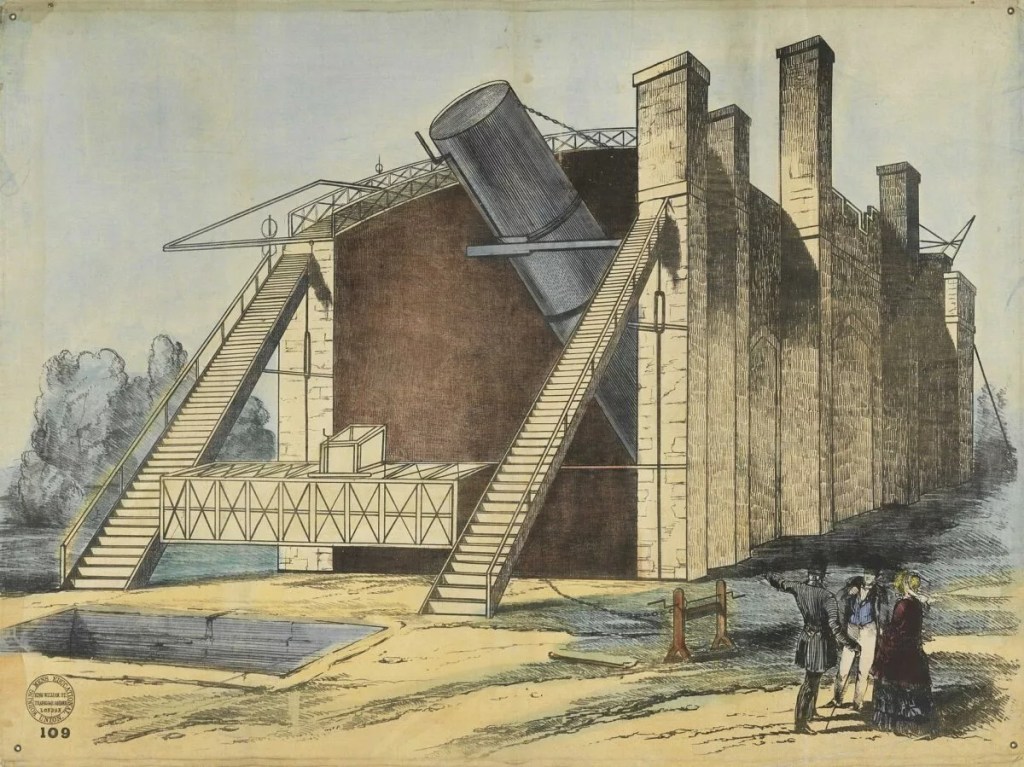
Image (Credit): The Leviathan of Parsonstown, or Rosse six-foot telescope. (Planetary Society)
On this day in 1845, a 72-inch reflecting telescope built by William Parsons, the 3rd Earl of Rosse, came into use on his estate in Ireland. The telescope remained the largest in the world until 1917, when it was eclipsed by the Hooker reflecting telescope in California.
Known as both the Leviathan of Parsonstown and Rosse six-foot telescope, it was used William Parson to observe star clusters and nebulae. For example, it was used to view a spiral nebula that we know today as the spiral galaxy Messier 51, or The Whirlpool Galaxy, which is about 31 million light years from Earth (see below). You can see The Whirlpool Galaxy today with a pair of binoculars.
Go here for more information on the Earl and his telescope.
Image (Credit): Spiral galaxy Messier 51, also called The Whirlpool Galaxy. (NASA, ESA, S. Beckwith (STScI) and the Hubble Heritage Team (STScI/AURA))




 Our Awesome Universe