Pic of the Week: The Green Comet

Image (Credit): Comet 2022 E3 (ZTF). (NASA and Dan Bartlett)

The so-called Green Comet that is garnering much attention in the media is captured in this image from last year. The comet was first discovered early last year.

Here is the full story from NASA:

Comet C/2022 E3 (ZTF) was discovered by astronomers using the wide-field survey camera at the Zwicky Transient Facility this year in early March. Since then the new long-period comet has brightened substantially and is now sweeping across the northern constellation Corona Borealis in predawn skies. It’s still too dim to see without a telescope though. But this fine telescopic image from December 19 does show the comet’s brighter greenish coma, short broad dust tail, and long faint ion tail stretching across a 2.5 degree wide field-of-view. On a voyage through the inner Solar System comet 2022 E3 will be at perihelion, its closest to the Sun, in the new year on January 12 and at perigee, its closest to our fair planet, on February 1. The brightness of comets is notoriously unpredictable, but by then C/2022 E3 (ZTF) could become only just visible to the eye in dark night skies.

If you grab your binoculars, you can still see the comet over the next week by looking south. Check out the graphic below from EarthSky.org if you need a sky map to find it.
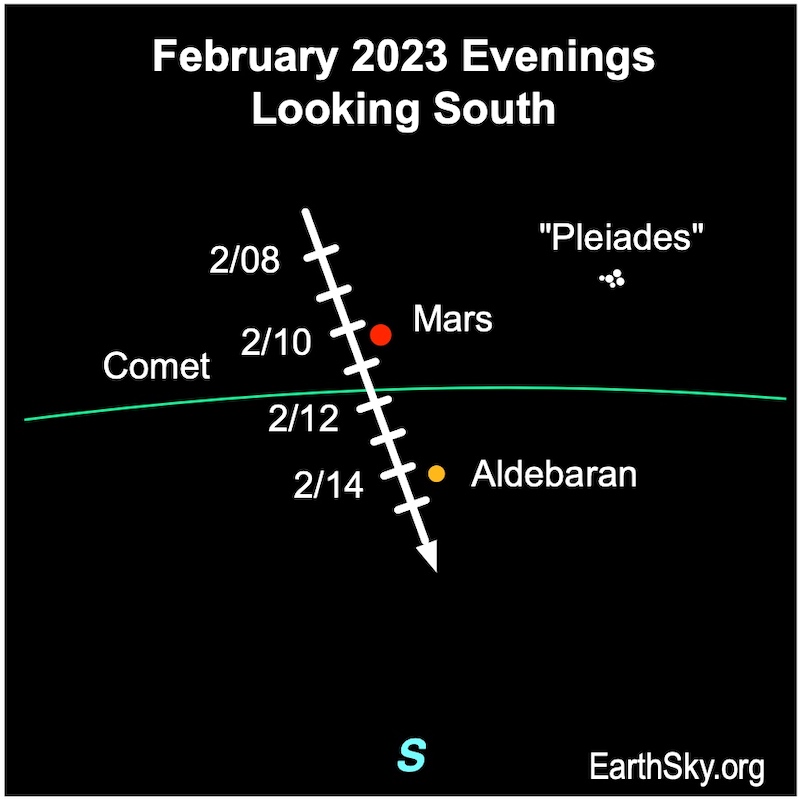
Credit: EarthSky.org

Space Stories: Jovian Moons, Charon’s Canyons, and a New Space Telescope

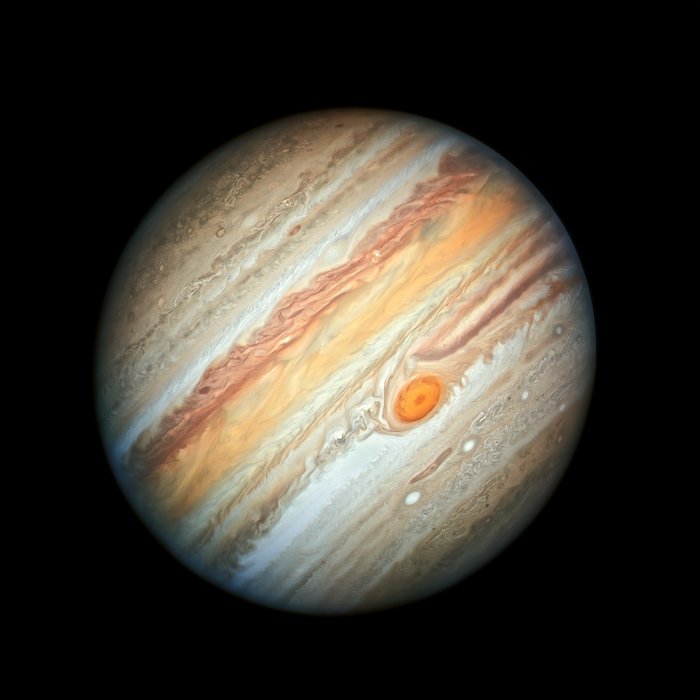
Image (Credit): Jupiter as seen by the NASA/ESA Hubble Space Telescope. (NASA, ESA, A. Simon (Goddard Space Flight Center), and M.H. Wong (University of California, Berkeley)

Here are some recent stories of interest.

Live Science: “Jupiter Officially has the Most Moons in the Solar System, Discovery of 12 New Satellites Confirms

Jupiter was already the king of the solar system, and new discoveries give the massive planet another way to reign supreme: It now has the most moons. Twelve new moons discovered orbiting Jupiter have been confirmed, bumping the count from 80 to 92, and knocking Saturn — which has 83 moons — down a peg. 

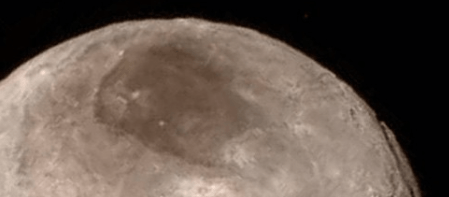
Phys.org: “Models Explain Canyons on Pluto’s Large Moon Charon

In 2015, when NASA’s New Horizons spacecraft encountered the Pluto-Charon system, the Southwest Research Institute-led science team discovered interesting, geologically active objects instead of the inert icy orbs previously envisioned. An SwRI scientist has revisited the data to explore the source of cryovolcanic flows and an obvious belt of fractures on Pluto’s large moon Charon. These new models suggest that when the moon’s internal ocean froze, it may have formed the deep, elongated depressions along its girth but was less likely to lead to cryovolcanoes erupting with ice, water and other materials in its northern hemisphere.

Big Think: “NASA’s Habitable Worlds Observatory to Finally Answer the Epic Question: “Are we Alone?”

…perhaps the biggest question of all — that of “Are we alone in the Universe?” — remains a mystery. While the current generation of ground-based and space-based telescopes can take us far into the Universe, this is a question that’s currently beyond our reach. To get there, we’ll need to directly image Earth-like exoplanets: planets with sizes and temperatures similar to Earth, but that orbit Sun-like stars, not the more common red dwarf stars like Proxima Centauri or TRAPPIST-1. Those capabilities are precisely what NASA is aiming for with its newly announced flagship mission: the Habitable Worlds Observatory. It’s an ambitious project but one that’s well worth it. After all, finding out we’re not alone in the Universe would quite possibly be the biggest revolution in all of science history.

Space Quote: Nukes in Space

Image (Credit): NASA’s Cassini spacecraft lifts off on Oct. 15, 1997, atop a Titan IVB rocket. (NASA)

“NASA should educate the public about why nuclear propulsion is not only something nice to have, but is a necessity if human civilization is to spread beyond the Earth on a greater scale than a few explorers. Access to the mineral and energy resources of the solar system would be a boon to all humankind and would be worth the infinitesimal risk of launching nuclear fuel into space.”

-Statement by Mark R. Whittington in an editorial in The Hill titled “Will the NASA-DARPA nuclear engine test cause environmental protests?” In his piece, Mr. Whittington discusses plans to build a nuclear-powered rocket for a Mars mission and highlights how protests surrounded the 1997 launch of the nuclear-powered Cassini probe to Saturn, with one scientist estimating that “an explosion on the launch pad could spread radioactive plutonium across Central Florida, potentially cause more than 1 million casualties…” Mr. Whittington is the author of various space exploration studies, such as Why is It So Hard to Go Back to the Moon?

Chinese Balloon: An Identified Flying Object

Image (Credit): Chinese balloon and jet airplane sharing the sky over North Carolina. (The Dallas Morning News)

It is not clear why China chose to test the U.S. this past week with a surveillance balloon, but it ended yesterday with the Air Force shooting down the device. These Chinese balloons have been seen all over the world, and this is not the first time they have visited the U.S. (having been sighted under the last president as well). What a balloon can do that a satellite cannot is somewhat unclear at the moment, and whether this action this puts our own surveillance craft observing China’s territory at risk is anyone’s guess.

It is unlikely this was an innocent error on the part of the Chinese, though the head of the China Meteorological Administration was fired anyway. NASA was even called in to give it opinion on the balloon, which makes sense given NASA’s experience with Earth-monitoring balloons.

And what about the U.S. Space Force? Would this fall under their jurisdiction? Does the Air Force end and the Space Force begin so many miles up?

The Space Force posted a press release on the balloon incidence, but was silent about its role in the matter. On its website, the Space Force seems to rely on the U.S. Air Force for quite a bit:

As a new military service, the U.S. Space Force will leverage the Department of the Air Force for more than 75 percent of its enabling functions to significantly reduce cost and avoid duplication. The Department of the Air Force will provide support functions that includes logistics, base operating support, IT support, audit agencies, etc. 

Maybe that support includes the necessary muscle to take down balloons.

It is somewhat amusing that all these years the government has been saying UFO sightings related to silly, harmless “weather balloons,” and now we are sending military fighter jets to take on threatening “weather balloons.” We are living in strange times.

Image (Credit): A NASA Super Pressure Balloon just before launch from Wanaka, New Zealand. (NASA)