The series, Fired on Mars, is described as an “Existential workplace comedy set on the Martian campus of a modern tech company.” It stars Pete Davidson. It’s animated. And HBO Max seems to be doing the bare minimum to advertise it. Or, more to the point, it is doing nothing to advertise it.
Does that peek your interest of scare you away?
I am more in the latter category, but I will watch the first episode to see that I think.
Update: I watched the first few episodes and decided that was enough. It really has very little to do with Mars. The planet is just a backdrop to an office drama that is not very interesting. If you want a good science fiction office drama you would do better watching Severance on Apple TV+.
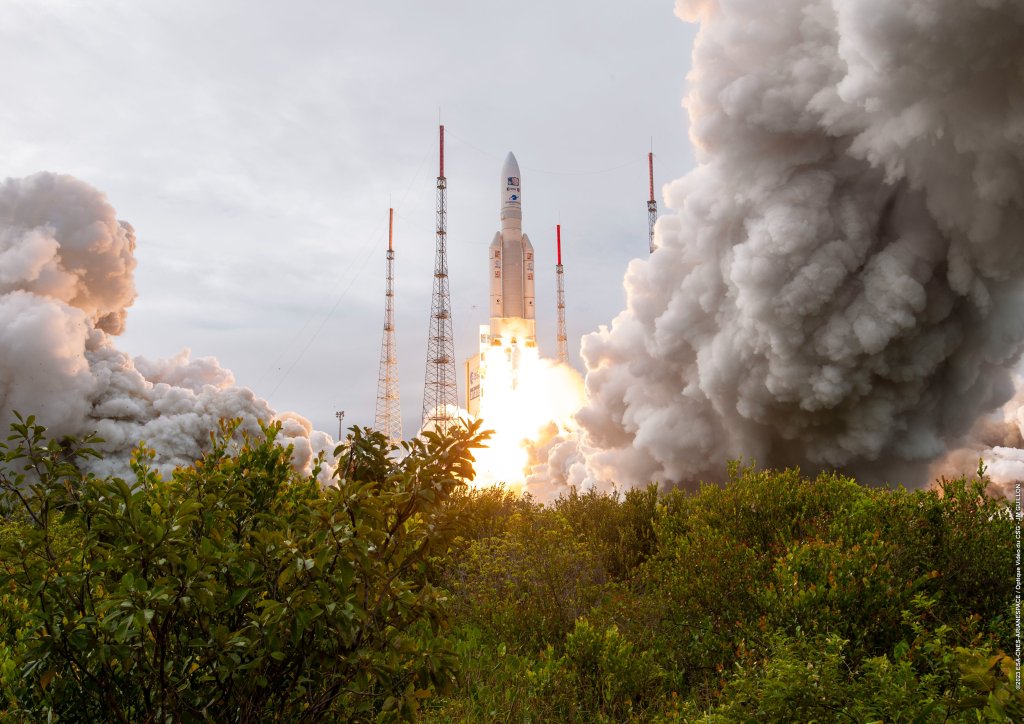
Image (Credit): The successful launch of the ESA’s Juice mission from Kourou, French Guiana on April 14, 2023. (ESA/M. Pédoussaut and ESA/CNES/Arianespace/Optique Vidéo du CSG/JM Guillon)
Earlier today, the European Space Agency’s (ESA) Jupiter Icy Moons Explorer (Juice) mission successfully launched from French Guiana. It is the start of a long trip to the Jovian planet and its moons. The spacecraft will not reach Jupiter until July 2031. You can watch of video of the launch here. ESA has numerous other videos on the mission here.
ESA, with its international partners, is on its way to Jupiter…Juice’s spectacular launch carries with it the vision and ambition of those who conceived the mission decades ago, the skill and passion of everyone who has built this incredible machine, the drive of our flight operations team, and the curiosity of the global science community. Together, we will keep pushing the boundaries of science and exploration in order to answer humankind’s biggest questions.
It is another great step forward in the exploration of our home solar system as we scan the skies for other more distant systems.
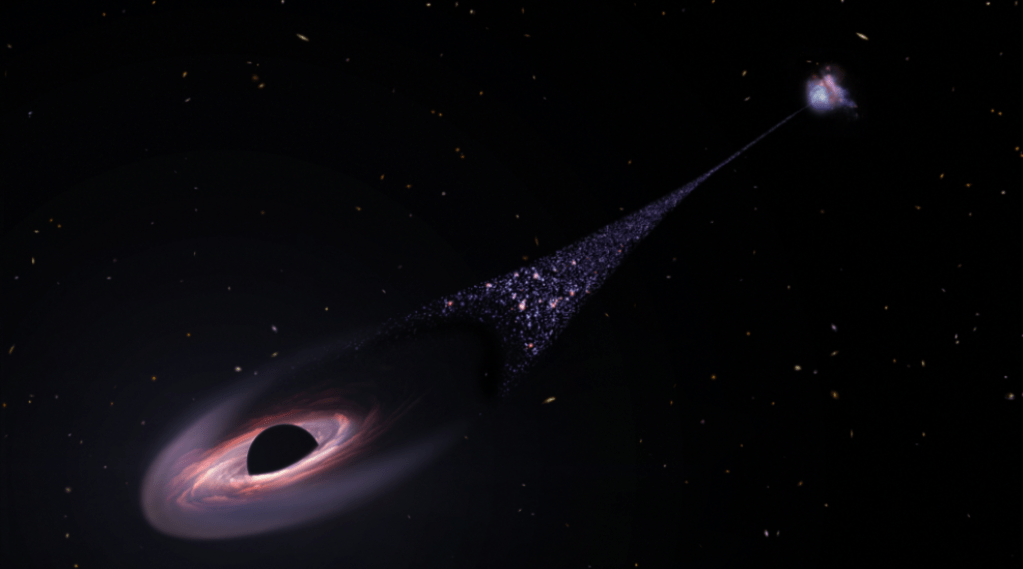
Image (Credit): Artist’s rendering of a black hole with a trail of stars behind it. (NASA, ESA, Leah Hustak, STScI)
This week’s image is an illustration showing what scientists believe the NASA/ESA Hubble Space Telescope has detected, though it initially showed as only a smudge. The dramatic illustration tells a fascinating story, as described by NASA’s Hubblesite
There’s an invisible monster on the loose, barreling through intergalactic space so fast that if it were in our solar system, it could travel from Earth to the Moon in 14 minutes. This supermassive black hole, weighing as much as 20 million Suns, has left behind a never-before-seen 200,000-light-year-long “contrail” of newborn stars, twice the diameter of our Milky Way galaxy. It’s likely the result of a rare, bizarre game of galactic billiards among three massive black holes.
When Dr. Makenzie Lystrup was sworn in as the new director of NASA’s Goddard Space Flight Center last week, she didn’t take her oath of office on the Bible or the U.S. Constitution, but rather on a tome revered by space enthusiasts everywhere: Carl Sagan’s Pale Blue Dot.The book, published in 1994, is named after an iconic image of Earth, snapped by the Voyager I probe, that depicts the planet as a small speck smothered by the emptiness of space. That photo inspired astronomer Carl Sagan to write: “Look again at that dot. That’s here. That’s home. That’s us.” For many, the book serves as a reminder of humanity’s place in the universe and the need to preserve our home planet, which makes it similar to holy scripture for a newly appointed NASA director.
China plans to start building a lunar base in about five years, kicking off with bricks made of moon soil, according to scientists with ties to the project, the South China Morning Post reported. Ding Lieyun, a top scientist at Huazhong University of Science and Technology, told local media that the first brick would be made from moon soil during the Chang’e 8 mission around 2028.
With its blazing city lights, New York is one of the worst places to go stargazing. But space aficionados will want to visit lower Manhattan this spring—dark skies or not—thanks to a new digital art exhibit created with participation from NASA and CNES (the French space agency) that opened April 7 at Hall des Lumières, the city’s first permanent immersive art center. An earlier iteration of this show premiered at Hall des Lumières’ sister museum in Paris, Atelier des Lumières, in 2021. Destination Cosmos: The Immersive Space Experiencewill run for eight weeks through June 4, 2023, at Hall des Lumières, which opened in 2022 in the former Emigrant Savings Bank across from City Hall.
The Washington Post recently published a story, “China’s military aims to launch 13,000 satellites to rival Elon Musk’s Starlink,” that can only terrify astronomers here on Earth trying to view the stars. The title says it all – the space race continues to clutter the skies with more and more low-Earth satellites broadcasting back to the surface. It is a dippy Dyson Sphere that contains scientists rather than energy.
Starlink’s success in Ukraine really bothers the Chinese, who see the network as a lifeline for Taiwan as well. The article quotes Chinese military researchers, who state:
Once the Starshield is completed, it will be tantamount to installing networked surveillance cameras all over the world. At that time, military operations including the launch of ballistic missiles, hypersonic missiles and fighter jets will hardly escape the monitoring of the United States.
I would prefer the space race between the US and China focused on the Moon or Mars rather than local invasions, but that is the state of the world at the moment. Not that the race to the Moon was a completely tame affair. For instance, the US contemplated exploding a nuclear bomb on the surface of the Moon to impress the Russians and everyone else. Fortunately, Project A119 never happened.




 Our Awesome Universe