One Less Player in the Space Race

Space company Virgin Orbit, owned by Richard Branson, has filed for bankruptcy after failing to raise sufficient funds to stay afloat. All of this follows a failed rocket launch back in January that set the company back.

Dan Hart, CEO of Virgin Orbit, stated in a company press release:

The team at Virgin Orbit has developed and brought into operation a new and innovative method of launching satellites into orbit, introducing new technology and managing great challenges and great risks along the way as we proved the system and performed several successful space flights – including successfully launching 33 satellites into their precise orbit. While we have taken great efforts to address our financial position and secure additional financing, we ultimately must do what is best for the business. We believe that the cutting-edge launch technology that this team has created will have wide appeal to buyers as we continue in the process to sell the Company. At this stage, we believe that the Chapter 11 process represents the best path forward to identify and finalize an efficient and value-maximizing sale.

It’s the sad end of a company that hoped to launch a “space revolution.” That task will now need to be taken up by others.

Space Stories: Volcanoes on Venus, Exoplanet Radio Signals, and Bright Baby Jupiter

Image (Credit): Map of volcanoes located on Venus. (Washington University in St. Louis)

Here are some recent stories of interest.

Washington University in St. Louis: “Scientists Share ‘Comprehensive’ Map of Volcanoes on Venus — all 85,000 of Them

Byrne and Hahn’s new study includes detailed analyses of where volcanoes are, where and how they’re clustered, and how their spatial distributions compare with geophysical properties of the planet such as crustal thickness. Taken together, this work provides the most comprehensive understanding of Venus’ volcanic properties — and perhaps of any world’s volcanism so far. That’s because, although we know a great deal about the volcanoes on Earth that are on land, there are still likely a great many yet to be discovered under the oceans. Lacking oceans of its own, Venus’ entire surface can be viewed with Magellan radar imagery.

CNN: “Repeating Radio Signal Leads Astronomers to an Earth-Size Exoplanet

Astronomers have detected a repeating radio signal from an exoplanet and the star that it orbits, both located 12 light-years away from Earth. The signal suggests that the Earth-size planet may have a magnetic field and perhaps even an atmosphere…Scientists noticed strong radio waves coming from the star YZ Ceti and the rocky exoplanet that orbits it, called YZ Ceti b, during observations using the Karl G. Jansky Very Large Array of telescopes in New Mexico. The researchers believe the radio signal was created by interactions between the planet’s magnetic field and the star.

ScienceNews: “Baby Jupiter Glowed so Brightly it Might have Desiccated its Moon

A young, ultrabright Jupiter may have desiccated its now hellish moon Io. The planet’s bygone brilliance could have also vaporized water on Europa and Ganymede, planetary scientist Carver Bierson reported March 17 at the Lunar and Planetary Science Conference. If true, the findings could help researchers narrow the search for icy exomoons by eliminating unlikely orbits. Jupiter is among the brightest specks in our night sky. But past studies have indicated that during its infancy, Jupiter was far more luminous. “About 10 thousand times more luminous,” said Bierson, of Arizona State University in Tempe.

Artemis Mission Astronauts Announced

Image (Credit): Newly-announced Artemis astronauts Commander Reid Wisemam, Pilot Victor Glover, Mission Specialist Jeremy Hansen, and Mission Specialist Christina Hammock Koch. (NASA)

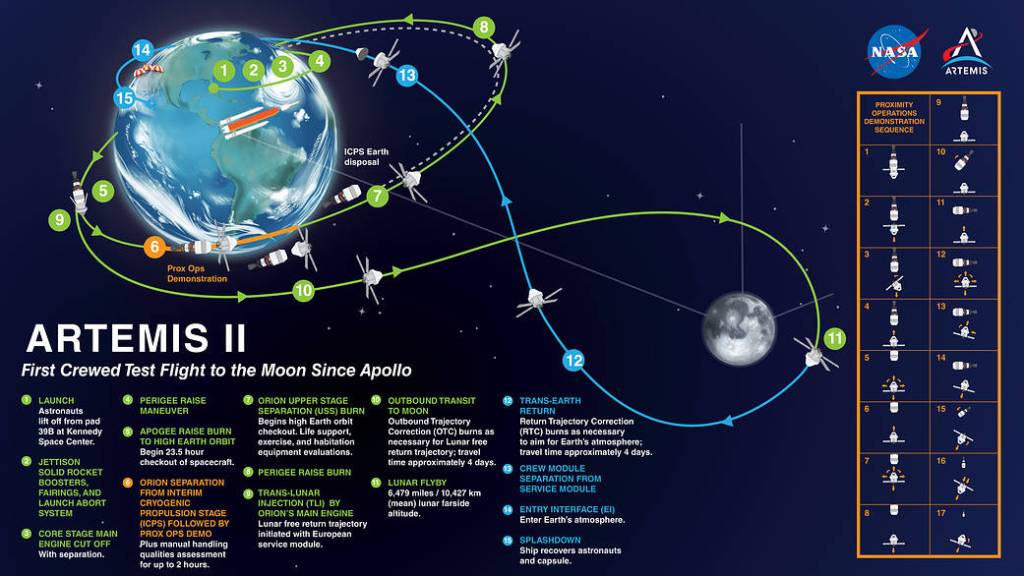
Another step was taken today to get us closer to a Moon landing. Earlier today NASA announced the names of the four astronauts on the next Artemis II mission:

The Artemis II mission will require the four astronauts to take an Orion capsule around the Moon to test a variety of systems and ensure the safety of a later Moon landing as part of Artemis III. You can see a graphic of the Artemis II mission below.

At today’s ceremony announcing the crew, NASA Administrator Bill Nelson stated:

The Artemis II crew represents thousands of people working tirelessly to bring us to the stars. This is their crew, this is our crew, this is humanity’s crew…NASA astronauts Reid Wiseman, Victor Glover, and Christina Hammock Koch, and CSA astronaut Jeremy Hansen, each has their own story, but, together, they represent our creed: E pluribus unum – out of many, one. Together, we are ushering in a new era of exploration for a new generation of star sailors and dreamers – the Artemis Generation.

You can also watch NASA’s full announcement of the new crew here.

Credit: NASA

NASA OIG: Artemis Partnerships with International Space Agencies

I was looking through audit reports from the Government Accountability Office and NASA’s Office of Inspector General (OIG) to see what was being said about NASA’s programs. The only report of interest so far pertained to the Artemis mission and the need for greater coordination among the various partners. Audit reports often make these same recommendations over and over again, yet it does make sense that NASA’s largest outreach program since the International Space Station (ISS) should have all the pieces in place, yet it does not.

Here is the first finding in the OIG report:

Interest in the Artemis campaign is high across the international space community, as evidenced by NASA’s 54 Artemis-related international instruments and the 23 signatories to the Artemis Accords. However, the Agency lacks an overarching strategy to coordinate Artemis contributions from international space agencies and entities. Except for the Gateway Program, the Artemis campaign does not have comprehensive forums—boards, panels, and working groups— for its international partners to routinely discuss topics such as flight and mission planning, safety, and research integration. In contrast, the ISS Program–seen as a model of long-term international space cooperation–employs these forums as well as on-site representation from partner agencies.

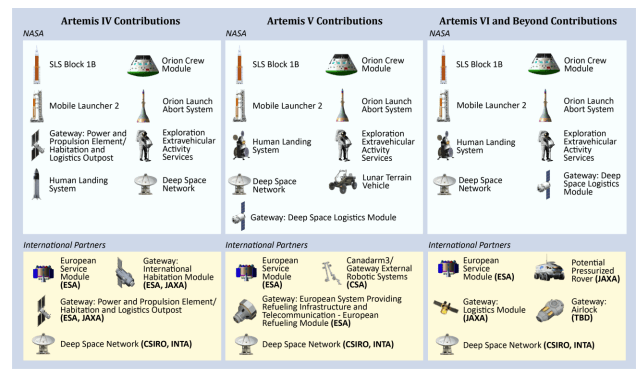
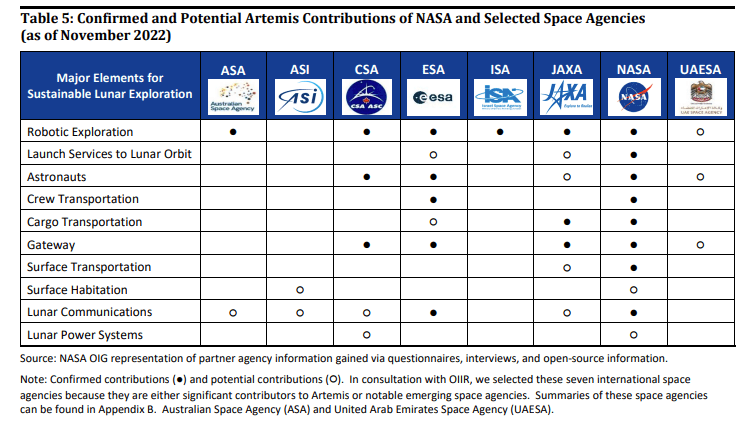
The OIG report makes a number of recommendations related to this issue and other identified by auditors. The report also includes some helpful graphics and tables that illustrate all of the pieces going into the three Artemis missions as well as the parties contributing those pieces. This looks significantly more complex than the ISS, so I would think good coordination would be even more critical.

Image (Credit): Contributions to the Artemis Program by NASA and partners. (NASA OIG)
Image (Credit): A table from the NASA OIG report IG-23-004. (NASA OIG)

NASA’s Workers are Happy, and Why Not?

What could be better than studying the planets and stars? Not much, apparently, for the workers at NASA. For the eleventh year in a row, NASA has been rated as the “Best Place to Work in the Federal Government” by its own employees. The rating here applies to large agencies, with NASA being followed next by the Department of Health and Human Services and the intelligence community (see the full list here). Other agencies of small and medium sizes have separate ratings.

Federal employees rated their agencies and departments back in June and July 2022. Most of this information was captured via the Office of Personnel Management’s Federal Employee Viewpoint Survey.

Any federal agency that can send satellites and rovers to distant planets, launch telescopes that see back in time, and prepare for a return to the Moon needs to have dedicated employees to make it all possible. Of course, I hope that all of the federal employees can enjoy their work and find meaning, but NASA adds so much fun and adventure was well to the mix.

Good work, NASA!