Space Stories: End of a Lunar Mission, Ancient Rivers on Mars, and the Second TROPICS Launch

Image (Credit): Launch of the Lunar Flashlight mission last December. (SpaceX)

Here are some recent stories of interest.

Engadget: “NASA Ends its Lunar Flashlight Mission

NASA has pulled the plug on its Lunar Flashlight project, which was designed to look for sources of ice on our nearest neighbor. The agency spent the last few months trying, and failing, to get the craft to generate the necessary amount of thrust to get the small satellite to its intended destination. Officials say that the issue was likely caused by debris buildup in the fuel lines, which prevented the CubeSat from working to its full potential. 

Insider:Photos from NASA’s Mars Rover Show the Red Planet’s Ancient Rivers were Much Wilder than Scientists First Thought

NASA’s Mars Perseverance rover has taken new images that reveal that some of the red planet’s ancient rivers were much wilder than scientists previously thought. “It’s the first time we’re seeing environments like this on Mars,” Katie Stack Morgan, Perseverance’s deputy project scientist, said in a NASA release. Scientists studying rock formations, features, and valleys on Mars, so far, have found evidence to suggest Mars was once covered by water. 

Businesswire:Rocket Lab Sets Date for Second NASA TROPICS Launch to Deploy Storm Monitoring Constellation

Rocket Lab USA, Inc., a leading launch and space systems company, is preparing for the second of two dedicated Electron launches to deploy a constellation of storm monitoring satellites for NASA. The launch, called ‘Coming To A Storm Near You,’ is scheduled for lift-off no earlier than 17:30 on May 22nd NZST from Rocket Lab Launch Complex 1 on New Zealand’s Mahia Peninsula. The launch follows on from the successful ‘Rocket Like a Hurricane’ Electron launch on May 8th 2023, which deployed the first two CubeSats of NASA’s TROPICS constellation. The ‘Coming To A Storm Near You’ launch will deploy the final two TROPICS CubeSats, completing the constellation.

Space Quote: New Horizons Can Do Much More

Image (Credit): Pluto in colorized infrared. (NASA/Johns Hopkins University Applied Physics Laboratory/Southwest Research Institute/ZLDoyle)

“New Horizons can still do great science for the rest of its time in the Kuiper belt. But stopping it next year is both premature scientifically and unwise from the standpoint of fiscal policy. I am very concerned about this, and it is fair to say that I am in good company.”

-Statement by Alan Stern, New Horizons’s principal investigator, as printed in The Guardian regarding NASA’s decision to reduce funding for the New Horizons spacecraft next year even though another four to five years exploration of the Kuiper Belt had been planned. While the spacecraft will still perform some basic functions related to monitoring “space weather,” it will not have a new destination for the time being.

Saturn is Winning the Moon Contest

Image (Credit): Saturn’s Death Star-like moon Tethys. (NASA)

So Saturn now has 145 moons due to the discovery of 62 new moons, which is 50 more than the next closest competitor, Jupiter, with 95 moons. You can thank the University of British Columbia (UBC) for the new moon count.

The new discoveries come from a process used by UBC astronomers called ‘shift and stack’:

Shifting a set of sequential images at the rate that the moon is moving across the sky results in enhancement of the moon’s signal when all the data is combined, allowing moons that were too faint to be seen in individual images to become visible in the stacked image. The team used data taken using the Canada-France-Hawaii Telescope (CFHT) on top of Mauna Kea, Hawaii between 2019 and 2021. By shifting and stacking many sequential images taken during three hour spans, they were able to detect moons orbiting Saturn down to about 2.5 kilometres in diameter.

So, as you can read, some of these moons are pretty small. As of today, NASA was still showing 124 moons around Saturn, and another site, theplanets.org, is showing only 62 moons total around the planet. It appear the space agency and others will need to update their pages to show the new mini-moons.

For some reason I doubt the counting is over, just like identified dwarf planets, that seem to range from 5 to 19 at the moment, depending on the source.

Movie: The Story of Carl Sagan

Image (Credit): Dr. Carl Sagan. (NASA)

Have you heard about the upcoming movie about Carl Sagan called Voyagers? Andrew Garfield of Spiderman fame will be playing Dr. Sagan. Daisy Edgar-Jones will play the part of Ann Druyan. The new film will be one of many shown at this year’s Cannes Film Festival, starting next week.

Here is the basic outline of the film by The Hollywood Reporter:

The film is set in 1977 as NASA is preparing to launch humanity’s first interstellar probes, the Voyager 1 and Voyager 2 missions. A team, led by Sagan, sets out to create a message to accompany them: the Golden Record, a group of images and sounds meant to express the essence of humanity and act as a first-contact greeting for any galactic lifeforms the probes might reach. But what starts out as a race-against-the-clock mission becomes an epic, unexpected love story between Sagan and his collaborator Druyan.

I have seen Andrew Garfield in a number of films and TV shows, and he never disappoints. Seeing his take on Dr. Sagan’s story should be fascinating and fun.

With all the recent films and series on twisted business icons, I will be happy to take a break and watch a film that covers one of science’s great icons. Maybe it can encourage a new generation of scientists and supporters of science.

Podcast: Two Worlds Collide in This Episode

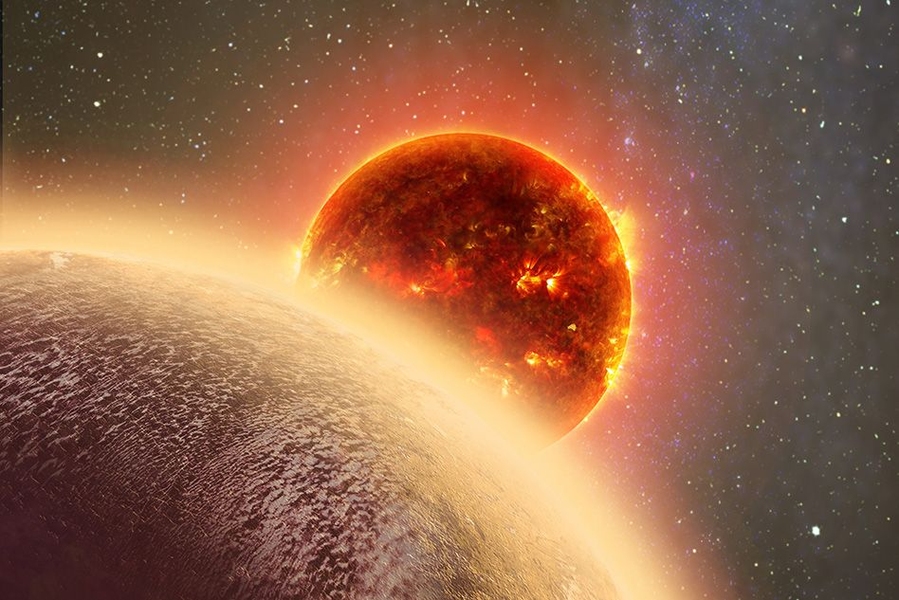
Image (Credit): Artist’s rending of exoplanet GJ 1132b. (MIT News)

If you are looking for a fun podcast this week, you cannot go wrong with Neil DeGrasse Tyson’s Startalk podcast when it hosts Cool Worlds‘ creator David Kipping. The episode, Cosmic Queries – Cool Worlds with David Kipping, covers questions related to exoplanets, exomoons, and more. It is fun to hear the two scientists play off each other.

You will also learn from this podcast that Cool Worlds should be releasing its own podcast in the near future. Its Youtube videos are already a great source of information, so I expect more of the same in these podcasts.

At the end of the podcast, Professor Kipping also mentioned a few upcoming space missions related to exoplanets, including the European PLAnetary Transits and Oscillations of stars (Plato) mission in 2026. You can learn more about the mission from this European Space Agency factsheet, which notes:

Does a second Earth exist in the Universe? Planet hunter Plato will focus on the properties of rocky planets orbiting Sun-like stars. In particular, Plato will discover and characterise planets in orbits up to the habitable zone – the ‘goldilocks’ region around a star where the temperature is just right for liquid water to exist on a planet’s surface.

Plato will characterise hundreds of rocky (including Earth twins), icy or giant planets by providing exquisite measurements of their radii (3% precision), masses (better than 10% precision) and ages (10% precision). This will revolutionise our understanding of planet formation and the evolution of planetary systems, as well as the potential habitability of these diverse worlds.

As well as looking at these planets, Plato will analyse their host stars. Using data from the mission, scientists hope to perform stellar seismology, gathering evidence of ‘starquakes’ in the imaged stars. This will give insight into the characteristics and evolution of the stars, improving our understanding of entire planetary systems.

It’s a fun, fact-filled show worth your time.