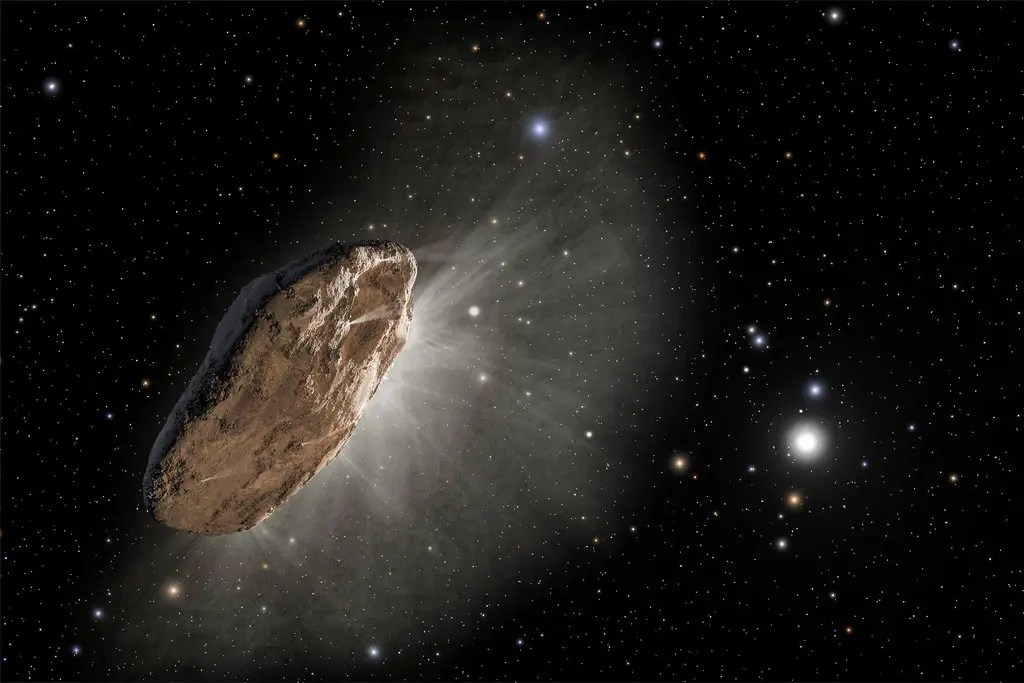
Image (Credit): Artist’s rendering of Oumuamua, an asteroid from outside out solar system. (JPL/NASA)
On International Asteroid Day, I thought it was worth revisiting an earlier video from Cool Worlds Lab on the first detected asteroid from outside our solar system. The video, “‘Oumuamua: An Interstellar Visitor,” notes that scientists have never seen an asteroid within our solar system with these cigar-shaped dimension.
Scientists now believe that more that 10,000 of such alien comments are now present in our solar system. That may offer us an opportunity for a future mission to study such an asteroid and learn about another solar system (given that the asteroids tend to stick around for about 10 years). It may also give us a better idea as whether such asteroids could have introduced life into our solar system.
This is quite a bit to ponder on this day dedicated to pondering asteroids.
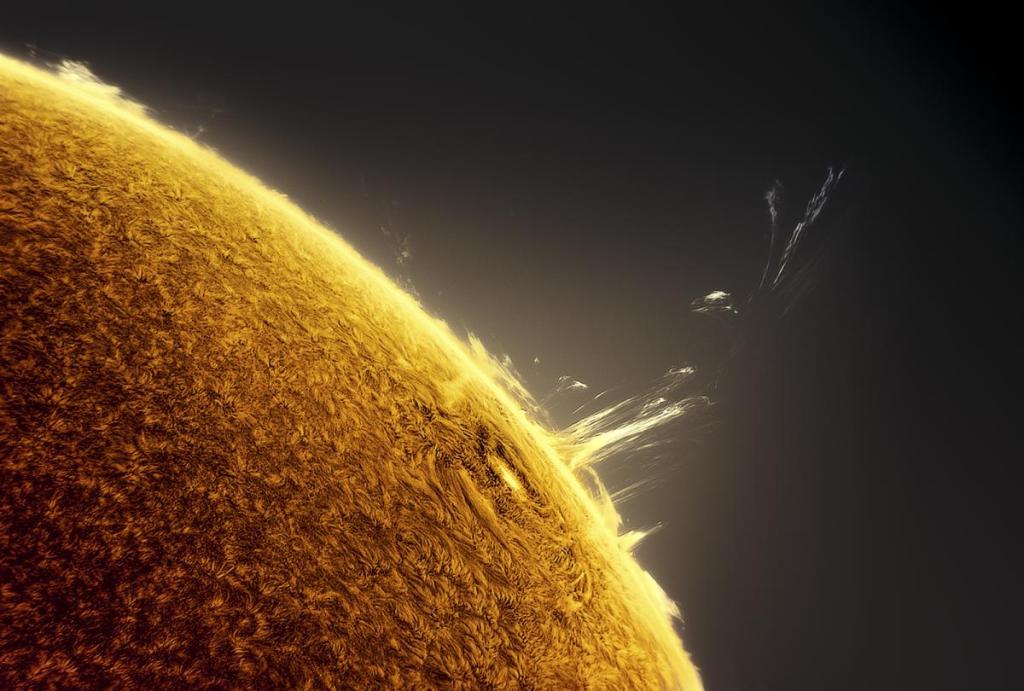
Image (Credit): Solar Flare X1 from AR2994 in ‘Motion.’ (Miguel Claro)
This week’s image is one of the finalist photos in the 2023 Astronomy Photographer of the Year shortlist held by the Royal Museums Greenwich. Check out the site for other fascinating finalist images.
Here is a little more about this solar flare image from photographer Miguel Claro taken in the Dark Sky Alqueva region, Évora district, Portugal:
“I was testing my new camera from Player One Apollo-M Max and photographing another region of the Sun, when I was notified by the SpaceWeatherLive app that an eruption was ongoing at 13.47 (UTC, Universal Time) with the release of an extraordinary X1-class solar flare [X class flares are the largest],” Miguel says.
“I had to immediately change my initial plans and pointed the telescope as quickly as possible to the limb where the flare departed from sunspot AR2994, already hidden behind the edge of the Sun. According to SpaceWeatherLive, ‘the explosion produced enough radiation for a strong shortwave radio blackout over the mid-Atlantic ocean and Europe’. Conditions were unstable, but I managed to make a short timelapse of about 27 minutes.”
Credit: Reto Stöckli, Nazmi El Saleous, and Marit Jentoft-Nilsen, NASA GSFC
Geophysical Research Letters (plain language) abstract:
Melting of polar ice sheets and mountain glaciers has been understood as a main cause of sea level rise associated with contemporary climate warming. It has been proposed that an important anthropogenic contribution is sea level rise due to groundwater depletion resulting from irrigation. A climate model estimate for the period 1993–2010 gives total groundwater depletion of 2,150 GTon, equivalent to global sea level rise of 6.24 mm. However, direct observational evidence supporting this estimate has been lacking. In this study, we show that the model estimate of water redistribution from aquifers to the oceans would result in a drift of Earth’s rotational pole, about 78.48 cm toward 64.16°E. In combination with other well-understood sources of water redistribution, such as melting of polar ice sheets and mountain glaciers, good agreement with PM observations serves as an independent confirmation of the groundwater depletion model estimate.
Citation: Ki-Weon Seo, Dongryeol Ryu, Jooyoung Eom, Taewhan Jeon, Jae-Seung Kim, Kookhyoun Youm, Jianli Chen, Clark R. Wilson. Drift of Earth’s Pole Confirms Groundwater Depletion as a Significant Contributor to Global Sea Level Rise 1993–2010. Geophysical Research Letters (2023). https://doi.org/10.1126/science.abo6192
Note: We have been unintentionally terra-forming the Earth while looking at Mars and elsewhere to find candidates for intentional terra-forming. I believe we are learning that it is much easier to break a working system than create a new system from scratch.
The ESA (European Space Agency) and SpaceX are targeting no earlier than 11:11 a.m. EDT (8:11 a.m. PDT) Saturday, July 1, to launch the Euclid spacecraft. Euclid is an ESA mission with contributions from NASA that will shed light on the nature of dark matter and dark energy, two of the biggest modern mysteries about the universe.
An intrepid space mission had another brief glimpse of its final destination this week, as the European Space Agency’s BepiColombo flew past Mercury for a third time. The team confirms that the spacecraft is in good health post flyby, and that all instruments performed as planned. “Everything went very smoothly with the flyby and the images from the monitoring cameras taken during the close-approach phase of the flyby have been transmitted to the ground,” said Ignacio Clerigo (ESA) in a recent press release. “While the next Mercury flyby isn’t until September 2024, there are still challenges to tackle in the intervening time.”
An international team of astronomers has discovered a planet-like object that is hotter than the sun. Their report has been accepted for publication in the journal Nature Astronomy and is currently available on the arXiv pre-print server. Brown dwarfs are sometimes called failed stars and do not qualify for the category of either a planet or a star. In this new effort, the researchers have identified one that orbits a star so closely that its temperature is hotter than our sun.
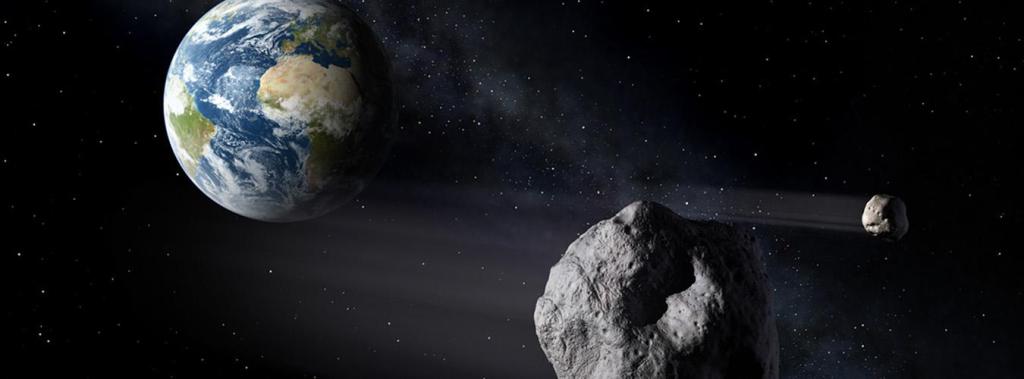
This Friday, June 30th, is International Asteroid Day as adopted by the United Nations to “…observe each year at the international level the anniversary of the Tunguska impact over Siberia, Russian Federation, on 30 June 1908, and to raise public awareness about the asteroid impact hazard.”
NASA has set up page to celebrate the day, as has the European Space Agency. And the Asteroid Foundation is sponsoring a few days of activities leading up to the July 1 Asteroid Day Festival in Luxembourg.
Or you can simply watch your favorite asteroid disaster film on Friday evening.
However you mark the day, enjoy yourself, and look up!




 Our Awesome Universe