Space Stories: Mapping with Pulsars, Rocky Exoplanets, and Words from the Pope

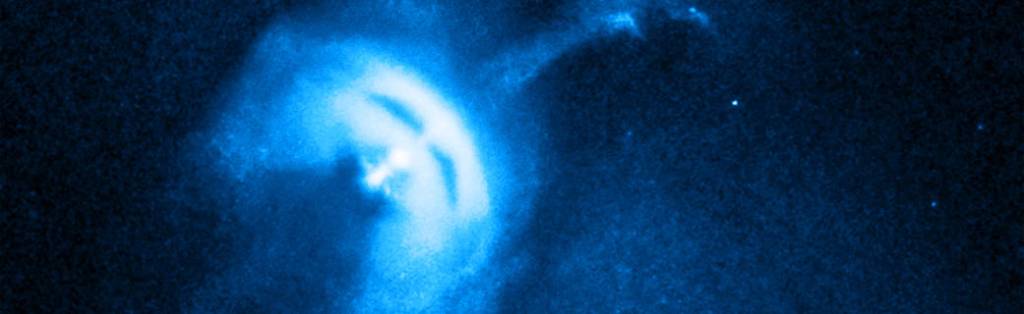
Image (Credit): The Vela pulsar, a neutron star that was formed when a massive star collapsed. (X-ray: NASA/CXC/Univ of Toronto/M.Durant et al; Optical: DSS/Davide De Martin)

Here are some recent stories of interest.

Universe Today: “Pulsars Could Help Map the Black Hole at the Center of the Milky Way

Last year, the Event Horizon Telescope (EHT)—an international consortium of astronomers and observatories—announced they had taken the first images of Sag A*, which came just two years after the release of the first-ever images of an SMBH (M87). In 2014, the European members of the EHT launched another initiative known as BlackHoleCam to gain a better understanding of SMBHs using a combination of radio imaging, pulsar observations, astrometry, and GR. In a recent paper, the BHC initiative described how they tested GR by observing pulsars orbiting Sgr A*.

Max Planck Institute for Astronomy: “Searching for an Atmosphere on the Rocky Exoplanet TRAPPIST-1 c

Using the James Webb Space Telescope, an MPIA-led group of astronomers searched for an atmosphere on rocky exoplanet TRAPPIST-1 c. Although the planet is nearly identical in size and temperature to Venus, its atmosphere has turned out to be very different. By analysing the heat emitted from the planet, they conclude it may only have a tenuous atmosphere with minimal carbon dioxide. However, this measurement is also consistent with a barren rocky planet without any significant atmosphere. This work contributes to our understanding of how the atmospheres of rocky planets orbiting low-mass stars can withstand their strong stellar winds and intense UV radiation.

Catholic News Service: “Pope Francis to Young Astronomers: Keep Love and Wonder Alive

Pope Francis sent a letter to young astronomy scholars Tuesday encouraging them to maintain their “sense of wonder” and surprise throughout their research. While praising the “great discoveries” of astronomy, he urged the researchers never to lose sight of other important realities such as love and friendship.

A Day in Astronomy: Sally Ride and Valentina Tereshkova

Credit: The San Diego Union

On this day in 1983, astronaut Sally Ride became the first American woman in space, traveling aboard the shuttle Challenger. And 20 years earlier on the same date, Russian cosmonaut Valentina Tereshkova, the first Russian female in space, returned to Earth aboard Vostok 6, after orbiting the planet 48 times. She still remains the only woman to travel into space on a solo mission.

Image (Credit): Cosmonaut Valentina Tereshkova (New Mexico Museum of Space History)

Podcast: Should We Be Talking to the Stars (or Exoplanets, to be More Precise)?

I recommend you tune into another episode from The Planetary Society’s podcast Planetary Radio. In the episode, Space Policy Edition: The Policy Implications of Active SETI, we hear a discussion about the advantages and disadvantages of an active SETI program, and whether we can even cease outreach to the neighboring systems given what has already been transmitted and the nature of our world today.

The guest on the episode is Jacob Haqq Misra, Senior Research Investigator at the Blue Marble Space Institute of Science. He is the author of a new book, Sovereign Mars: Transforming Our Values Through Space Settlement, though his main points related to our SETI program.

For instance, whether or not people support an active or passive SETI program often depends on whether we believe in benevolent or destructive aliens. Of course, the matter is unknowable until it happens, yet fraught with fears based on what we know about ourselves and our own exploration.

The discussion also discussed the presentation of SETI in films, such as Contact, as well as the definition of intelligence itself, be it whales (remember Star Trek IV: The Voyage Home?) or even ChatGPT. And we are already past the point of turning off our “active outreach” given that interested aliens are probably looking for both bio-signatures and techno-signatures, which we are creating without any thought. Astronomers are currently searching for such signatures among the exoplanets, so it would make sense the same type of search is being focused on our solar system.

Plenty of food for thought. Enjoy the show.

Credit: University Press of Kansas

Virgin: Tourism Wins Over Commercial Cargo

Credit: Virgin Galactic

While Virgin Orbit failed back in April, Virgin Galactic is going strong and planning to start its tourism business in August. But first it has a scientific mission later this month.

Here is the word from Virgin Galactic:

While carrying satellites into space is no longer on the menu, bringing scientists to space for work is still part of the plan. But with many individuals willing to pay $450,000 apiece to experience the weightlessness of space, it appears tourism is the winner here.

I am not sure what that says about commercial space stations. Would they be better as floating hotels or casinos? Maybe so, as we learned in an Architectural Digest story late last year titled “A Space Hotel Could Open as Soon as 2025” (see image below).

Image (Credit): Artist’s rendering of the Voyager Station. (Orbital Assembly Corporation)

Are We Too Focused on the Goldilocks Zone?

Image (Credit): Saturn’s moon Enceladus. (NASA)

Astronomers peering into the night sky always talk about exoplanets located in the “Goldilocks Zone,” or “Habitable Zone,” similar to the Earth’s location from the sun. But what if that is too limited? What if we should also be focusing on colder regions as well as exomoons?

The new study released this week based on data from NASA’s spacecraft Cassini has found that Saturn’s moon Enceladus contains the ingredients for life as we know it. The study states:

Saturn’s moon Enceladus harbours a global ice-covered water ocean. The Cassini spacecraft investigated the composition of the ocean by analysis of material ejected into space by the moon’s cryovolcanic plume. The analysis of salt-rich ice grains by Cassini’s Cosmic Dust Analyzer enabled inference of major solutes in the ocean water (Na+, K+, Cl, HCO3, CO32–) and its alkaline pH. Phosphorus, the least abundant of the bio-essential elements, has not yet been detected in an ocean beyond Earth. Earlier geochemical modelling studies suggest that phosphate might be scarce in the ocean of Enceladus and other icy ocean worlds. However, more recent modelling of mineral solubilities in Enceladus’s ocean indicates that phosphate could be relatively abundant.

Again, this represents the building blocks of life and it is the first time all these ingredients have been discovered in our solar system outside of Earth. We did not find it on Venus or Mars, two other planets in the Goldilocks Zone. No, it was found in a much colder part of the solar system on a tiny moon.

This discovery certainly mixes up the situation and provides a much broader region for life to appear in other solar systems. It’s not a new idea, but it has more credibility now that we know a little more about our own neighborhood.

Maybe Goldilock’s concerns about something being too cold was not such a problem after all.

Note: It seems James Cameron figured this out years ago. The planet visited in the Avatar movies, Pandora, is portrayed as a moon (or exomoon) in the Alpha Centauri System.

Image (Credit): Pandora and its host  gas giant Polyphemus from the movie Avatar. (20th Century Fox)