DRACO: A New Approach for Traveling to Mars

Image (Credit): Artist’s rendering of the DRACO spacecraft. (DARPA)

When you hear the word DRACO, you may think of the Harry Potter series or even severe Athenians, but NASA wants you to think of speedy travel to Mars. DRACO, or Demonstration for Rocket to Agile Cislunar Operations, is NASA’s plan to develop a nuclear thermal rocket engine with the Defense Advanced Research Projects Agency (DARPA). Defense contractor Lockheed Martin was recently tapped to lead this effort.

Such an engine would shorten the journey to Mars, thereby exposing astronauts to less risk from solar energetic particles and galactic cosmic rays as well as lessening the amount of supplies needed for the trip. The rocket engine could also be used initially for shorter trips to the Moon.

Dr. Stefanie Tompkins, director, DARPA, stated earlier:

The space domain is critical to modern commerce, scientific discovery, and national security. The ability to accomplish leap-ahead advances in space technology through the DRACO nuclear thermal rocket program will be essential for more efficiently and quickly transporting material to the Moon and eventually, people to Mars.

You can read more about this new rocket approach and the parties involved at this NASA link.

Video: Flyby of Jupiter’s Moon Io

Image (Credit): View of Jupiter’s moon Io. (NASA/JPL-Caltech/SwRI/MSSS)

Last week, NASA released this video showing the Juno spacecraft’s view of Jupiter and its moon Io as it flew by on May 16, 2023. The clip includes music by Vangelis. It is short but stunning video.

Juno was launched back in 2011 and first started orbiting Jupiter in 2016. Sent to study Jupiter, the current flyby is part of the spacecraft’s extended mission.

Juno’s closest approach to Io will occur today, so you can expect more images shortly.

If you want to read more about Io and the mission, visit this NASA site.

What Do Frozen Worms Say About Space Travel?

Image (Credit): Hibernation pods for space travel as shown in the movie Aliens. (20th Century Fox)

Earlier this week we learned about worms taken from Siberian permafrost that have been revived after being frozen for 46,000 years. In the Scientific American, the co-author of the study with these finding, cell biologist Teymuras Kurzchalia, stated, “The radiocarbon dating is absolutely precise, and we now know that they really survived 46,000 years.”

So what does this mean for life that is somewhat more complex than a worm? Given that the findings are still being challenged, maybe nothing. Yet, if true, it may say something about life on this planet, life on other planets, and human life spans should we want to travel to distant locations. While such hibernation is a staple of science fiction, it seems to be a bit closer to reality with this study out there.

The European Space Agency (ESA) and others are already looking into human hibernation for space travel. In one ESA press article from 2019 regarding hibernation for travel to Mars, we read how one study concluded the following:

Not only does hibernation have positive psychological effects, it also allows for a complete mission and system re-design, optimised for human hibernation, which could minimise both mass and cost.

I think the “cost” point may be the key decider on this distant travel matter. Besides, how long can you play “I see a red star” before you go mad?

Space Quote: Alien Crash Retrieval and Reverse Engineering?

Image (Credit): Roswell road sign. (Washington Post)

“In 2019, the UAPTF director tasked me to identify all Special Access Programs & Controlled Access Programs (SAPs/CAPs) we needed to satisfy our congressionally mandated mission.

At the time, due to my extensive executive-level intelligence support duties, I was cleared to literally all relevant compartments and in a position of extreme trust in both my military and civilian capacities.

I was informed, in the course of my official duties, of a multi-decade UAP crash retrieval and reverse engineering program to which I was denied access to those additional read-on’s.

I made the decision based on the data I collected, to report this information to my superiors and multiple Inspectors General, and in effect become a whistleblower.”

Prepared statement by David Grusch, Former National Reconnaissance Officer Representative on DOD’s Unidentified Anomalous Phenomena (UAP) Task Force, for a hearing before the House Oversight Committee held earlier this week. The hearing was titled “Unidentified Anomalous Phenomena: Implications on National Security, Public Safety, and Government Transparency.” The hearing is part of a series of such hearings calling for greater transparency by the federal government regarding UAP issues.

Pic of the Week: Fire in the Canary Islands

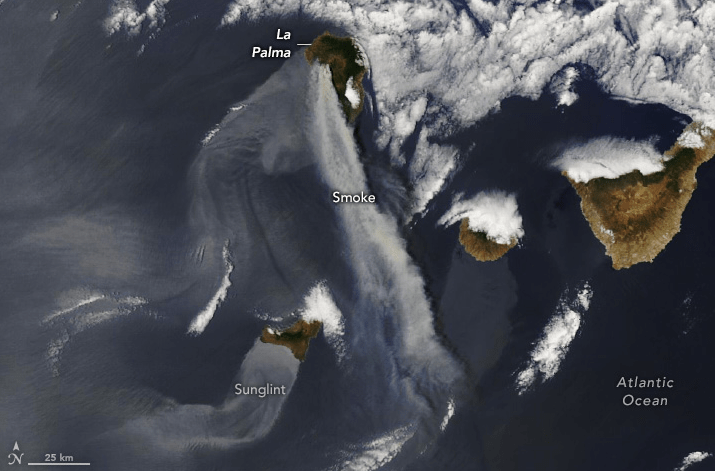
Image (Credit): July 15, 2023 fire in the Canary Islands. (NASA Earth Observatory images by Wanmei Liang, using MODIS data from NASA EOSDIS LANCE and GIBS/Worldview)

This week’s image is from NASA’s Earth Observatory showing the recent fires in the Canary Islands. The image below provides great detail regarding what you are seeing.

Here is the story from NASA:

In the early hours of July 15, 2023, a wildfire broke out on La Palma, the most northwesterly of the Canary Islands….The bright areas near islands south of La Palma resemble smoke, but they are actually the result of an optical phenomenon caused by sunglint.

The fire burned through pine forests west of a large caldera on the northern part of the island. At least 20 buildings were destroyed and 4,000 people evacuated their homes, according to Reuters. On July 16, authorities reported that the fire had charred at least 4,650 hectares (18 square miles)…

Fires on La Palma are common in summer due to the island’s dry climate. One analysis of tree rings suggests that intense fires burn the island’s forests roughly every 7 years on average, with less intense fires burning every 2-4 years.

Image (Credit): Greater details showing the July 15, 2023 fire in the Canary Islands. (NASA Earth Observatory images by Wanmei Liang, using MODIS data from NASA EOSDIS LANCE and GIBS/Worldview)