
Here are some recent stories of interest.
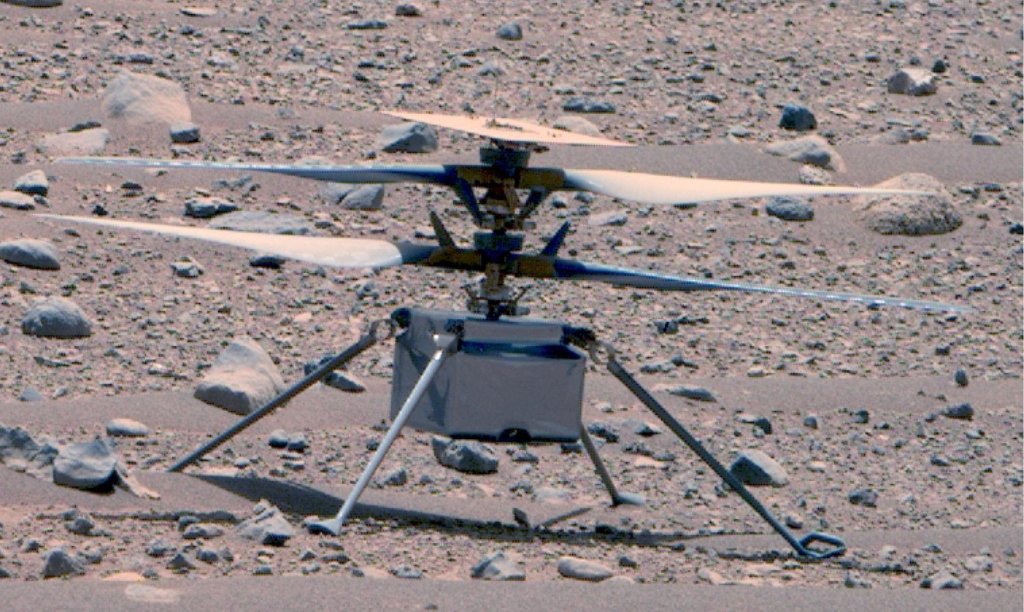
—NASA: “NASA’s Ingenuity Mars Helicopter Phones Home“
The 52nd flight of NASA’s Ingenuity Mars Helicopter is now in the official mission logbook as a success. The flight took place back on April 26, but mission controllers at NASA’s Jet Propulsion Laboratory in Southern California lost contact with the helicopter as it descended toward the surface for landing. The Ingenuity team expected the communications dropout because a hill stood between the helicopter’s landing location and the Perseverance rover’s position, blocking communication between the two.
—Phys.org: “NASA Achieves Water Recovery Milestone on International Space Station“
Astronauts on interplanetary missions will be a bit less thirsty after a new NASA system succeeded at reclaiming 98% of waste water aboard the International Space Station (ISS) by converting things like urine into a drinkable state. Future crewed deep space missions that will last months or even years will be very different from any that have come before. Until now, astronauts have either carried their own supplies along or relied on regular visits from cargo ships. As to waste products, these were simply disposed of in a variety of ways. Unfortunately, deep space missions don’t have that luxury.
—SCI.News: “Astronomers Directly Image Jupiter-Like Exoplanet around Nearby Young Star“
AF Leporis is a bright F8V star located about 87.5 light-years away from Earth in the constellation of Lepus. Also known as AF Lep, HD 35850, HIP 25486 and HR 1817, the star has an age of 24 million years and a mass of 1.2 solar masses. The star hosts a young exoplanet, AF Leporis b (AF Lep b), which is located about 8 times the Earth-Sun distance and is among the first ever discovered using a technique called astrometry. This method measures the subtle movements of a host star over many years to help astronomers determine whether hard-to-see orbiting companions, including planets, are gravitationally tugging at it.
 Our Awesome Universe