Image (Credit): Assistant Professor of Astronomy David Kipping sharing his story of rejection. By the way, the image behind him is the exomoon Pandora from the movie Avatar. (Cool Worlds Lab)
A few months back, Assistant Professor of Astronomy David Kipping shared a short video regarding his organization’s failure to secure James Webb Space Telescope (JWST) time to search for exomoons that he knows are there. His organization, Cool Worlds Lab, has done some amazing work studying and publicizing issues related to astronomy. You should visit his site for some challenging topics.
What is unique about his video is that it was recorded only one hour after he learned that his organization would not be able to use JWST for his exomoon search and he wanted to share what rejection felt like “in real time.” He goes on to say that such rejection is part of science, as brutal as it may feel at the moment, noting that for every seven JWST proposals, only one will be approved.
Fortunately, we have scientists out there with very thick skin sharing new ideas and proposals. And Dr. Kipping will not be giving up on his exomoon push anytime soon. That is good news for all of us.
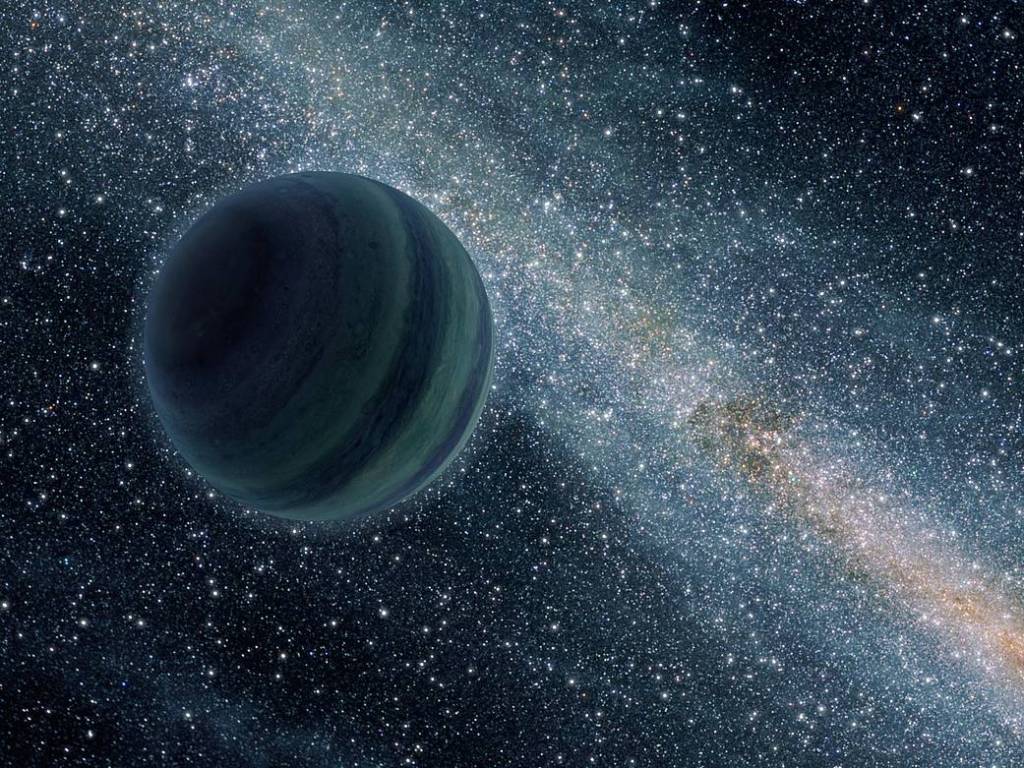
New predictions suggest an upcoming NASA space telescope could spot over 400 Earth-mass worlds hidden throughout the Milky Way that have “gone rogue” and therefore wander our galaxy alone. Such orphan worlds are thought to start their lives in a planetary system, akin to the solar system, but get kicked at some point out by a mechanism thus far unknown. Despite the familiar picture of planets neatly orbiting a star, new research suggests such orphaned starless worlds may outnumber stars in the Milky Way by 20 to 1. This implies untethered worlds in our galaxy are around six times more common than planets orbiting parent stars.
A NASA power outage disrupted communication between Mission Control and the International Space Station on Tuesday. Mission Control couldn’t send commands to the station and talk with the seven astronauts in orbit. The power outage hit as upgrade work was underway in the building at Houston’s Johnson Space Center. Space station program manager Joel Montalbano said neither the astronauts nor station were ever in any danger and that backup control systems took over within 90 minutes. The crew was notified of the problem through Russian communication systems, within 20 minutes of the outage.
Boeing and NASA say they’ll collaborate with Seattle-based Alaska Airlines and four other major airlines on the Sustainable Flight Demonstrator project, which aims to put Boeing’s innovative X-66 braced-wing aircraft design through flight tests in the 2028-2029 time frame. The X-66A makes use of a concept known as the Transonic Truss-Braced Wing, or TTBW, which features ultra-long, ultra-thin, drag-reducing wings that are stabilized by diagonal struts.
The CEO of the South African National Space Agency announced plans to send two female astronauts to the International Space Station (ISS). It is something that the space agency hopes to accomplish in the next two years.
This latest announcement appears to be based on Russian efforts to parlay better relations with African nations. The Russian RT news recently stated:
Roscosmos announced plans last month to expand its space partnerships with African countries. According to its director, an agreement will be signed with a number of the continent’s nations at the Russia-Africa summit this week in St. Petersburg.
In other news, the Chinese Tiangong space station is also getting visitors – zebrafish. The fish are part of experiments to learn more about bone loss in astronauts. The news story goes on to note that the Russians were the first to use zebrafish in space back in 1976.
Image (Credit): Pluto as seen by the New Horizons spacecraft. (NASA/Johns Hopkins University Applied Physics Laboratory/Southwest Research Institute)
You may enjoy last week’s Astronomy magazine video that is part of This Week in Astronomy with Dave Eicher titled “Is Pluto a Planet?“. The issue on the table is whether scientists were a little too quick to dismiss Pluto’s status under new criteria given that we may have not understood whether the Earth even met this criteria. Is Earth a dwarf planet?
Check out the video and the accompanying article, and then visit the NASA page on the earlier New Horizons mission for some interesting background on the little planet, or dwarf planet, depending on your view.
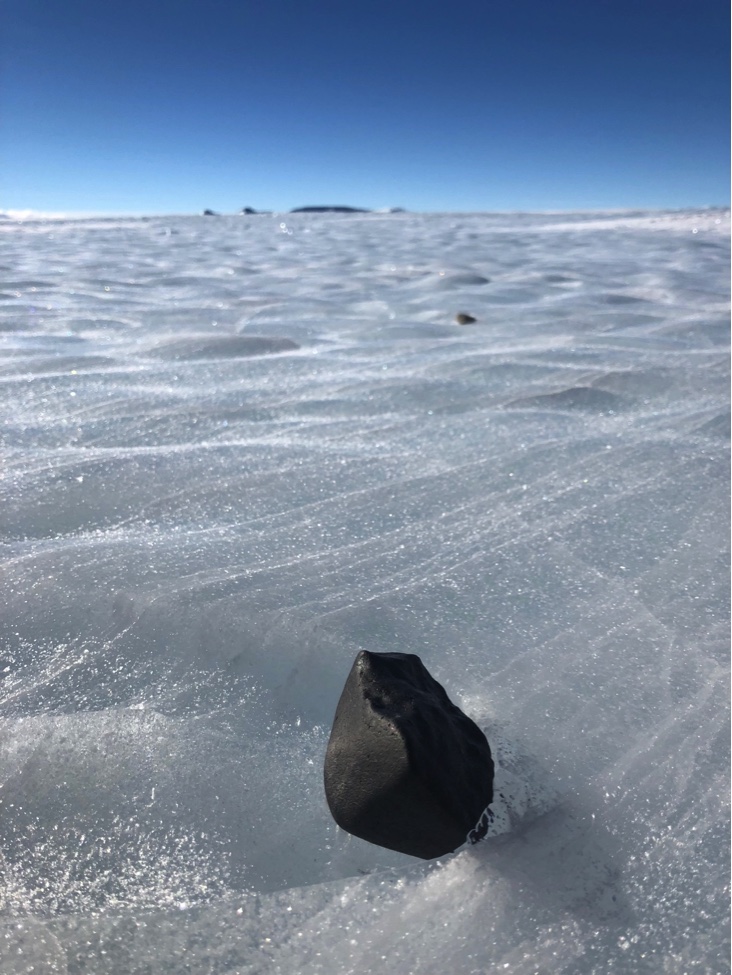
Image (Credit): A meteorite in the Antarctic. (Rutgers University)
“We get a piece for our collection and a new meteorite sample for potential research…In turn, they know what they can sell the specimen for because they know what kind of meteorite it is.”
-Statement by Alan Rubin, a research geochemist and curator of the University of California, Los Angeles meteorite collection, in a Wall Street Journal article titled “A $25,000 Prize Still Sits in the Maine Woods. Meteorite Hunters Aren’t Giving Up.” The article discusses the meteorite-hunting hobby of some individuals and how it has created a symbiotic relationship between hunters and scientists. As another scientist in the article stated, ““We as scientists, with a few exceptions, don’t have the time, effort or money to go hunting meteorites.” You can also find the article here.




 Our Awesome Universe