Travel to Moon and Mars Not Most Important Missions for the Public

While both Buzz Aldrin and I believe that lunar and Martian colonies are important, it would appear the public has other ideas about NASA’s priorities. The graphic above shows in a recent Pew Research Center study indicates the more Americans are interested in monitoring the Earth’s climate as well as watching for asteroids.

Even finding exoplanets that could support life seems to be more important than occupying local moons and planets. I am not sure how that would help us now if we want to spread the risk of living on one planet, as some propose. We are nowhere near sending a probe to exoplanets, let alone getting humans there.

The study has quite a bit to ponder, including:

  • 58% of U.S. adults believe it is essential to include the use of human astronauts in the U.S. space program, while 41% say astronauts are not essential;
  • Some 44% of Americans have a great deal of confidence private companies will make a profit in their space-related ventures;
  • As the public considers the possibilities ahead for ordinary citizens to orbit the Earth in a spacecraft, more Americans say they would not want to orbit the Earth than say they would (58% to 42%); and
  • About seven-in-ten Americans (72%) say it is essential for the U.S. to continue to be a world leader in space exploration, and eight-in-ten (80%) say the space station has been a good investment for the country.

I am not sure the survey shows a lot of consistency in the answers, but this can be a difficult topic at the outset. NASA should just be worried if Americans saw no reason for a space program, which does not seem to be the case. As noted above, the majority of Americans want a strong space program. Let’s see if that helps with the ongoing congressional budget discussions.

Pic of the Week/A Day in Astronomy: Moon Landing

Image (Credit): Astronaut Edwin E. (Buzz) Aldrin Jr., Lunar Module (LM) pilot, climbs down the LM ladder, preparing for his first steps on the Moon. (NASA)

On this day in 1969, the Apollo 11 crew stepped on the Moon for the first time, showing that mankind could actually travel to another world. The image above shows Astronaut Buzz Aldrin preparing the step on the Moon as the second human to ever walk on the lunar surface.

Buzz Aldrin has plenty of quotes related to his Moon mission and life in general, but I like his quotes about our next trip to Mars, like this one:

When we set out to land people on the surface of Mars, I think we should as a nation, as a world, commit ourselves to supporting a growing settlement and colonization there. To visit a few times and then withdraw would be an unforgivable waste of resources.

NASA’s Artemis mission is retracing Buzz Adrin’s steps, which is a good sign given that we visited only a few times and then withdrew for decades. Let’s hope Artemis gets us settlements on both the Moon and Mars.

Space Stories: More Moon Missions, a Two-Faced Star, and Missing Dark Matter

Image (Credit): An artist’s rendering of NASA’s VIPER Moon rover. (NASA/Daniel Rutter)

Here are some recent stories of interest.

Ars Technica : “NASA Starts Building Ice-hunting Moon Rover

The search for ice at the Moon’s poles has loomed large in the field of lunar science since an instrument on an Indian satellite discovered water molecules inside shadowed crater floors more than a decade ago. NASA is now assembling a golf cart-size rover to drive into the dark polar craters to search for ice deposits that could be used by future astronauts to make their own rocket propellant and breathable air. “A large group of people have been working on this idea for 10-plus years,” said Anthony Colaprete, project scientist for NASA’s Volatiles Investigating Polar Exploration Rover (VIPER) mission.

Caltech: “Two-Faced Star Exposed

In a first for white dwarfs, the burnt-out cores of dead stars, astronomers have discovered that at least one member of this cosmic family is two faced. One side of the white dwarf is composed of hydrogen, while the other is made up of helium. “The surface of the white dwarf completely changes from one side to the other,” says Ilaria Caiazzo, a postdoctoral scholar at Caltech who leads a new study on the findings in the journal Nature. “When I show the observations to people, they are blown away.”

Instituto de Astrofísica de Canarias: “The Puzzle of the Galaxy with No Dark Matter

A team of scientists, led by the researcher at the IAC and the University of La Laguna (ULL) Sebastién Comerón, has found that the galaxy NGC 1277 does not contain dark matter. This is the first time that a massive galaxy (it has a mass several times that of the Milky Way) has not shown evidence for this invisible component of the universe. “This result does not fit in with the currently accepted cosmological models, which include dark matter,” explains Comerón.

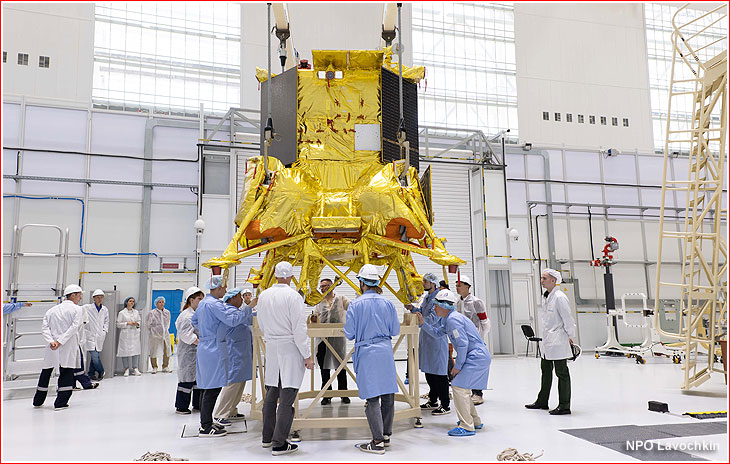
Russia is also Heading to the Moon

Image (Credit): Russia’s Luna-Glob-Lander. (https://www.russianspaceweb.com/)

As noted in an earlier post, India left for the moon’s south pole last week, but it won’t be alone for long. Russia is planning to launch its Luna-25 spacecraft, also called the Luna-Glob-Lander, next month. According to NASA, the mission has two primary scientific objectives at the Moon’s south pole:

  • to study composition of the polar regolith, and
  • to study the plasma and dust components of the lunar polar exosphere.

The last Luna mission was Luna-24 back in 1976 and involved the return of lunar samples to Earth.

The European Space Agency was planning to be part of this latest mission until the invasion of Ukraine, so Russia is on its own now.

I imagine simpler missions like this will be necessary if Russia plans to eventually build a moon base, though finding a partner may be tough. It is clear that the US and Russia are no longer in a neck-to-neck race back to the Moon. Only China seems to have the stamina to compete with NASA’s Artemis program, though the US is still in the lead for now.

The Luna-25 launch is planned for August 10 if all goes well.

Two Space Probes will be Mothballed

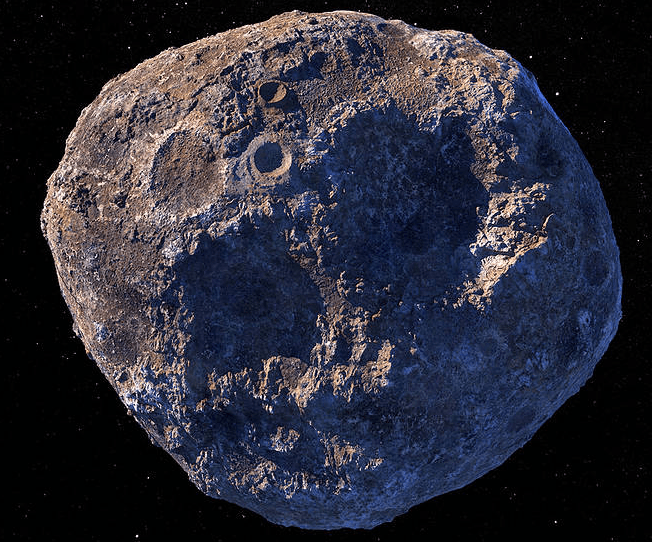
Image (Credit): Illustration of the asteroid Psyche. (NASA)

The delay in the launch of the Psyche spacecraft to visit the asteroid Psyche is having ripple effects on another NASA mission. The $50 million Janus mission with its two probes was supposed to accompany Psyche on the mission to observe two binary asteroid. However, too much time has passed for this separate mission be be accomplished due to the binary asteroids now being too distant from the main mission. Hence, the Janus probes will have to sit this one out. ARSTechnica has a full story on this development.

The good news is that the Psyche spacecraft should be launched this October. So not all is lost.

This will be a tough budget year under this Congress, so NASA will be lucky if it can keep most of its missions on track.