Rocket Launches: Good and Bad News for Lunar Launches

Image (Credit): Chandrayaan-3 launch on July 14, 2023. (Aijaz Rahi/AP)

First, the good news is that India successfully launched a rocket to the Moon last Friday. The Chandrayaan-3 mission, or “moon craft,” includes an orbiter as well as a rover that will explore the southern pole of the Moon. This is India’s second attempt to land on the lunar surface after a failed attempt back in 2019.

The Indian rover is expected to land on the Moon on August 23rd. You can read more about the mission on the Indian government’s mission page.

The other rocket news involves a setback with the United Launch Alliance’s (ULA) new heavy-lift rocket. The launch of the new rocket, the Vulcan Centaur, was delayed until later this year after it was determined that “minor reinforcements” were still needed with the rocket’s upper stage. The upper stage failed back in March.

The Vulcan Centaur is the successor to ULA’s Atlas V and Delta IV rockets. It’s planned first launch includes Astrobotic’s Peregrine Lunar Lander (shown below). NASA notes that the lander’s scientific objectives for the upcoming Moon mission include:

…to study the lunar exosphere, thermal properties and hydrogen abundance of the lunar regolith, magnetic fields, and the radiation environment. It will also test advanced solar arrays. 
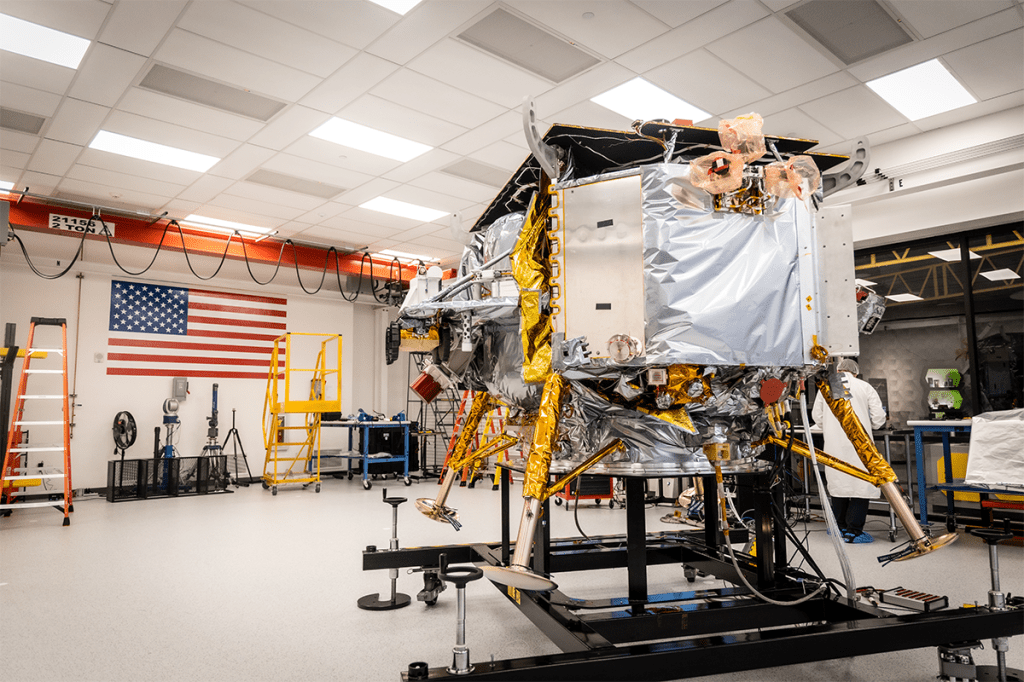
Image (Credit): Newly assembled Peregrine lunar lander being readied for its journey to Florida for integration with the Vulcan Centaur. (Astrobiotic)

Study Findings: Diverse Organic-mineral Associations in Jezero Crater, Mars

Image (Credit): NASA’s Mars Perseverance rover selfie with its Ingenuity helicopter in the background. (NASA/JPL-Caltech/MSSS)

Nature abstract of the study findings:

The presence and distribution of preserved organic matter on the surface of Mars can provide key information about the Martian carbon cycle and the potential of the planet to host life throughout its history. Several types of organic molecules have been previously detected in Martian meteorites and at Gale crater, Mars. Evaluating the diversity and detectability of organic matter elsewhere on Mars is important for understanding the extent and diversity of Martian surface processes and the potential availability of carbon sources. Here we report the detection of Raman and fluorescence spectra consistent with several species of aromatic organic molecules in the Máaz and Séítah formations within the Crater Floor sequences of Jezero crater, Mars. We report specific fluorescence-mineral associations consistent with many classes of organic molecules occurring in different spatial patterns within these compositionally distinct formations, potentially indicating different fates of carbon across environments. Our findings suggest there may be a diversity of aromatic molecules prevalent on the Martian surface, and these materials persist despite exposure to surface conditions. These potential organic molecules are largely found within minerals linked to aqueous processes, indicating that these processes may have had a key role in organic synthesis, transport or preservation.

Citation: Sharma, S., Roppel, R.D., Murphy, A.E. et al. Diverse organic-mineral associations in Jezero crater, Mars. Nature (2023).
https://doi.org/10.1038/s41586-023-06143-z

Study-related stories:

Television: Season Two of Foundation

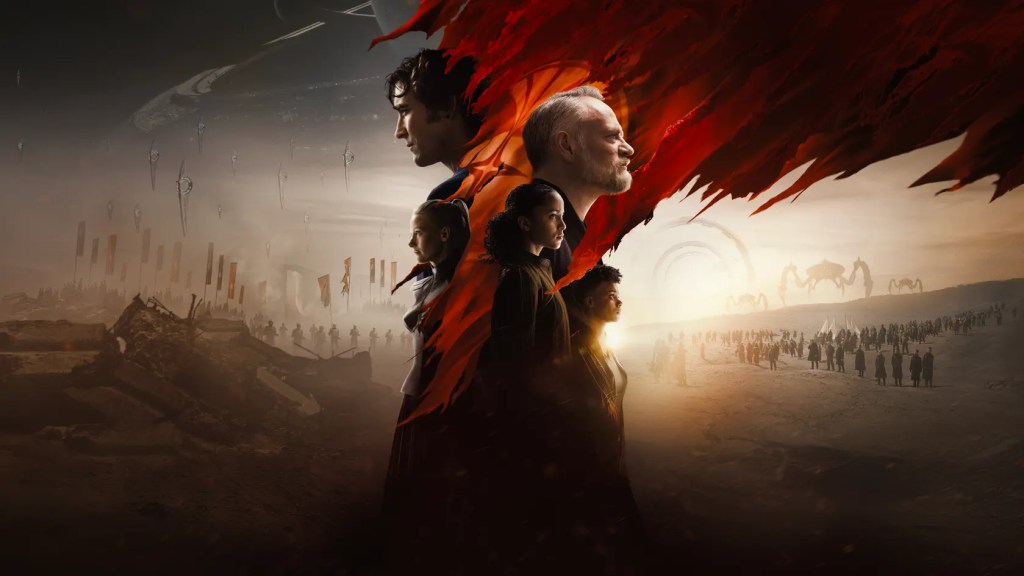
Image (Credit): Poster for season two of Foundation. (Apple TV+)

If you are not watching Foundation on Apple TV+, I recommend you give it a try. Season two begins today.

We need it during a summer with very few if any films touching on space fantasies (without Marvel or DC Comics superheros). The season two trailer will show you what is in store this season, but you need to start from the beginning with season one. You do not want to miss a minute of this series.

The Foundation television series is a cross between Dune and Game of Thrones, with plenty of corrupt dynasties, rebel alliances, and moral dilemmas. However, you should not expect it to closely track Issac Asimov’s books. It deviates from and expands on the themes from the books, but this television story is its own creature. You should enjoy the book and television series separately.

Back in 2021, Belen Edwards wrote a good piece for Mashable called “How Apple TV’s ‘Foundation’ is different from the books.” You will not need it if you are new to the overall story or willing to trust Apple TV+ to give you a good show, but if you are curious about the variations on a theme then this will satisfy that itch.

I am just happy that we have a summer space blockbuster to keep us satisfied. And it is a welcome addition to the constant renewal of Star Trek and Star Wars series. Don’t get me wrong. I want all of it. But Asimov’s universe is another great place to travel if only to better understand the world back here.

Pic of the Week: Anniversary Image from JWST

Image (Credit): The Rho Ophiuchi cloud complex as captured by JWST. (NASA, ESA, CSA, STScI, Klaus Pontoppidan (STScI))

This amazing image was released by NASA earlier this week in celebration of the James Webb Space Telescope’s (JWST) one year anniversary. It shows the Rho Ophiuchi cloud complex, which is the closest star-forming region to Earth.

Here is more from NASA:

Webb’s image shows a region containing approximately 50 young stars, all of them similar in mass to the Sun, or smaller. The darkest areas are the densest, where thick dust cocoons still-forming protostars. Huge bipolar jets of molecular hydrogen, represented in red, dominate the image, appearing horizontally across the upper third and vertically on the right. These occur when a star first bursts through its natal envelope of cosmic dust, shooting out a pair of opposing jets into space like a newborn first stretching her arms out into the world. In contrast, the star S1 has carved out a glowing cave of dust in the lower half of the image. It is the only star in the image that is significantly more massive than the Sun.

“Webb’s image of Rho Ophiuchi allows us to witness a very brief period in the stellar lifecycle with new clarity. Our own Sun experienced a phase like this, long ago, and now we have the technology to see the beginning of another’s star’s story,” said Klaus Pontoppidan, who served as Webb project scientist at the Space Telescope Science Institute in Baltimore, Maryland, since before the telescope’s launch and through the first year of operations.