Image (Credit): June 26, 2023 Starship engine test viewed from above. (SpaceX)
The image above shows the SpaceX Ship 25 rocket from above as it tested it engines on June 26, 2023. Presumably, Elon Musk was tweeting out this and other such shots, but given the restrictions placed on Twitter these days, you may not be able to acquire this on your own without an account.
As far as the next Starship launch, the exact date has yet to be shared. However, NASA is already talking about delaying the Artemis III lunar mission, which will use the Starship, from 2025 to 2026.
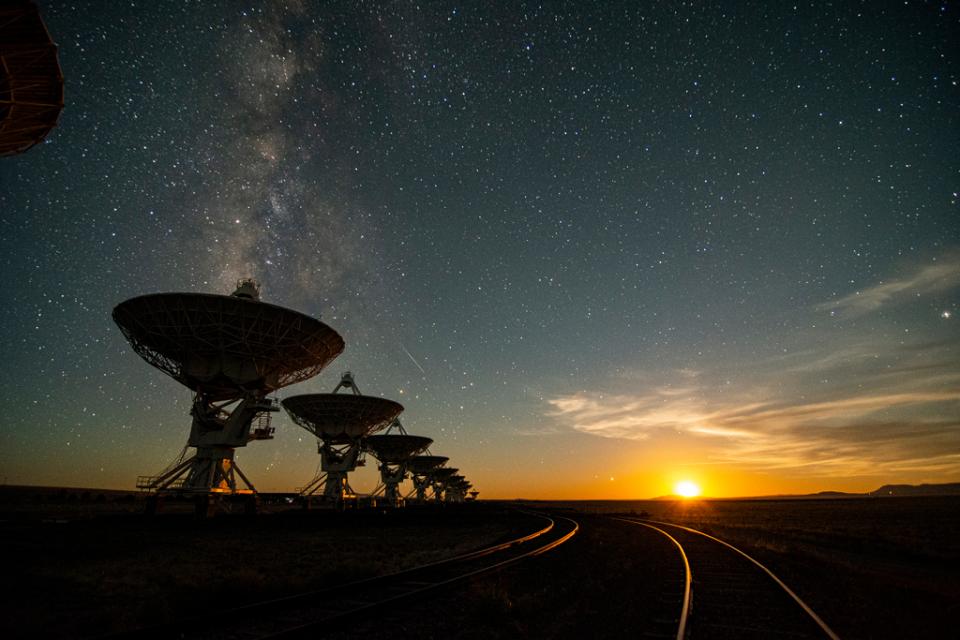
Image (Credit): Karl G. Jansky Very Large Array (VLA) in New Mexico. (Jeff Hellermann, NRAO/AUI/NSF)
COSMIC, also known as the Commensal Open-Source Multimode Interferometer Cluster, is part of the search for extraterrestrial intelligence (SETI) by attempting to find technosignatures using the National Science Foundation’s Karl G. Jansky Very Large Array (VLA) in New Mexico. This new project is a joint venture between the SETI Institute and the National Radio Astronomy Observatory (NRAO). The initial plan is to search for these technosignatures among about 40 million star systems.
Technosignature are basically indicators of technology not caused by natural phenomena. Examples include radio signals, pollutants, nighttime lighting, megastructures, or even the fallout from a nuclear war (not very optimistic, I know). This is different than the biosignatures that other astronomers are looking for among exoplanets by studying the composition of an exoplanet’s atmosphere.
The NRAO has created a page on the COSMIC project that provides plenty of details.
It is good to see federal funding going into the SETI program again after Congress walked away from the program in 1993. With all the new evidence coming to us regarding the multitude of exoplanets, it only makes sense to have a multi-pronged approach to find alien life, particularly intelligent life.
Let’s hope COSMIC is the start of a new and stronger SETI partnership.
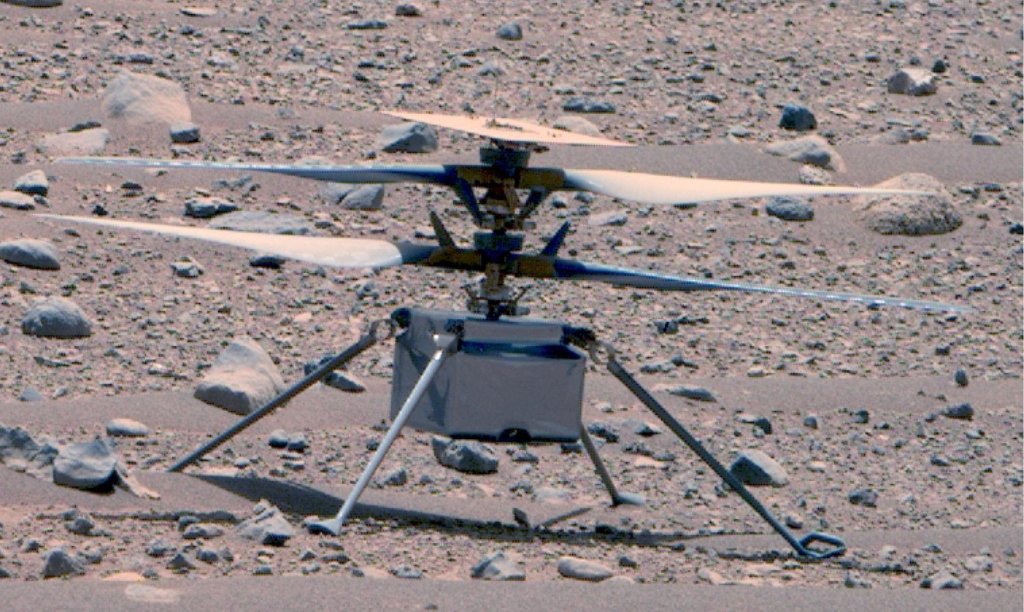
The 52nd flight of NASA’s Ingenuity Mars Helicopter is now in the official mission logbook as a success. The flight took place back on April 26, but mission controllers at NASA’s Jet Propulsion Laboratory in Southern California lost contact with the helicopter as it descended toward the surface for landing.The Ingenuity team expected the communications dropout because a hill stood between the helicopter’s landing location and the Perseverance rover’s position, blocking communication between the two.
Astronauts on interplanetary missions will be a bit less thirsty after a new NASA system succeeded at reclaiming 98% of waste water aboard the International Space Station (ISS) by converting things like urine into a drinkable state. Future crewed deep space missions that will last months or even years will be very different from any that have come before. Until now, astronauts have either carried their own supplies along or relied on regular visits from cargo ships. As to waste products, these were simply disposed of in a variety of ways. Unfortunately, deep space missions don’t have that luxury.
AF Leporis is a bright F8V star located about 87.5 light-years away from Earth in the constellation of Lepus. Also known as AF Lep, HD 35850, HIP 25486 and HR 1817, the star has an age of 24 million years and a mass of 1.2 solar masses. The star hosts a young exoplanet, AF Leporis b (AF Lep b), which is located about 8 times the Earth-Sun distance and is among the first ever discovered using a technique called astrometry. This method measures the subtle movements of a host star over many years to help astronomers determine whether hard-to-see orbiting companions, including planets, are gravitationally tugging at it.
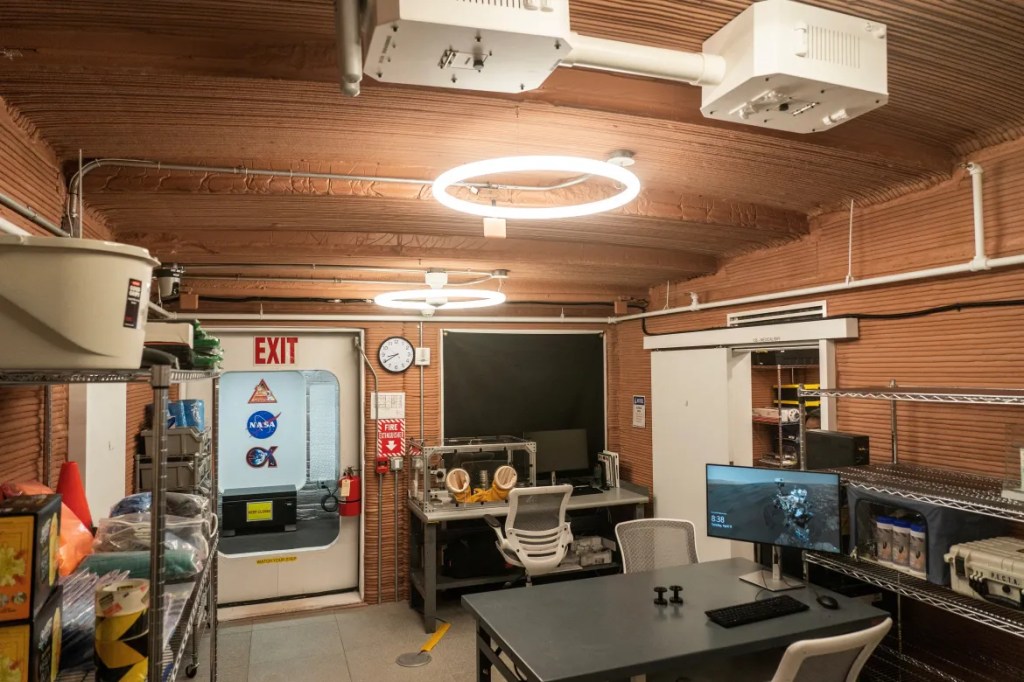
Image (Credit): Interior of NASA’s Mars Simulator, the Mars Dune Alpha. (NASA)
“They are about to embark on an analog mission that encompasses operations, logistics, and research of living and working on Mars. The importance of this study cannot be overstated…NASA scientists will learn critical insights on the physical and behavioral aspects of a mission on Mars.”
-Statement by Judith Hayes, NASA’s Chief Science Officer in the Human Health and Performance Directorate, as quoted in Universe Today. The four member “crew” entered the simulator last week and will live in the 1,700 square foot facility for the next year. The year-long mission is one of three planned by NASA at the Johnson Space Center in Texas.
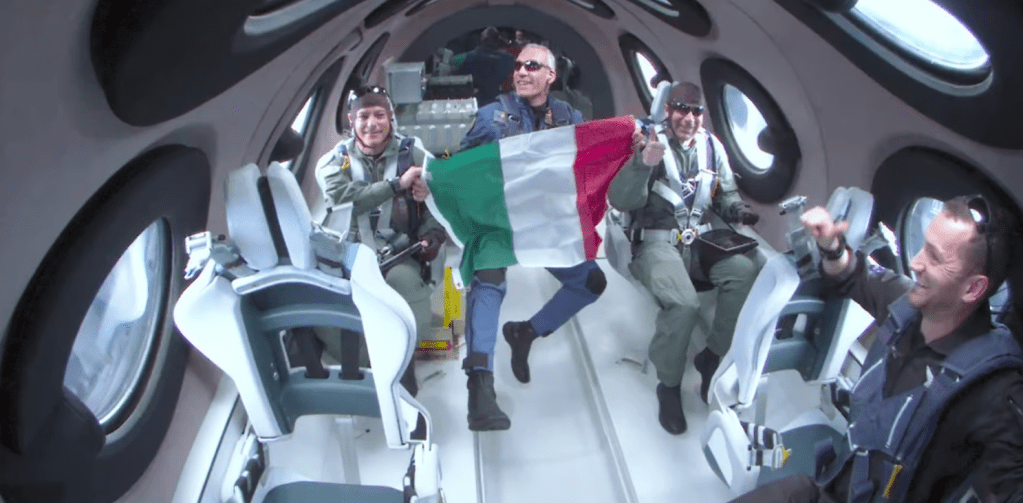
Image (Credit): Interior of Galactic 01 after the successful launch. (Virgin Galactic)
Last Thursday, Virgin Galactic successfully brought paying customers to space, or at least to the edge of space. In this case, it was three Italians, an instructor, and two pilots. You can watch a video of the flight here.
Below is the statement by Virgin Galactic’s CEO:
Tourist flights (at $450,000 per seat) are expected to begin next month. It is too bad that this flight comes so close to the loss of the Titan submersible, but the show must go on.
I expect we might learn just as much about our home planet at the bottom of the sea than miles up in the atmosphere, but such learning will be dangerous and need the right people and skills. The rest is playful profits.



 Our Awesome Universe