Space Stories: The End of Arecibo, Early Black Holes, and Habitable Red Dwarf Exoplanets

Image (Credit): Aerial view of the damaged Arecibo Observatory after one of the main cables holding the receiver broke in Arecibo, Puerto Rico, on December 1, 2020. (Photo by Ricardo ARDUENGO / AFP)

Here are some recent stories of interest.

Scientific American : “Arecibo Observatory Shuts Down Its Science

After weathering hurricanes, earthquakes, budget cuts and a pandemic-induced shutdown, the iconic Arecibo Observatory in Puerto Rico closed its doors on 14 August. After its main instrument collapsed two years ago, the site was supposed to shift from carrying out astronomy and other research to being a science education centre. But concrete plans for that have yet to materialize — and funding for current operations has run out. Scientists were disappointed that research would formally halt at the site, but they had hoped to keep some instruments running, both for the students who might use the educational centre and to continue the site’s astronomy legacy. Doubts now swirl, as equipment is taken offline and dismantled, that Arecibo will ever again study the sky.

Quanta Magazine : “JWST Spots Giant Black Holes All Over the Early Universe

In recent months, a torrent of observations of the cosmic smudges has delighted and confounded astronomers…The most straightforward explanation for the tornado-hearted galaxies is that large black holes weighing millions of suns are whipping the gas clouds into a frenzy. That finding is both expected and perplexing. It is expected because JWST was built, in part, to find the ancient objects. They are the ancestors of billion-sun behemoth black holes that seem to appear in the cosmic record inexplicably early. By studying these precursor black holes, such as three record-setting youngsters discovered this year, scientists hope to learn where the first humongous black holes came from and perhaps identify which of two competing theories better describes their formation: Did they grow extremely rapidly, or were they simply born big?

Phys.org : “New Study Suggests Some Exoplanets Orbiting Red Dwarfs May be Habitable After All

A team of astrophysicists from the University of Bordeaux and Observatoire Astronomique de l’Université de Genève is suggesting that some exoplanets may not have been too hot during their formative years to harbor life today. In their paper published in the journal Nature, the group suggests that due to factors not considered in the past, some exoplanets may not have grown so hot that they lost the water in their atmospheres to evaporation into space.
Good Article: Looking Ahead in Astronomy

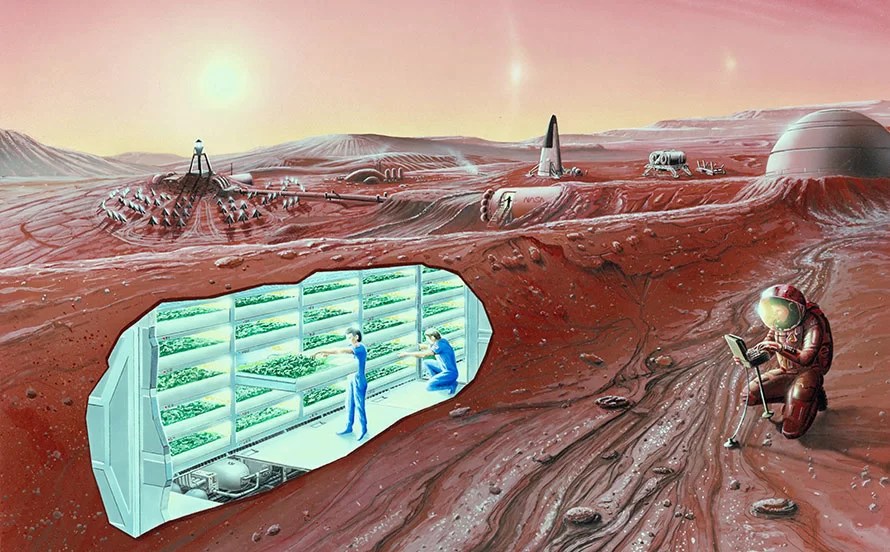
Image (Credit): An imagined Martian settlement. (NASA)

Astronomy magazine has a good article titled “Predictions for the Next 50 Years of Astronomy.” Five astronomers provide their ideas about what we might experience in the field of astronomy in the 2070s.

For instance, S. Alan Stern, a planetary scientist and member of the U.S. National Science Board, had this prediction:

By the ’70s, I expect we’ll have human exploration taking place on multiple worlds in the solar system, with Antarctic-like, semipermanent bases scattered around the globes of at least Luna and Mars. I also expect we may by then have much larger and more powerful launch vehicles, even fusion-based or high-power electric propulsion, making trip times an order of magnitude shorter than today. Just think: Mars in a few weeks, Pluto and the Kuiper Belt in a year!

I just want to see the Moon landing get underway before any predictions about the Kuiper Belt, but it is all exciting and in many ways unknowable given what has happened in the last 50 years. For instance, how many people 50 years ago believed that we would have a catalog of thousands of exoplanets, many similar to Earth?

Of course, predictions are tough. Here is what some scientists were saying in the 1970s about the fate of our little planet, as reported by the American Enterprise Institute:

  •  {Paul] Ehrlich sketched out his most alarmist scenario for the 1970 Earth Day issue of The Progressive, assuring readers that between 1980 and 1989, some 4 billion people, including 65 million Americans, would perish in the “Great Die-Off.”
  • Harrison Brown, a scientist at the National Academy of Sciences, published a chart in Scientific American that looked at metal reserves and estimated the humanity would totally run out of copper shortly after 2000. Lead, zinc, tin, gold, and silver would be gone before 1990.

We have our issues today, but I am very happy that these earlier scientists did not have the gift of prophesy.

Television: Another Star Wars Series Comes to Disney+

Image (Credit): Ahsoka, the main character in Disney’s new series Ahsoka. (Disney+)

If you thought that Disney had run out of Star Wars series ideas, you are far from the mark. The past few series have pulled a variety of stories from the movies, be it The Mandalorian or The Book of Boba Fett. However, the new series Ahsoka comes from the animated The Clone Wars series rather than the films. Is this going too far for the original fans?

The trailer for Ahsoka, which premieres on August 23rd, is fast-paced and intriguing, as expected. Yet Disney’s description is pretty sparse:

Set after the fall of the Empire, Ahsoka” follows the former Jedi Knight Ahsoka Tano as she investigates an emerging threat to a vulnerable galaxy.

So what do we know about this Ahsoka? The Star Wars page share this:

…prior to The Clone Wars, no one had known that Anakin Skywalker taught an apprentice — no one, that is, except George Lucas. In creating the character of Ahsoka Tano, George Lucas offered a vital point of view for the audience, one that kids could directly relate to as they watched the galactic confrontation between the Jedi Knights and Darth Sidious unfold. Ahsoka’s experiences could be their experiences, and as she grew up, so did they. Arriving first in the Clone Wars film, her journey unfolded in the series and beyond.

The eight-part series will also include Hayden Christensen as Anakin Skywalker, giving it a little more heft as was the case with Luke Skywalker appearing on The Mandalorian.

I plan to watch a few episodes to see what Disney has created, though at the outset I have some doubts. Are we looking another The Book of Boba Fett (which was pretty bad) or Andor (which surpasses expectations)? I am eager to know.

Space Quote: What’s the Launch Date for Artemis III?

Credit: NASA

“We really are trying to get in the details of that schedule because when we come up with a date, December of 2025, or whatever that date might be, we want to have confidence for our teams, that we all have a realistic path to get there.” 

-Statement by Jim Free, NASA associate administrator of Exploration Systems Development, regarding the launch date of the Artemis III mission, as reported in Florida Today. The story highlights the potential delays related to SpaceX’s Starship and Axiom’s space suits.

Virgin Galactic: Tourism has Started

Credit: Virgin Galactic

We knew the day was coming, and it took place this week. Virgin Galactic is now open for business for interested space tourists.

Virgin Galactic’s “Galactic 02” mission brought six individuals into space on Thursday, which included three private passengers. Each of these passengers is believed to have paid between $250,000 to $450,000 per seat for the 90-minute experience. That’s about $2,800 per minute at the lower cost range.

Would I call then astronauts? Not really, and the Federal Aviation Administration (FAA) would agree. The criteria for a commercial astronaut are as follows:

To be eligible for FAA Commercial Space Astronaut Wings, commercial launch crew members must meet the following criteria:
a. Meet the requirements for flight crew qualifications and training under Title 14 of the Code of Federal Regulations (14 CFR) part 460.
b. Demonstrated flight beyond 50 statute miles above the surface of the Earth as flight crew on an FAA/AST licensed or permitted launch or reentry vehicle.
c. Demonstrated activities during flight that were essential to public safety, or contributed to human space flight safety
.

I doubt the three passengers met the criteria under c, nor would one expect them to on a fun 90-minute flight. That is fine, but if that’s the case then let’s retire the term astronaut for such tourists.

I am just glad Virgin Galactic is not interfering with actual space work and trying to put people aboard the International Space Station. That would be weird, right?

In the end, these space flights are glorified hot-air balloon rides for the wealthy. As long as they stay in their own lane (so to say), the skies should be open and friendly to all.