
Take a look at the image above. Can you determine where this image originated? Take a guess and then check your answer by going to the “Where is This? The Answer Sheet” page.

Take a look at the image above. Can you determine where this image originated? Take a guess and then check your answer by going to the “Where is This? The Answer Sheet” page.
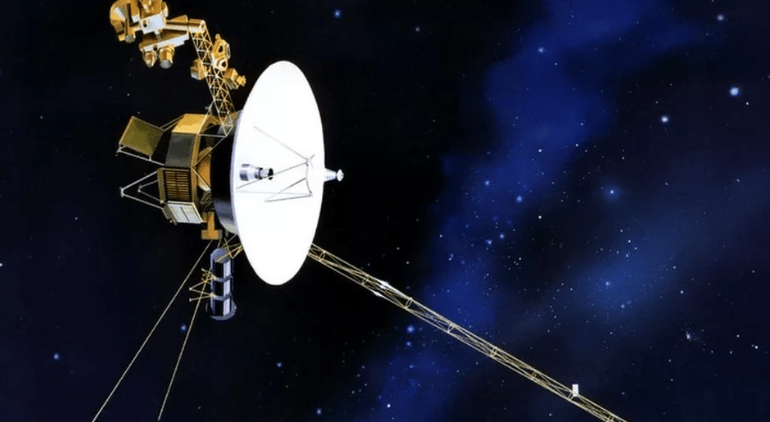
After two weeks with no word, Voyager 2 is back to communicating with us as it continues its journey beyond our solar system. The whole incident started when NASA sent a bad command, but all is well.
Voyager 2 first left Earth back in August 1977 and exited the solar system in December 2018. Like Voyager 1, which is also outside the solar system now, Voyager 2 had the initial task of studying the planets. Voyager 2 focused on Jupiter, Saturn, Uranus and Neptune. It has shown it was capable of much more as it dragged the human race to the bleeding edge of space.
You can read all about Voyager 2’s accomplishments at this NASA site, including:
An impressive list of accomplishments, and the spacecraft is still ticking as it goes into the great unknown.
We need to keep these achievements in mind as we battle over this year’s NASA budget. We also need to remember that there was supposed to be four Voyager-like spacecraft rather than two, but budget cuts nixed the second set. Meaning we can still get some great things done even if we don’t have the budget to fund every piece of a grand vision.
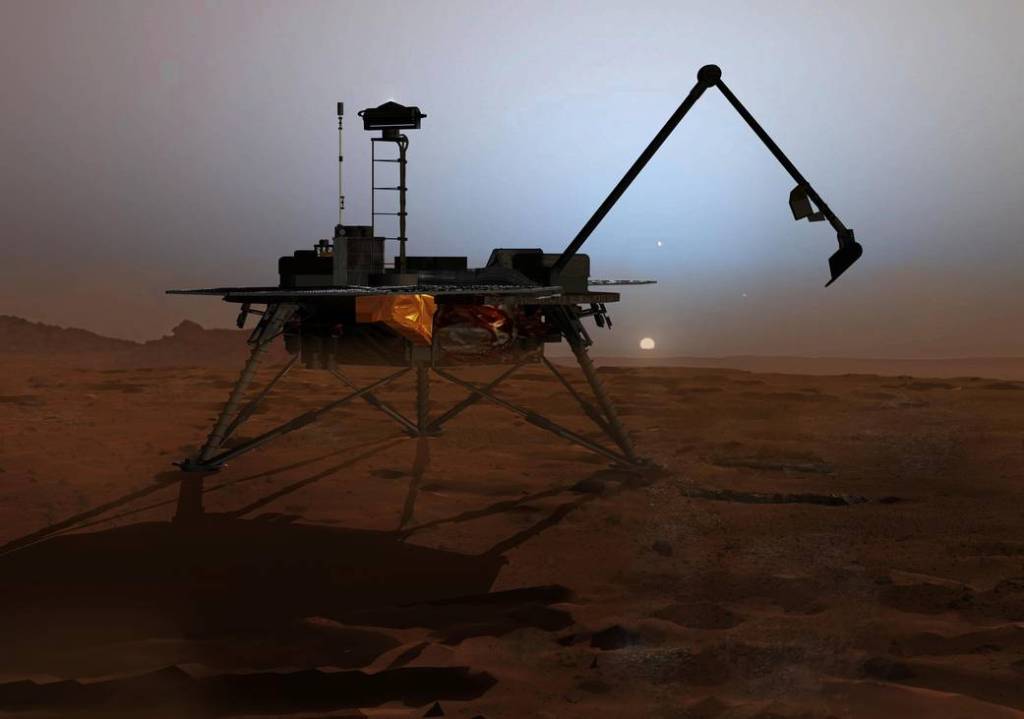
On this day in 2007, NASA launched the Phoenix Mars Lander from Cape Canaveral towards the Red Planet. The lander had two key objectives: (1) to study the history of water in the Martian arctic and (2) to search for evidence of a habitable zone and assess the biological potential of the ice-soil boundary.
The lander set down on Mars on May 25, 2008 and continued with its mission until November of that same year. The lander performed numerous tests on the Martian surface, confirmed the presence of water, and even discovered water ice right below where it landed. The lander also found perchlorate in the soil, which could be a source of oxygen for future missions.
The mission ended when the Martian winter diminished the sunlight needed to run the solar panels. The Phoenix Mars Lander did not survive the winter, but it successfully accomplished its mission.

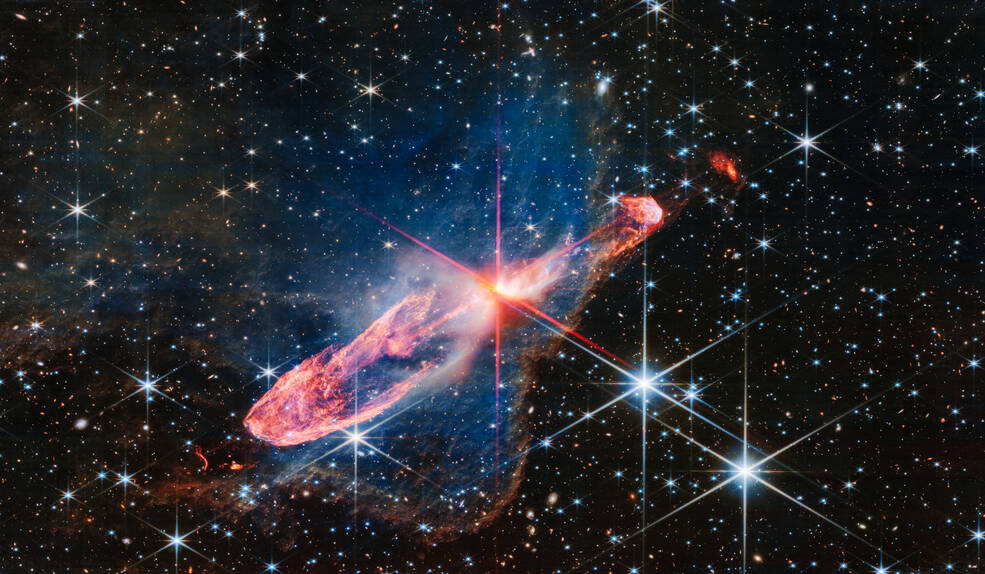
This week’s image is from the James Webb Space Telescope (JWST). It shows the formation of new stars 1,470 light-years away that will take millions of years to form.
Here is a partial description of what you are seeing from NASA (visit the link for the full desciption):
NASA’s James Webb Space Telescope has captured the “antics” of a pair of actively forming young stars, known as Herbig-Haro 46/47, in high-resolution near-infrared light. To find them, trace the bright pink and red diffraction spikes until you hit the center: The stars are within the orange-white splotch. They are buried deeply in a disk of gas and dust that feeds their growth as they continue to gain mass. The disk is not visible, but its shadow can be seen in the two dark, conical regions surrounding the central stars.
The most striking details are the two-sided lobes that fan out from the actively forming central stars, represented in fiery orange. Much of this material was shot out from those stars as they repeatedly ingest and eject the gas and dust that immediately surround them over thousands of years.
When material from more recent ejections runs into older material, it changes the shape of these lobes. This activity is like a large fountain being turned on and off in rapid, but random succession, leading to billowing patterns in the pool below it. Some jets send out more material and others launch at faster speeds. Why? It’s likely related to how much material fell onto the stars at a particular point in time.

After going through Amazon’s list of top science fiction books, I pulled the top five involving interplanetary travel that may be of interest to readers. I am not endorsing these (nor would I in some clear cases), but rather pointing them out if you left for the beach and forgot to bring a book or two. It’s a good idea to have a backup book, and I also recommend you start at the beginning of each series just to make life easier.
Set against the backdrop of China’s Cultural Revolution, a secret military project sends signals into space to establish contact with aliens. An alien civilization on the brink of destruction captures the signal and plans to invade Earth. Meanwhile, on Earth, different camps start forming, planning to either welcome the superior beings and help them take over a world seen as corrupt, or to fight against the invasion. The result is a science fiction masterpiece of enormous scope and vision.
The Reaper is a legend, more myth than man: the savior of worlds, the leader of the Rising, the breaker of chains.
But the Reaper is also Darrow, born of the red soil of Mars: a husband, a father, a friend.
Marooned far from home after a devastating defeat on the battlefields of Mercury, Darrow longs to return to his wife and sovereign, Virginia, to defend Mars from its bloodthirsty would-be conqueror Lysander.
Lysander longs to destroy the Rising and restore the supremacy of Gold, and will raze the worlds to realize his ambitions.
The worlds once needed the Reaper. But now they need Darrow, and Darrow needs the people he loves—Virginia, Cassius, Sevro—in order to defend the Republic.
So begins Darrow’s long voyage home, an interplanetary adventure where old friends will reunite, new alliances will be forged, and rivals will clash on the battlefield.
Because Eo’s dream is still alive—and after the dark age will come a new age: of light, of victory, of hope.
You’d think being abducted by aliens would be the worst thing that could happen to me. And you’d be wrong. Because now, the aliens are having ship trouble, and they’ve left their cargo of human women – including me – on an ice planet. And the only native inhabitant I’ve met? He’s big, horned, blue, and really, really has a thing for me…
Humans have been in the stars far longer than Van originally thought, and they’ve been busy.
But not every visitor to or from Earth has good intentions, and the Peacemakers are faced with an uncomfortable reality. The Earth is about to meet aliens. Some of the aliens are bringing goods to trade. And among those items—are weapons.
When a secret cabal of humans who want to exploit the Earth is revealed, Van has to decide how and where to fight this threat. Along the way, he reveals a secret history that began in the Great War—and ends with mass chaos on his home planet.
Van won’t let that happen—at least not without a fight, and to hold back the gears of war, he’s going to need a lot of help. With Torina at his side, the crew faces a decision that will change the future of the stars themselves, and challenge the Guild, the Earth, and the Equal Grasp as the universe gets smaller with each contact between humans and aliens.
How can Van manage the clash, save earth, and deliver peace?
If he can, what will it cost him?
A storm of fate is gathering, and Zac finds himself at its center.
Having escaped the Orom’s prison, Zac has finally returned to Earth. Much has changed during his years off-world, with war brewing in the Zecia Sector. Struggle is the System’s mandate, where the strong thrive, and the weak suffer.
Zac and the Atwood Empire are racing against time to accumulate the power needed to survive. With danger comes opportunity, and all clues point toward the chaotic Million Gates Territory. That’s where the invaders are hiding, and that’s where Ogras is trapped. But first, Zac needs a spaceship.
Meanwhile, ancient forces from the depths of the Multiverse stir, their gazes pointed toward the desolate frontier.
 Our Awesome Universe