Television: Space Tourism

CBS News had a recent broadcast called “Space Tourism: The Next Great Leap.” Here is the CBS summary:

In the aftermath of the Titan submersible tragedy, extreme travel has come under fresh scrutiny. But one industry stands out for both its allure and the lack of regulation protecting participants’ safety: space tourism. CBS Reports explores the next great leap for humankind and whether regulators and industry stakeholders are striking the right balance between encouraging innovation and ensuring safety.

It was only a matter of time that the deep sea deaths led to greater interest in other nonessential risk. It discusses the space tourist programs under SpaceX, Blue Origin, Virgin Galactic, and others, though it does not get any of them on the record to talk about risk. The news program does reach out to a few tourists, and spends a lot of time with a balloon company that is not yet a real player in this industry.

Many if not most of the space tourists are wealthy individuals with the means to investigate and understand the risk, so one can only worry so much. This is the same subset of humanity climbing mountains because they are there or jumping from helicopters to ski, so they would probably find some other way to expire with their money just to be “alive.” So, should we care? Maybe millionaire guinea pigs are an easier way to fund missions and experiment until space travel is safer for greater numbers.

Probably we should have at least minimal standards equivalent to other forms of privately-owned craft, be it boats or planes. And only when these craft become true transports for the public should they fall under greater regulation. It’s just an idea, but until then caveat emptor.

Posted in TV

Space Quote: New Horizons for New Horizons

Image (Credit): Artist’s rending of the New Horizons spacecraft approaching Pluto. (Johns Hopkins University Applied Physics Laboratory/Southwest Research Institute (JHUAPL/SwRI))

“The New Horizons mission has a unique position in our solar system to answer important questions about our heliosphere and provide extraordinary opportunities for multidisciplinary science for NASA and the scientific community…The agency decided that it was best to extend operations for New Horizons until the spacecraft exits the Kuiper Belt, which is expected in 2028 through 2029.”

Statement by Nicola Fox, NASA’s associate administrator for NASA’s Science Mission Directorate in Washington, regarding the plans for the New Horizons spacecraft. The NASA statement notes that starting in fiscal year 2025, the New Horizons spacecraft will focus on gathering unique heliophysics data, which does not preclude additional flybys of later identified items in the Kuiper Belt.

Pic of the Week: Herbig-Haro 211

Image (Credit): Herbig-Haro 211 as captured by the JWST.

This week’s image is from the James Webb Space Telescope (JWST). It shows a colorful and expansive Herbig-Haro 211, with a Herbig-Haro (HH) being “…luminous regions surrounding newborn stars, formed when stellar winds or jets of gas spewing from these newborn stars form shock waves colliding with nearby gas and dust at high speeds.”

NASA explains what we are seeing:

This image of HH 211 from NASA’s James Webb Space Telescope reveals an outflow from a Class 0 protostar, an infantile analog of our Sun when it was no more than a few tens of thousands of years old and with a mass only 8% of the present-day Sun (it will eventually grow into a star like the Sun).

Infrared imaging is powerful in studying newborn stars and their outflows, because such stars are invariably still embedded within the gas from the molecular cloud in which they formed. The infrared emission of the star’s outflows penetrates the obscuring gas and dust, making a Herbig-Haro object like HH 211 ideal for observation with Webb’s sensitive infrared instruments. Molecules excited by the turbulent conditions, including molecular hydrogen, carbon monoxide, and silicon monoxide, emit infrared light that Webb can collect to map out the structure of the outflows.

The image showcases a series of bow shocks to the southeast (lower-left) and northwest (upper-right) as well as the narrow bipolar jet that powers them. Webb reveals this scene in unprecedented detail — roughly 5 to 10 times higher spatial resolution than any previous images of HH 211. The inner jet is seen to “wiggle” with mirror symmetry on either side of the central protostar. This is in agreement with observations on smaller scales and suggests that the protostar may in fact be an unresolved binary star.

Space Stories: Remembering the Solar System Delivery System, Many More Milky Ways, and AI Investigates Alien Life

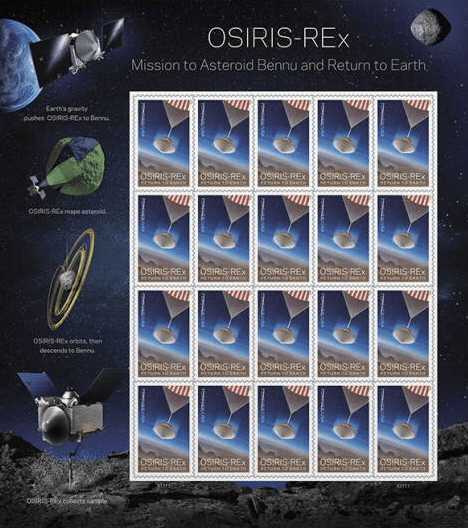
Credit: USPS

Here are some recent stories of interest.

NASA:New US Postage Stamp Commemorates NASA’s Asteroid Sample Delivery

On Sept. 24, NASA’s OSIRIS-REx (Origins, Spectral Interpretation, Resource Identification and Security – Regolith Explorer) spacecraft will speed past Earth and – at precisely the right moment – jettison its sample capsule containing material from asteroid Bennu…To help celebrate this engineering and scientific achievement, the U.S. Postal Service issued a commemorative stamp featuring an artist’s impression of the sample capsule as it parachutes to Earth over its landing site on the Department of Defense’s Utah Test and Training Range…Although OSIRIS-REx has already had many scientific accomplishments, at its heart, the mission’s research goals circle around the sample delivery from Bennu. That influenced the Postal Service’s decision to select the capsule’s descent as the subject of the new stamp.

LiveScience.com:James Webb Telescope Spots Thousands of Milky Way Lookalikes That ‘Shouldn’t Exist’ Swarming Across the Early Universe

The James Webb Space Telescope (JWST) has found more than 1,000 galaxies mysteriously resembling our own Milky Way hiding out in the early universe. Shaped like warped vinyls and sporting delicate spiral arms, the Milky Way doppelgangers were found by JWST more than 10 billion years into the universe’s past — during a period when violent galactic mergers were thought to have made an abundance of such fragile galaxies impossible. Yet the disk galaxies are 10 times more common in the early universe than astronomers previously thought, new research reveals.

Astronomy.com:Can AI Find Life in the Universe?

Scientists could soon use common lab technology along with sophisticated algorithms to answer one of the biggest questions in all of astronomy — are we alone in the universe? In new research published today in Proceedings of the National Academy of Sciences (PNAS), a team of scientists announced a novel technique that can take a sample of a material, feed it through a machine-learning algorithm, and find out if the material did — or didn’t — come from a living organism with 90 percent accuracy.

Future Plans for a Spaceship to Decommission the ISS

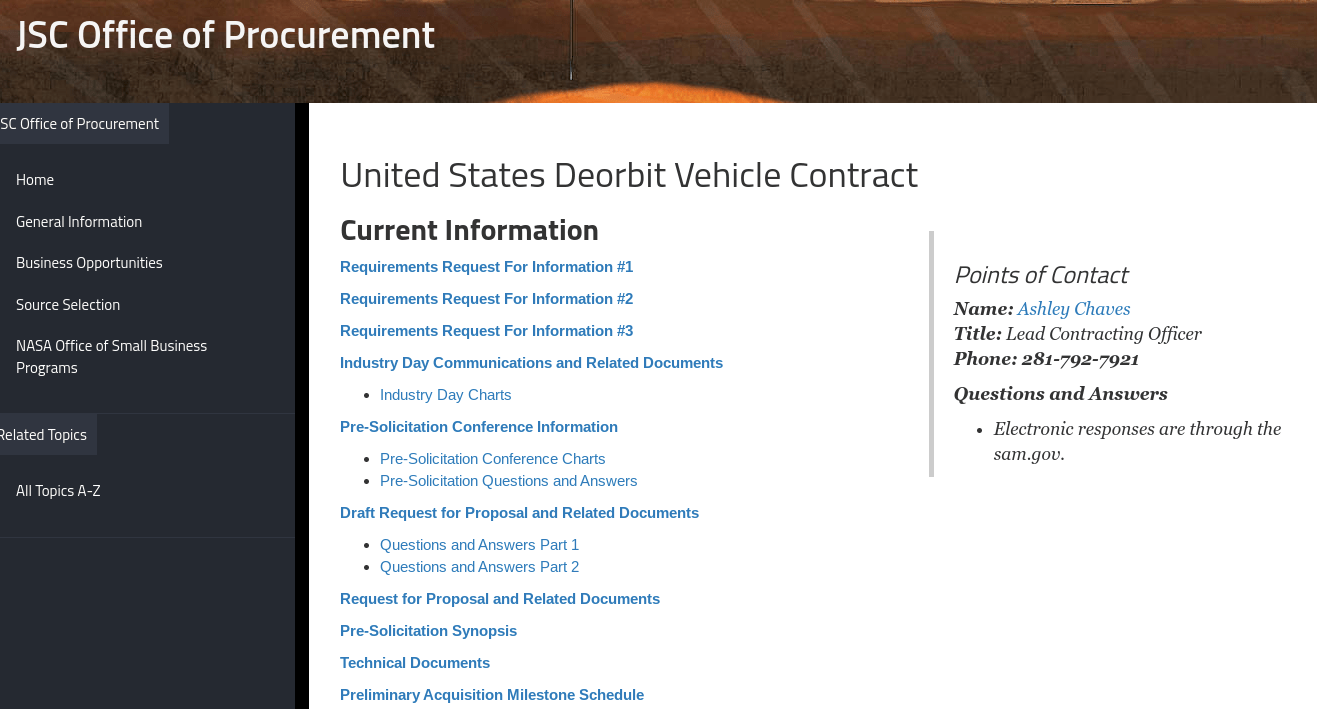
How much does it cost to decommission a space station? Well, according to NASA as cited by London’s Daily Mail, it will cost at least $1 billion to ensure the International Space Station (ISS) finds a safe spot to crash. And NASA even has a name for the spacecraft that will be needed to steer the ISS into the Earth – the US Deorbit Vehicle (USDV) – because everything needs an fancy acronym.

The ISS is not expected to disappear until 2031, but plans are underway to start the decommissioning process now. If you want to help build the USDV you have until November of this year to share your plans with NASA (see below and visit this link). Just as we have companies in a race to put humans on the Moon again, we will now have a race for the final days of the ISS.

And where will the ISS end up? In its Requiremenst for Request Information, NASA is asking for a “controlled reentry into an unpopulated region.” It appears the goal is to aim any burning remains at Point Nemo, which is a spot in the Pacific Ocean used many times for such purposes (see the diagram above).

The US apparently has plans for an ISS replacement. I just hope at least part of the new station is in orbit by 2031. We do not need a long gap with no space station. The gap between end of the space shuttle and the restart of US-controlled rocket missions to the ISS was far too long. We have time to get it right.

Credit: NASA