
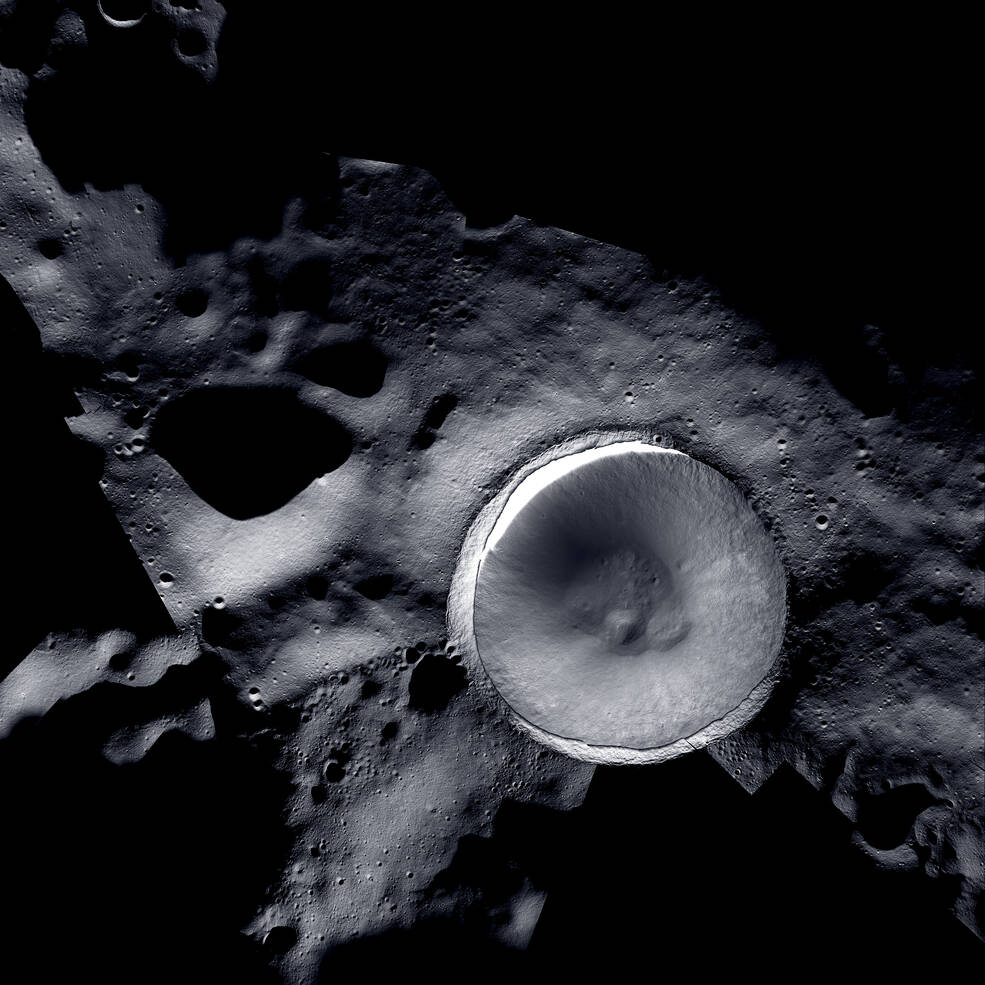
This week’s image shows the Shackleton Crater located at the Moon’s South Pole. To create what you see above, an image from NASA’s Lunar Reconnaissance Orbiter Camera (LROC) was combined with another image from ShadowCam, a NASA instrument on board a KARI (Korea Aerospace Research Institute) spacecraft called Danuri,
Here is more information from NASA concerning the two cameras:
LROC can capture detailed images of the lunar surface but has limited ability to photograph shadowed parts of the Moon that never receive direct sunlight, known as permanently shadowed regions. ShadowCam is 200-times more light-sensitive than LROC and can operate successfully in these extremely low-light conditions, revealing features and terrain details that are not visible to LROC. ShadowCam relies on sunlight reflected off lunar geologic features or the Earth to capture images in the shadows.
ShadowCam’s light sensitivity, however, renders it unable to capture images of parts of the Moon that are directly illuminated, delivering saturated results. With each camera optimized for specific lighting conditions found near the lunar poles, analysts can combine images from both instruments to create a comprehensive visual map of the terrain and geologic features of both the brightest and darkest parts of the Moon. The permanently shadowed areas in this mosaic, such as the interior floor and walls of Shackleton Crater, are visible in such detail because of the imagery from ShadowCam. In contrast, the sunlit areas in this mosaic, like the rim and flanks of the crater, are a product of imagery collected by LROC.
 Our Awesome Universe