
Here are some recent stories of interest.
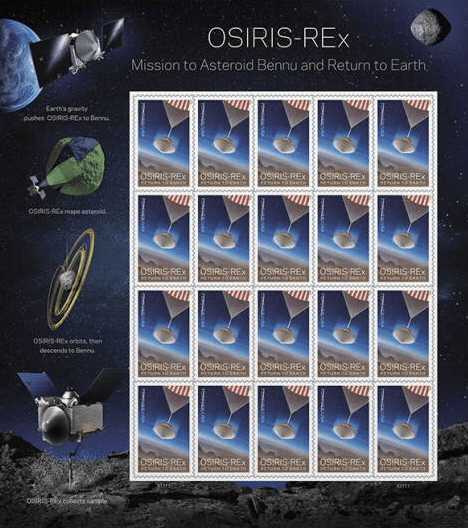
—NASA: “New US Postage Stamp Commemorates NASA’s Asteroid Sample Delivery“
On Sept. 24, NASA’s OSIRIS-REx (Origins, Spectral Interpretation, Resource Identification and Security – Regolith Explorer) spacecraft will speed past Earth and – at precisely the right moment – jettison its sample capsule containing material from asteroid Bennu…To help celebrate this engineering and scientific achievement, the U.S. Postal Service issued a commemorative stamp featuring an artist’s impression of the sample capsule as it parachutes to Earth over its landing site on the Department of Defense’s Utah Test and Training Range…Although OSIRIS-REx has already had many scientific accomplishments, at its heart, the mission’s research goals circle around the sample delivery from Bennu. That influenced the Postal Service’s decision to select the capsule’s descent as the subject of the new stamp.
—LiveScience.com: “James Webb Telescope Spots Thousands of Milky Way Lookalikes That ‘Shouldn’t Exist’ Swarming Across the Early Universe“
The James Webb Space Telescope (JWST) has found more than 1,000 galaxies mysteriously resembling our own Milky Way hiding out in the early universe. Shaped like warped vinyls and sporting delicate spiral arms, the Milky Way doppelgangers were found by JWST more than 10 billion years into the universe’s past — during a period when violent galactic mergers were thought to have made an abundance of such fragile galaxies impossible. Yet the disk galaxies are 10 times more common in the early universe than astronomers previously thought, new research reveals.
—Astronomy.com: “Can AI Find Life in the Universe?“
Scientists could soon use common lab technology along with sophisticated algorithms to answer one of the biggest questions in all of astronomy — are we alone in the universe? In new research published today in Proceedings of the National Academy of Sciences (PNAS), a team of scientists announced a novel technique that can take a sample of a material, feed it through a machine-learning algorithm, and find out if the material did — or didn’t — come from a living organism with 90 percent accuracy.
 Our Awesome Universe