Image (Credit): The Soyuz MS-24 spacecraft blasts off to the ISS from the Baikonur Cosmodrome, Kazakhstan on September 15, 2023. (Maxim Shemetov/Reuters)
Earlier today, US astronaut astronaut Loral O’Hara as well as Roscosmos cosmonauts Oleg Kononenko and Nikolai Chub departed from Kazakhstan on a Soyuz rocket that will take them to the International Space Station (ISS). The space station will be crowded again until the three relieved crew members, including US astronaut Frank Rubio, can return to Earth.
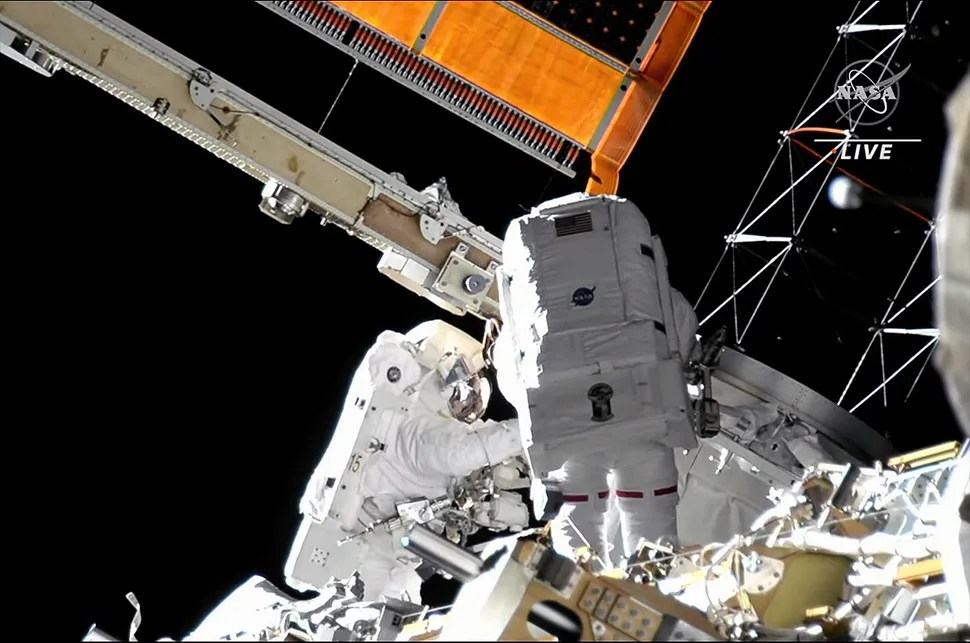
Image (Credit): NASA astronauts Frank Rubio (left) and Josh Cassada (back to camera) working outside the ISS last November. (NASA TV)
This week’s image shows astronaut Frank Rubio hard at work last year outside the International Space Station (ISS). He has now exceeded the U.S. space duration record, which was 355 days. All of this was unplanned, come as the result of a faulty Russian capsule that kept him on the station longer than his scheduled six month tour.
Mr. Rubio is set to return to Earth on September 27. At that point, he will have spent 371 days in space.
This CBS News segment discusses some of the risks related to a longer stay on the station.
Image (Credit): Dr. McCoy on the television series Star Trek. (CBS / Paramount)
The Star Trek name and characters have been thrown around in popular culture for years, but now scientists have locked onto them. A new group of spiders, part of the Roddenberryus genus (yes, that’s right), have been named Kirk, McCoy and Spock.
If you do not believe me, take a look at this article in the New York Times, “It’s a Spider, Not a Doctor, Captain or Vulcan.” The article quotes Dr. Bonaldo, a researcher at the Paraense Emílio Goeldi Museum in Brazil, who made this statement about the newly-named spiders:
They somewhat resemble Star Trek spaceships…Arachnologists have a long tradition of giving interesting scientific names for new genera and species, as most of us believe it is a great opportunity to acknowledge people or draw parallels with pop culture and local customs.
Image (Credit): Artist’s concept showing exoplanet K2-18 b. (Illustration: NASA, CSA, ESA, J. Olmsted (STScI), Science: N. Madhusudhan (Cambridge University))
The exoplanet, some 120 light-years away, has caught the attention scientists using the James Webb Space Telescope (JWST). K2-18 b, about 8.6 times as massive as Earth, has carbon-bearing molecules in its atmosphere, including methane and carbon dioxide. This could mean the exoplanet has a hydrogen-rich atmosphere and a water ocean-covered surface (called a Hycean exoplanet).
Exoplanets of this size, between the size of Earth and Neptune, are called “sub-Neptune” exoplanets. These are the most most common type of exoplanet found to date in our galaxy.
Nikku Madhusudhan, an astronomer at the University of Cambridge and lead author of the paper announcing these results, stated:
Our findings underscore the importance of considering diverse habitable environments in the search for life elsewhere…Traditionally, the search for life on exoplanets has focused primarily on smaller rocky planets, but the larger Hycean worlds are significantly more conducive to atmospheric observations.
You can read more about this discovery at the NASA site.
Uncle Sam is starting up a new website so the public can report UFOs, or Unidentified Anomalous Phenomena (UAP) to use the politically correct term. The Pentagon’s All-domain Anomaly Resolution Office (AARO) is building the website, which notes:
AARO will be accepting reports from current or former U.S. Government employees, service members, or contractors with direct knowledge of U.S. Government programs or activities related to UAP dating back to 1945. These reports will be used to inform AARO’s congressionally directed Historical Record Report.
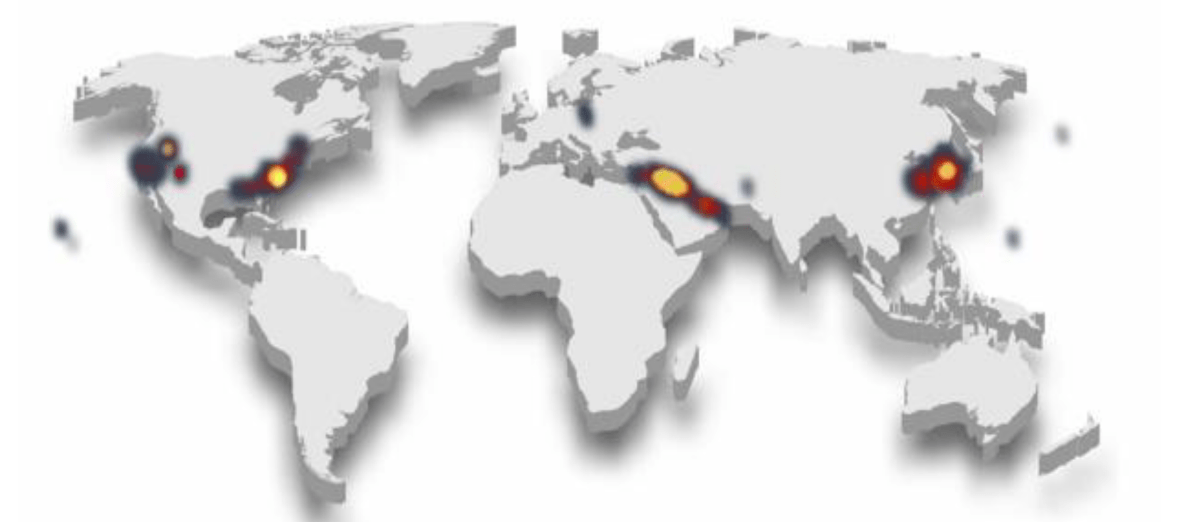
You can already find some of the UAP data trends on the AARO website, such as the graphic below.
And what type of information is the government collecting on these UAPs? This page summarizes some of the reporting criteria. Once the website is up, the specific reporting criteria will be shared.
Keep looking up, and keep a notebook by your side.
Image (Credit): Reported-UAP hot spots per published statistics as of April 17, 2023. (AARO)





 Our Awesome Universe