Image (Credit): SpaceX’s Starbase in Boca Chica, Texas. (SpaceX)
“The final mishap investigation report cited a total of sixty-three (63) corrective actions for SpaceX to implement. These included actions to address redesigns of vehicle hardware to prevent leaks and fires, redesign of the launch pad to increase its robustness, incorporation of additional reviews in the design process, additional analysis and testing of safety critical systems and components including the Autonomous Flight Safety System (AFSS), and the application of additional change control practices.”
-Statement in a September 7, 2023 letter from the Federal Aviation Administration to SpaceX regarding its April 20, 2023 Starship launch from Boca Chica, Texas. These correction actions are expected to be implemented before the next launch can proceed. No date for the next Starship launch has been shared to date.
Nearly a year ago, NASA successfully smashed an asteroid for the first time, in a landmark test to see whether we could divert a killer space rock before disaster — but now, the asteroid in question is behaving strangely. As New Scientist reports, a schoolteacher and his pupils seem to have discovered that the orbit of Dimorphos, the space rock socked by the Double Asteroid Redirection Test (DART) last September, has apparently continued slowing down, unexpectedly, in the year since the refrigerator-sized craft smashed into it.
Researchers from Japan predict, based on computer simulations, the likely existence of an Earth-like planet in the distant Kuiper Belt. There are many unexplained anomalies in the orbits and distribution of trans-Neptunian objects, small celestial bodies located at the outer reaches of the solar system. Now, based on detailed computer simulations of the early outer solar system, researchers from Japan predict the possibility of an undiscovered Earth-like planet beyond Neptune orbiting the Sun. Should this prediction come true, it could revolutionize our understanding of the history of the solar system.
The Japan Aerospace Exploration Agency’s (JAXA) X-Ray Imaging and Spectroscopy Mission (XRISM) lifted off on a H-IIA rocket from the Tanegashima Space Center in Japan at 08:42 JST / 00:42 BST / 01:42 CEST on 7 September 2023. The successful launch marks the beginning of an ambitious mission to explore the growth of galaxy clusters, the chemical make-up of the Universe, and the extremes of spacetime. XRISM is a collaboration between JAXA and NASA, with significant participation from ESA.
Image (Credit): Photo of the Vikram lander, which put the Pragyan rover on the Moon. (ISRO via AP/Alamy)
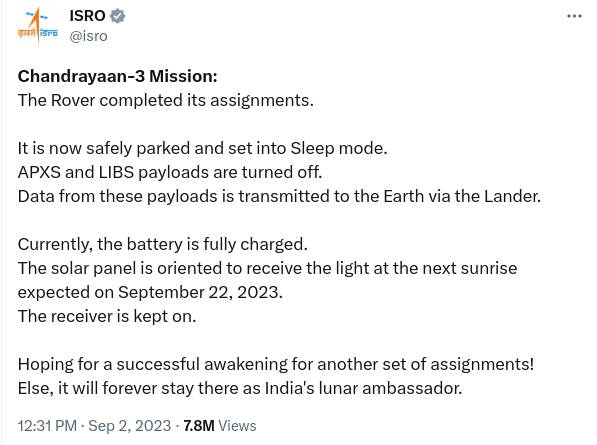
After a few weeks of work, India’s Pragyan rover on the Moon’s south pole was put to sleep last weekend to sit out the long lunar evening. It accomplished all of its goals, according to a Tweet from the Indian Space Research Organisation (ISRO):
We shall know in a few weeks whether the little lander is ready for more work.
Nature magazine noted some of the findings from the rover’s primary mission, including:
ions and electrons swirling near the lunar pole;
variations in soil temperature;
a moonquake; and
presence of sulfur and other elements.
Whatever happens, the Indian rover has been a great success.
Image (Credit): NGC 6530 as captured by the NASA/ESA Hubble Space Telescope. (ESA/Hubble & NASA, ESO, O. De Marco)
This week’s image is from the Hubble Space Telescope. It shows a fantastic array of colors from a portion of NGC 6530, which is about 4,350 light-years from Earth.
A portion of the open cluster NGC 6530 appears as a roiling wall of smoke studded with stars in this image from the NASA/ESA Hubble Space Telescope…The cluster is set within the larger Lagoon Nebula, a gigantic interstellar cloud of gas and dust. It is the nebula that gives this image its distinctly smokey appearance; clouds of interstellar gas and dust stretch from one side of this image to the other.
You can also watch this short video that pans over the cluster.
Image (Credit): Astronaut James Lovell and Marilyn Lovell at a 1969 news conference. (Paul Shane/AP)
Marilyn Lovell died on August 27th in Lake Forest, Illinois at the age of 93. She is the wife of astronaut James A. Lovell Jr., who commanded the troubled Apollo 13 mission. You can read her full obituary at the Washington Post site.
I just wanted to highlight one interesting piece from the obituary. It relates to the Lovell’s viewing the 1969 film Marooned shortly before the 1970 Apollo 13 crisis. The film, starring Gregory Peck and Gene Hackman, was a fictional account of three astronauts in a capsule facing possible destruction after a rocket failure. A short time later her husband would be one of the three astronauts facing a real crisis in a crippled capsule, while she worried below.
They say life is stranger than fiction. Luckily, Apollo 13 ended better for the crew. You way want to check out this trailer for Marooned and even rent it one of these days.
As for Marilyn Lovell, she led an amazing life here on Earth with her husband (now 95) and large family.




 Our Awesome Universe