Space Stories: Dinosaur Dust, Missing Stars, and SETI Signals

Image (Credit): The end of the dinosaurs. (NYT, Roger Harris/Science Source)

Here are some recent stories of interest.

Royal Observatory of Belgium: “Dust Played a Major Role in Dinosaur Demise

Fine dust from pulverized rock generated by the Chicxulub impact likely played a dominant role in global climate cooling and the disruption of photosynthesis following the event. This is suggested by a new study published in Nature Geoscience, in which researchers Cem Berk Cenel, Özgür Karatekin and Orkun Temel of the Royal Observatory of Belgium contributed.

Express: “Astronomers Trying to Unravel Mystery of Three Stars that Suddenly Disappeared from Sky

A team of Spanish astronomers is leading the investigation into one of stargazing’s most perplexing mysteries. Three bright stars photographed in the night sky above southern California in 1952 vanished just an hour later. Generations of scientists have sought to explain the rare phenomenon over the past half-century, but nothing has yet convinced the community. Researchers at the Centre for Astrobiology (CAB) in Madrid tried to solve the riddle of the “triple transient” that has “remained absent from telescope exposures for 71 years” in a new paper published online.

Sci.News: “New Study Sets Clearer Bounds on Search for Technosignatures from Extraterrestrial Intelligences

A stable-frequency transmitter with relative radial acceleration to a receiver will show a change in received frequency over time, known as a ‘drift rate.’ For a transmission from an exoplanet, astronomers must account for multiple components of drift rate: the exoplanet’s orbit and rotation, the Earth’s orbit and rotation, and other contributions. Understanding the drift rate distribution produced by exoplanets relative to Earth, can help scientists constrain the range of drift rates to check in a Search for Extraterrestrial Intelligence (SETI) project to detect radio technosignatures, and help them decide validity of signals-of-interest, as they can compare drifting signals with expected drift rates from the target star. In a new study, University of California, Los Angeles astronomer Megan Grace Li and colleagues modeled the drift rate distribution for over 5,300 confirmed exoplanets, using parameters from the NASA Exoplanet Archive.

Study Findings: A Planetary Collision Afterglow and Transit of the Resultant Debris Cloud

Image (Credit): Artist’s rendering of two colliding planets. (NASA)

Nature abstract of the study findings:

Planets grow in rotating disks of dust and gas around forming stars, some of which can subsequently collide in giant impacts after the gas component is removed from the disk. Monitoring programmes with the warm Spitzer mission have recorded substantial and rapid changes in mid-infrared output for several stars, interpreted as variations in the surface area of warm, dusty material ejected by planetary-scale collisions and heated by the central star: for example, NGC 2354–ID8, HD 166191 and V488 Persei. Here we report combined observations of the young (about 300 million years old), solar-like star ASASSN-21qj: an infrared brightening consistent with a blackbody temperature of 1,000 Kelvin and a luminosity that is 4 percent that of the star lasting for about 1,000 days, partially overlapping in time with a complex and deep, wavelength-dependent optical eclipse that lasted for about 500 days. The optical eclipse started 2.5 years after the infrared brightening, implying an orbital period of at least that duration. These observations are consistent with a collision between two exoplanets of several to tens of Earth masses at 2–16 astronomical units from the central star. Such an impact produces a hot, highly extended post-impact remnant with sufficient luminosity to explain the infrared observations. Transit of the impact debris, sheared by orbital motion into a long cloud, causes the subsequent complex eclipse of the host star.

Citation: Kenworthy, M., Lock, S., Kennedy, G. et al. A planetary collision afterglow and transit of the resultant debris cloud. Nature 622, 251–254 (2023).
https://doi.org/10.1038/s41586-023-06573-9

Study-related stories:

A Day in Astronomy: Flyby of Asteroid Gaspra

Image (Credit): Asteroid Gaspra as photographed by the Galileo spacecraft. (NASA)

On this day in 1991, NASA’s Galileo spacecraft conducted a flyby of asteroid Gaspra, an asteroid that orbits in the asteroid belt between Mars and Jupiter. The asteroid is about 10.5 miles long. Gaspra was discovered in 1916 by Russian astronomer G. N. Neujmin, who named it after a famous Russian spa retreat in Crimea.

The Galileo spacecraft’s primary mission was to visit Jupiter and its moons, but it also conducted other observations along the way, including flybys of asteroids Gaspra and Ida.

Here are a few facts about the Galileo mission from NASA:

  • Galileo was the first spacecraft to orbit an outer planet.
  • It was the first spacecraft to deploy an entry probe into an outer planet’s atmosphere.
  • It completed the first flyby and imaging of an asteroid (Gaspra, and later, Ida).
  • It made the first, and so far only, direct observation of a comet colliding with a planet’s atmosphere (Shoemaker-Levy 9).
  • It was the first spacecraft to operate in a giant planet magnetosphere long enough to identify its global structure and to investigate its dynamics.

Source of ISS Leak Identified on Russian Module

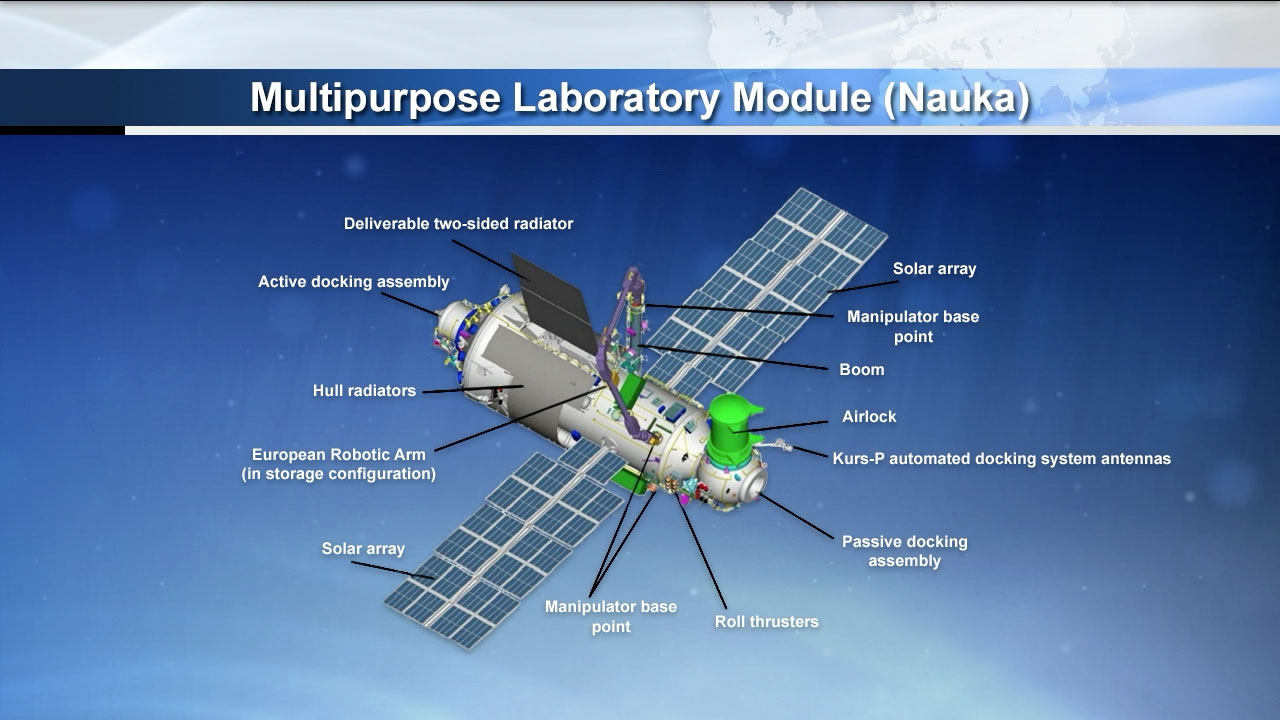
Image (Credit): Russia’s Nauka laboratory module on the ISS. (NASA)

We know Mr. Putin wants to pursue his own space station, but how about fixing the one Russia is already part of?

Cosmonauts Oleg Kononenko and Nikolai Chub conducted a spacewalk this week to investigate the third leak aboard the International Space Station (ISS). Luckily, the source of the leak was found – a 2010 radiator attached to Russia’s Nauka laboratory module.

News reports indicate that Russia’s space agency, Roscosmos, is downplaying the leak, noting that it did not impact the primary coolant loop. Roscosmos finished by stating, “the crew and the station are not in any danger.” That’s hopeful, but still a worrisome incident for the aging space station.

A disaster with the $100 billion space station will set back if not kill future funding for similar stations. As with the US space shuttle, the space station could be a passing phase if we cannot keep it running and our astronauts and cosmonauts safe.

Maybe it is time for Russia to go its own way if it is not willing to keep the ISS afloat. I would rather Russia steps up its game, but it may have trouble fighting wars and funding space at the same time.

Note: The US and Russian need to get this fixed so that the focus can return to science. While the ISS crew was searching for leaks this week, China sent another team to its Tiangong space station.

Space Quote: Russia Moves Past Moon Crash and Readies for a New Space Station

Image (Credit): View of the International Space Station from  a Crew Dragon spacecraft. (NASA)

“Mistakes are mistakes. It is a shame for all of us. This is space exploration and everyone understands that. It is experience that we can use in the future.”

-Statement by Russia’s President Putin, as reported by Reuters, addressing the Luna-25 crash on the Moon in August. He added that the lunar missions will continue. He also said Russia also hopes to have its first segment of a new space station in operation by 2027, stating, “As the resources of the International Space Station run out, we need not just one segment, but the entire station to be brought into service.”