
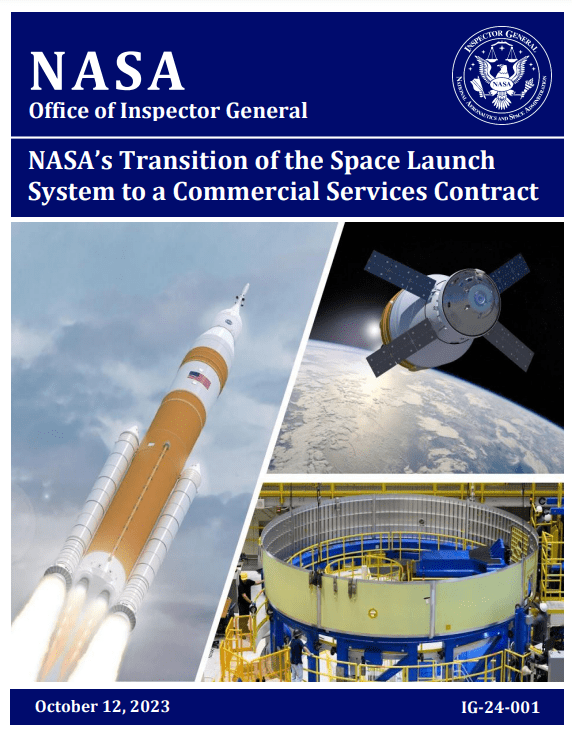
First, the US Government Accountability Office reported that NASA’s Space Launch System (SLS) is unaffordable, and now NASA’s Office of Inspector General (OIG) doubles down on that earlier finding, reporting that the SLS, a key component of the Artemis program, has costs that are spinning out of control.
In its report, NASA’s Transition of the Space Launch System to a Commercial Services Contract, NASA OIG concludes:
Our analysis shows a single SLS Block 1B will cost at least $2.5 billion to produce—not including Systems Engineering and Integration costs—and NASA’s aspirational goal to achieve a cost savings of 50 percent is highly unrealistic. Specifically, our review determined that cost saving initiatives in several SLS production contracts such as reducing workforce within Boeing’s Stages contract and gaining manufacturing efficiencies with Aerojet Rocketdyne’s RS-25 Restart and Production Contract were not significant and, as a result, a single SLS will cost more than $2 billion through the first 10 SLS rockets produced under [the Exploration Production and Operations Contract].
NASA OIG concludes that maybe other contractors needs to be considered, stating:
Although Congress directed NASA in 2010 to build a heavy-lift rocket and crew capsule using existing contracts from the canceled Constellation effort to meet its space exploration goals, the Agency may soon have more affordable commercial options to carry humans to the Moon and beyond. In our judgment, the Agency should continue to monitor the commercial development of heavy-lift space flight systems and begin discussions of whether it makes financial and strategic sense to consider these options as part of the Agency’s longer-term plans to support its ambitious space exploration goals.
Where are these “more affordable commercial options”? Could it be SpaceX? Blue Origin? If so, let’s start the transition ASAP so that the Moon and Mars remain a realistic goal in the near future. We have plenty of talent in this country and a race to the top is what we need, not a space agency stuck with an Edsel rocket system.
 Our Awesome Universe