
Here are some recent stories of interest.
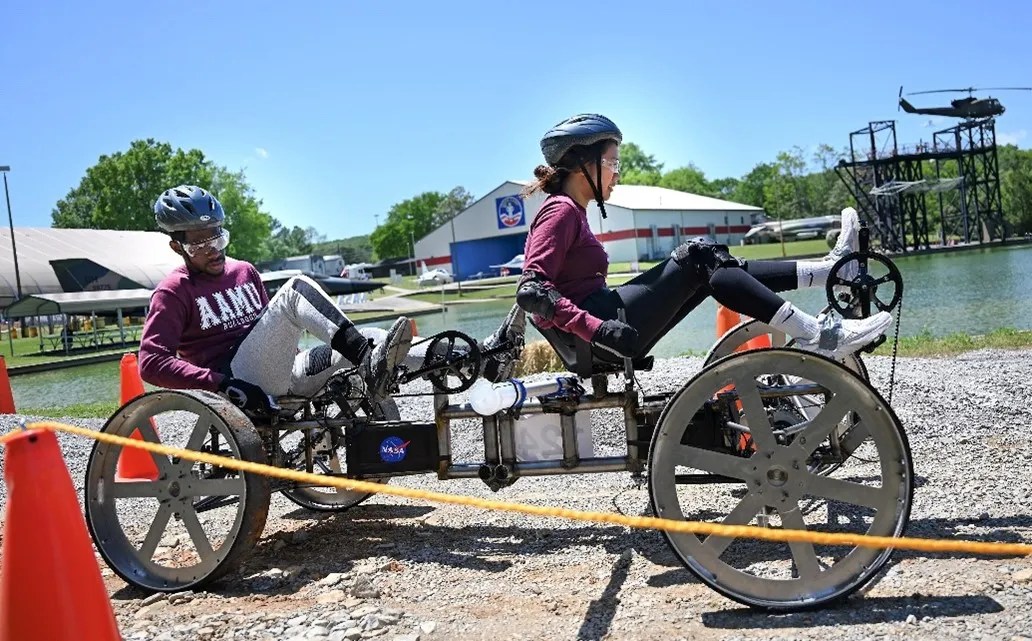
—NASA: “Dozens of Student Teams Worldwide to Compete in NASA Rover Challenge“
NASA has selected 72 student teams to begin an engineering design challenge to build human-powered rovers that will compete next April at the U.S. Space & Rocket Center in Huntsville, Alabama, near the agency’s Marshall Space Flight Center. Celebrating its 30th anniversary in 2024, the Human Exploration Rover Challenge tasks high school, college, and university students to design, build, and test lightweight, human-powered rovers on an obstacle course simulating lunar and Martian terrain, all while completing mission-focused science tasks.
—Space.com: “NASA’s Roman Space Telescope will Launch in 2027. Here’s How Scientists are Getting Ready“
NASA is mobilizing the scientific community to ensure the agency’s next big space telescope will be ready to deliver a “big picture” view of the universe almost immediately after launching. The Nancy Grace Roman Telescope — also known as the Roman Space Telescope, or just Roman — is set to launch in 2027 and will view the cosmos with a staggeringly wide field of view. Its big-picture observations of distant and early galaxies could help scientists solve the mysteries of dark matter and dark energy. Collectively, this so-called dark universe accounts for 95% of the energy and matter in the cosmos, yet the true nature of dark matter and dark energy eludes scientists.
—SF YIMBY: “UC Berkeley Announces $2 Billion Space Center At NASA Ames Research Center“
New plans have been revealed for a $2 billion research center run by UC Berkeley at the NASA Ames Center in Mountain View, Santa Clara County. The Berkeley Space Center, as it will be called, will reshape 36 acres on the sprawling Ames Research Center, providing a hub for future companies to collaborate with the school and NASA scientists & engineers to improve technology for aviation, space exploration, and how people live and work in space.
 Our Awesome Universe