Image (Credit): View of Jupiter taken by the NASA’s Juno mission. (NASA/JPL-Caltech/SwRI/MSSS, Vladimir Tarasov)
NASA has an image for all of us just in time for Halloween. The strange face you see above is a view of Jupiter taken on September 7, 2023 by NASA’s Juno spacecraft on its 54th close flyby of the planet.
NASA explains what you are seeing in this northern region of Jupiter:
The image shows turbulent clouds and storms along Jupiter’s terminator, the dividing line between the day and night sides of the planet. The low angle of sunlight highlights the complex topography of features in this region, which scientists have studied to better understand the processes playing out in Jupiter’s atmosphere.
Now I want to see the images from the first 53 flybys to understand what we might have missed.
About 46 years after NASA’s Voyager 1 and Voyager 2 launched on an epic journey to explore space, the probes’ antique hardware continues to receive tweaks from afar. One update, a software fix, ought to tend to the corrupted data that Voyager 1 began transmitting last year, and another set aims to prevent gunk from building up in both spacecraft’s thrusters. Together, these updates intend to keep the spacecraft in contact with Earth for as long as possible.
NASA’s Lucy spacecraft is preparing for its first close-up look at an asteroid. On Nov. 1, it will fly by asteroid Dinkinesh and test its instruments in preparation for visits in the next decade to multiple Trojan asteroids that circle the Sun in the same orbit as Jupiter. Dinkinesh, less than half a mile, or 1 kilometer, wide, circles the Sun in the main belt of asteroids located between the orbits of Mars and Jupiter. Lucy has been visually tracking Dinkinesh since Sept. 3; it will be the first of 10 asteroids Lucy will visit on its 12-year voyage. To observe so many, Lucy will not stop or orbit the asteroids, instead it will collect data as it speeds past them in what is called a “flyby.”
A team of astronomers has found a new clue that a recently discovered near-Earth asteroid, Kamooalewa, might be a chunk of the moon. They hypothesized that the asteroid was ejected from the lunar surface during a meteorite strike–and they found that a rare pathway could have allowed Kamooalewa to get into orbit around the sun while remaining close to the orbits of the Earth and the Moon. The research team details their findings in the Oct. 23 issue of the journal Nature Communications Earth & Environment. Kamo`oalewa has been the object of several astronomy studies in recent years. As a result, a Chinese mission launching in 2025 is set to land on the asteroid and return samples to Earth.
Image (Credit): Apollo 17 commander Eugene Cernan approaching the Lunar Roving Vehicle. (NASA)
In addition to the asteroid Bennu sample, a lunar sample from 1972 is also grabbing headlines. It appears that the lunar sample collected by the Apollo 17 crew indicates the Moon may be about 40 million years older than previously believed.
The atomic spatial resolution analysis of individual mineral grains demonstrates the absence of nanoscale clustering of lead, which supports a 4.46 Ga ancient formation age for lunar zircon in sample 72255. This age pushes back the age of the first preserved lunar crust by ∼40 Myr and provides a minimum formation age for the Moon within 110 Myr after the formation of the solar system.
If you can forgive the title of the piece, it basically resets the understanding of the Moon’s formation and, thereby, the formation of the early Earth.
In a Reuters story, Cosmochemist Philipp Heck, senior director of research at the Field Museum in Chicago and senior author of the study, noted:
The giant impact that formed the moon was a cataclysmic event for Earth and changed Earth’s rotational speed. After that, the moon had an effect on stabilizing Earth’s rotational axis and slowing down Earth’s rotational speed…The formation date of the moon is important as only after that Earth became a habitable planet.
What will we still be learning about asteroid Bennu in 50 years (assuming we can get all of that soil out of the canister)?
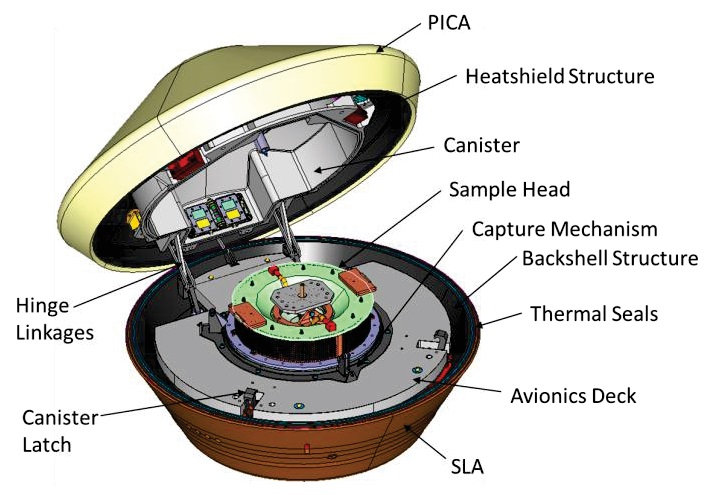
Remember when you had to run the pickle jar under the faucet before you could take off the lid? Well, this can even happen to scientists. In fact, it has happened with NASA’s Origins, Spectral Interpretation, Resource Identification, and Security–Regolith Explorer (OSIRIS-REx) sample canister.
NASA has reported that it is still trying to get the lid off of the canister, though it has been able to collect material from outside the container. On Friday, NASA stated:
In the last week, the team at NASA’s Johnson Space Center in Houston changed its approach to opening the TAGSAM head, which contained the bulk of the rocks and dust collected by the spacecraft in 2020. After multiple attempts at removal, the team discovered two of the 35 fasteners on the TAGSAM head could not be removed with the current tools approved for use in the OSIRIS-REx glovebox. The team has been working to develop and implement new approaches to extract the material inside the head, while continuing to keep the sample safe and pristine.
NASA stated it may take a few more weeks to resolve since the scientists need to be careful with the tools they use in the confined space.
The good news is that, even without the additional material, the team has already recovered about 70 grams of material from asteroid Bennu sample, which surpasses the agency’s goal of bringing at least 60 grams to Earth.
It is a pretty odd ending after the sample has gone through a multi-year journey before landing in the Utah desert. At least the sample canister is in a safe place while the scientists play with it.
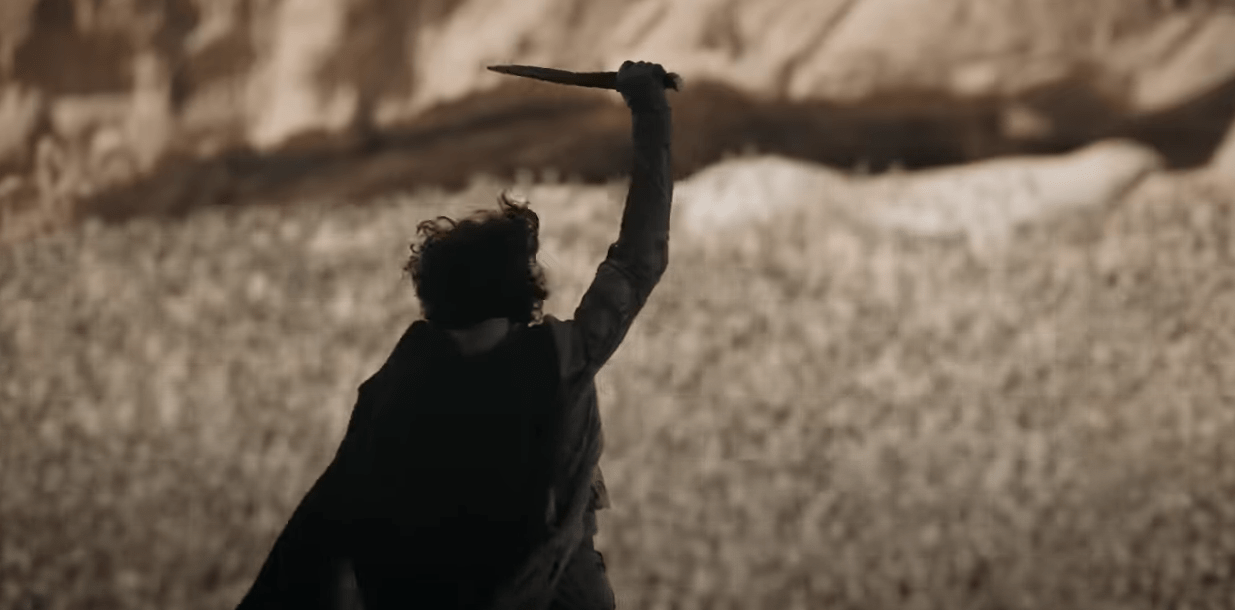
Image (Credit): Scene from Dune, Part Two. (Warner Bros. Pictures)
I had been posting the planned November 3, 2023 date for the premiere of the film Dune, Part Two, but the movie has had some issues and it is not planned for March 15, 2024. Yes, I know, it’s a big disappointment.
Many of you probably already know this. I guess I haven’t been watching the press on this one because Variety magazine and others reported on the delay back in August, attributing it to the writer’s strike.
The last official trailer from Warner Bros. Pictures was three months ago, but it is worth watching again if only to prepare for what is to come (you can see a variety of other more recent trailers floating around from various parties, such as this one from Screen Culture).
I am glad the second film is coming, regardless of the delay. I will just have to re-watch the first part a few more times to get ready for the big battle.


 Our Awesome Universe