Image (Credit): The Australian Square Kilometre Array Pathfinder (ASKAP) radio telescope in Western Australia, which detected the 8 billion-year-old signal. (https://www.icrar.org/)
“We were lucky to be looking at that little spot in the sky for that one millisecond after the eight billion years the pulse had travelled to catch it.”
-Statement by Ryan Shannon, an astrophysicist at Australia’s Swinburne University and co-author of a study describing the signal that was received June 10th last year, as quoted by CBS News. The same article noted that “The pulse was so powerful that — in under a millisecond — it released as much energy as the sun emits over 30 years.”
Image (Credit): Logo of the Indian Space Research Organization. (ISRO)
After recently sending a rover to the Moon and a spaceship to the Sun, India announced plans to build its own space station by 2035 and also send its own astronaut to the Moon by 2040. It also wants to start work on missions to Venus and Mars. How is that for ambitious?
In a press release this week, India’s Prime Minister Shri Narendra Modi stated the following:
Building on the success of the Indian space initiatives, including the recent Chandrayan-3 and Aditya L1 Missions, Prime Minister directed that India should now aim for new and ambitious goals, including setting up ‘Bharatiya Antariksha Station’ (Indian Space Station) by 2035 and sending first Indian to the Moon by 2040.
To realize this Vision, the Department of Space will develop a roadmap for Moon exploration. This will encompass a series of Chandrayaan missions, the development of a Next Generation Launch Vehicle (NGLV), construction of a new launch pad, setting up human-centric Laboratories and associated technologies.
Prime Minister also called upon Indian scientists to work towards interplanetary missions that would include a Venus Orbiter Mission and a Mars Lander.
The space race continues with India showing itself as a strong player in space, potentially replacing Russia as one of the key space-faring nations. It benefits everyone to have more nations studying our solar system. It is unfortunate that Russia has concerned itself with less dignified matters back here on Earth. Maybe it will look to the stars again one day soon.
Image (Credit): Lunar shadow captured on October 14, 2023. (NASA)
This image of last week’s annular solar eclipse was captured by NASA’s Earth Polychromatic Imaging Camera (EPIC) imager carried aboard the Deep Space Climate Observatory (DSCVR), which is a joint venture between NASA, NOAA, and the U.S. Air Force.
An annular eclipse occurs when the Moon passes in front of the Sun but is too far from Earth to completely obscure it. The Moon is at or near its farthest distance from Earth—known as its apogee—during an annular eclipse, making it look smaller in the sky. This leaves the Sun’s edges exposed in a red-orange ring, dubbed the “ring of fire.” A satellite caught an earthly view of the event, as the Moon’s shadow crossed North America.
NASA also provided a map showing those areas in the United States most impacted by the eclipse (shown below).
Image (Credit): Map showing the dark path of the annularity stretching across the lower 48 states from Oregon to Texas. (NASA)
Last month there were a few podcasts worth checking out on our search for intelligent life elsewhere in the galaxy.
The first was an episode from The Planetary Society’s podcast Planetary Radio titled Alone but not lonely with Louis Friedman. Dr. Friedman, co-founder of The Planetary Society, is very skeptical about the Search for Extraterrestrial Life (SETI) efforts, believing we are most likely alone in the universe in terms of intelligent life and, even if there were other lifeforms out there, they are too far away for us to engage with it. That said, he does have ideas for studying exoplanets, such as a solar gravity lens that could significantly magnify the objects we are viewing.
He also discusses The Planetary Society’s solar sail spacecraft and how it could be left floating in our solar system awaiting and then inspecting incoming objects from outside our solar system. Its a great idea. You can read more about his ideas in his latest book (shown above).
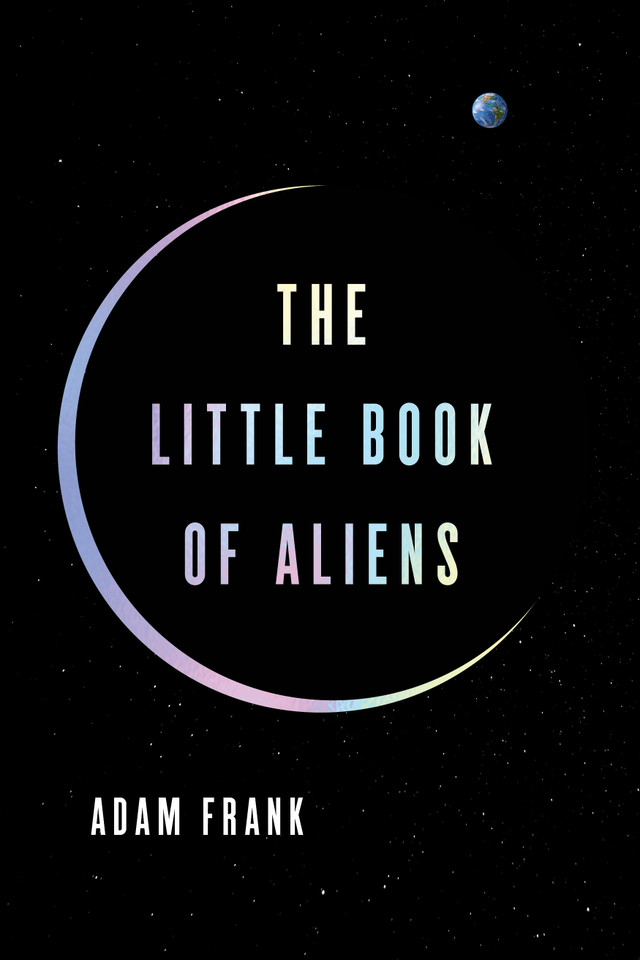
The second episode is from Cool Worlds Lab titled Adam Frank – Technosignatures, Semantic Information, Galactic Colonization. Dr. Frank, a Professor of Physics and Astronomy at Rochester University, is much more optimistic about our ability to eventually find intelligent life in the galaxy and discusses the methods being used today to do so (going beyond the decades old SETI approach). He agrees with Dr. Friedman that we are dealing with great distances that may preclude human travel to these locations.
Dr. Frank even discusses the idea that maybe we were visited by alien civilizations in the past and we don’t know it because we were not here at the time. He discussed this very topic an much more in an earlier Scientific American article, “Alone in a Crowded Milky Way,” stating:
Perhaps long, long ago aliens came and went. A number of scientists have, over the years, discussed the possibility of looking for artifacts that might have been left behind after such visitations of our solar system. The necessary scope of a complete search is hard to predict, but the situation on Earth alone turns out to be a bit more manageable. In 2018 another of my colleagues, Gavin Schmidt of the NASA Goddard Institute for Space Studies, together with Frank, produced a critical assessment of whether we could even tell if there had been an earlier industrial civilization on our planet.
As fantastic as it may seem, Schmidt and Frank argue—as do most planetary scientists—that it is actually very easy for time to erase essentially all signs of technological life on Earth. The only real evidence after a million or more years would boil down to isotopic or chemical stratigraphic anomalies—odd features such as synthetic molecules, plastics or radioactive fallout. Fossil remains and other paleontological markers are so rare and so contingent on special conditions of formation that they might not tell us anything in this case.
It’s a terrific article that also argues that we may be in a part of the galaxy that gets fewer visitors. I recommend listening to the podcast and then reading the article (or checking out his book on the topic, shown below).
Image (Credit): Students at this year’s obstacle course at the U.S. Space & Rocket Center during NASA’s Human Exploration Rover Challenge event. (NASA)
NASA has selected 72 student teams to begin an engineering design challenge to build human-powered rovers that will compete next April at the U.S. Space & Rocket Center in Huntsville, Alabama, near the agency’s Marshall Space Flight Center. Celebrating its 30th anniversary in 2024, the Human Exploration Rover Challenge tasks high school, college, and university students to design, build, and test lightweight, human-powered rovers on an obstacle course simulating lunar and Martian terrain, all while completing mission-focused science tasks.
NASA is mobilizing the scientific community to ensure the agency’s next big space telescope will be ready to deliver a “big picture” view of the universe almost immediately after launching. The Nancy Grace Roman Telescope — also known as the Roman Space Telescope, or just Roman — is set to launch in 2027 and will view the cosmos with a staggeringly wide field of view. Its big-picture observations of distant and early galaxies could help scientists solve the mysteries of dark matter and dark energy. Collectively, this so-called dark universe accounts for 95% of the energy and matter in the cosmos, yet the true nature of dark matter and dark energy eludes scientists.
New plans have been revealed for a $2 billion research center run by UC Berkeley at the NASA Ames Center in Mountain View, Santa Clara County. The Berkeley Space Center, as it will be called, will reshape 36 acres on the sprawling Ames Research Center, providing a hub for future companies to collaborate with the school and NASA scientists & engineers to improve technology for aviation, space exploration, and how people live and work in space.




 Our Awesome Universe