Television: The First Season of Star Wars: Ahsoka

Image (Credit): The main character Ahsoka. (Disney)

So now that I have seen the full series of the Star Wars TV series Ahsoka, I can say that it was better than I expected. However, it was pretty slow all the way up until episode 6 when a another galaxy far, far away was introduced.

The first five episodes where slow, predictable, and almost had the feeling of a fan-created film. Everything from the dialogue to the uniforms to the spacecraft was odd. And creating a female-based story that merely mimics earlier tropes, such as the first episode with Ashoka playing Indiana Jones and Sabine Wren playing a disgruntled teenage (much like the younger Luke Skywalker), was a bit too much. Plus, the idea that these women were pining for a lost boyfriend (Ezra) who they needed to save was the cherry on top of a collapsing pile of mess.

The presence of Anakin Skywalker mid-series did not enhance my feelings towards the show. More than anything, I found it confusing. Why is this show trying to resurrect the reputation of a man who slaughtered children in a Jedi daycare and murdered millions by blowing up planets? Did the creators really need a cameo that bad that they would sink to that level?

Only with episode six with the Grand Admiral “Papa Smurf” Thrawn and his Macbeth-like witches did the series become interesting, though I do not know why the storm troopers were unable to wash their armor and the Imperial Star Destroyer was painted up like a hippie van. And did the creatures on the planet remind you of gentle Jawas and warlike Sand People, or is that just me?

Anyway, I will give the show another chance now that I know what is possible, though I would not say this was the strongest showing by Disney. That said, it was better than some of the other Star Wars spin-offs.

Here is my ranking of all the Star Wars live-action series to date:

  1. Andor
  2. The Mandalorian
  3. Ahsoka
  4. The Book of Boba Fett
  5. Obi-Wan Kenobi

I have many more comments about the new series, but I will leave it there. I am dropping in a few more comments I found that parallel mine to some degree.

At least we still have “Andor.”
Ben Travers, indieWire

No matter how hard it strives for widespread accessibility, it’s a sequel that will be of primary interest to established fans.
Nick Schager, The Daily Beast

At a time when audiences have thinning patience both for super-heroics and too much fan service, Ahsoka will still need to raise its game to prove it’s more than wish fulfillment for longtime Star Wars fans.
Eric Deggans, NPR

Space Quote: Rich Bounty from the Asteroid Bennu Sample

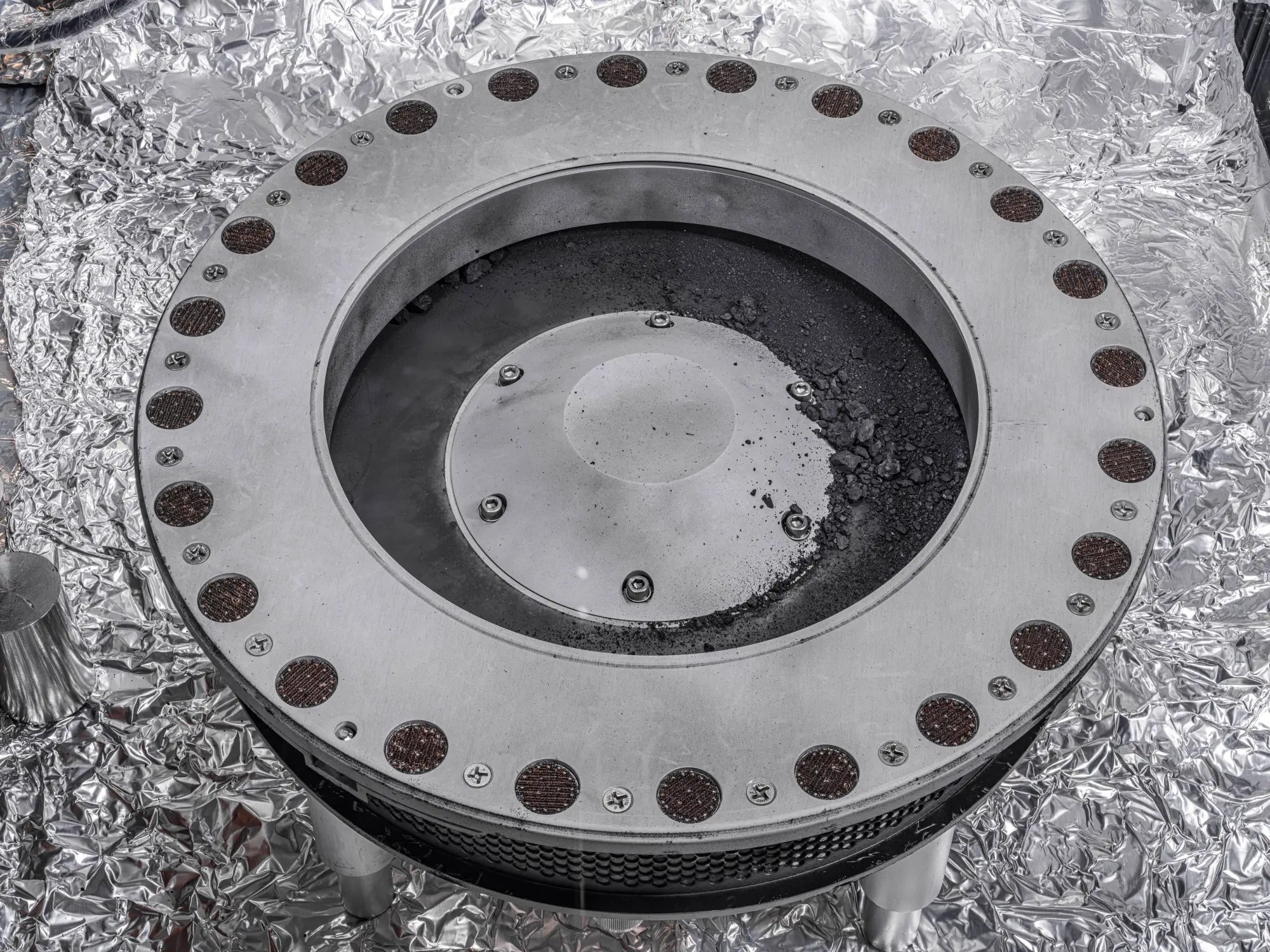
Image (Credit): Outside view of the OSIRIS-REx sample collector. You an see sample material from asteroid Bennu on the middle right. (NASA/Erika Blumenfeld & Joseph Aebersold)

“As we peer into the ancient secrets preserved within the dust and rocks of asteroid Bennu, we are unlocking a time capsule that offers us profound insights into the origins of our solar system…The bounty of carbon-rich material and the abundant presence of water-bearing clay minerals are just the tip of the cosmic iceberg. These discoveries, made possible through years of dedicated collaboration and cutting-edge science, propel us on a journey to understand not only our celestial neighborhood but also the potential for life’s beginnings. With each revelation from Bennu, we draw closer to unraveling the mysteries of our cosmic heritage.”

Statement by Dante Lauretta, OSIRIS-REx principal investigator, regarding the recently-arrived sample collected from asteroid Bennu. NASA and its partners are expected to study the sample for the next two years to learn more about the asteroid and our solar system.

Audit Results: More Concern About NASA’s Space Launch System

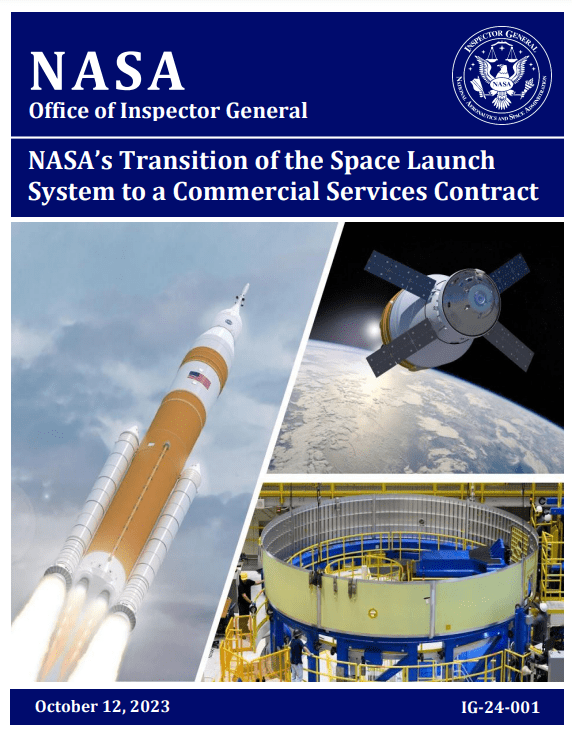
First, the US Government Accountability Office reported that NASA’s Space Launch System (SLS) is unaffordable, and now NASA’s Office of Inspector General (OIG) doubles down on that earlier finding, reporting that the SLS, a key component of the Artemis program, has costs that are spinning out of control.

In its report, NASA’s Transition of the Space Launch System to a Commercial Services Contract, NASA OIG concludes:

Our analysis shows a single SLS Block 1B will cost at least $2.5 billion to produce—not including Systems Engineering and Integration costs—and NASA’s aspirational goal to achieve a cost savings of 50 percent is highly unrealistic. Specifically, our review determined that cost saving initiatives in several SLS production contracts such as reducing workforce within Boeing’s Stages contract and gaining manufacturing efficiencies with Aerojet Rocketdyne’s RS-25 Restart and Production Contract were not significant and, as a result, a single SLS will cost more than $2 billion through the first 10 SLS rockets produced under [the Exploration Production and Operations Contract].

NASA OIG concludes that maybe other contractors needs to be considered, stating:

Although Congress directed NASA in 2010 to build a heavy-lift rocket and crew capsule using existing contracts from the canceled Constellation effort to meet its space exploration goals, the Agency may soon have more affordable commercial options to carry humans to the Moon and beyond. In our judgment, the Agency should continue to monitor the commercial development of heavy-lift space flight systems and begin discussions of whether it makes financial and strategic sense to consider these options as part of the Agency’s longer-term plans to support its ambitious space exploration goals.

Where are these “more affordable commercial options”? Could it be SpaceX? Blue Origin? If so, let’s start the transition ASAP so that the Moon and Mars remain a realistic goal in the near future. We have plenty of talent in this country and a race to the top is what we need, not a space agency stuck with an Edsel rocket system.

The Psyche Mission Begins

Credit: NASA

It may be Friday the 13th, but the news has been positive about the Psyche spacecraft, which earlier today successfully launched from  NASA’s Kennedy Space Center in Florida.

Here is part of a statement by Arizona State University Professor Lindy Elkins-Tanton, the Principal Investigator (PI) of the Psyche mission, from back in 2017 as she awaited word on whether the Psyche mission had been green-lighted by NASA:

I’ve only been working on this project for five and a half years. Some of my competitors have been through the process before with the same ideas, and are coming up on a decade of trying to fly their concept. Still, five and a half years. About 150 people have worked on this concept with me. We’ve written about 2,000 pages, including the step 1 and step 2 proposals and all the written, edited, revised, formatted, and published answers to questions that came in between. We have art and models and videos and new scientific and engineering results because of all our efforts to understand how to get to the metal world Psyche and what we might find if we did, and how we could measure it and send the information back to Earth and understand it and interpret it for everyone in the world.

To say our hearts are in this project would be too facile, too surficial, too trite. We have lived and breathed this. We know and love each other and we know each other’s families and we have learned when to be quiet and let the other person work through a peak of frustration late at night after no rest for weeks. We have sweated through countless reviews and celebrated with numerous cakes and dinners the many intermediate successes that allowed us to get here, the ultimate intermediate success, the privilege to wait for the phone call.

Here is PI Lindy Elkins-Tanton’s quote from earlier today:

We said ‘goodbye’ to our spacecraft, the center of so many work lives for so many years – thousands of people and a decade…But it’s really not a finish line; it’s a starting line for the next marathon. Our spacecraft is off to meet our asteroid, and we’ll fill another gap in our knowledge – and color in another kind of world in our solar system.

Congratulations to PI Lindy Elkins-Tanton and her team on a job well done (so far, of course).

Pic of the Week: Eyeing the Ring Nebula

Image (Credit): The Ring Nebula as captured by the JWST. (ESA/Webb, NASA, CSA, M. Barlow (University College London), N. Cox (ACRI-ST), R. Wesson (Cardiff University))

This week’s image comes from the Jame Webb Space Telescope’s (JWST) Near-Infrared Camera (NIRCam). It shows the Ring Nebula, which is approximately 2,500 light-years away. It looks like a heavenly eyeball. with an Earth-colored iris.

Here is more on the image from NASA:

The NASA/ESA/CSA James Webb Space Telescope has observed the well-known Ring Nebula with unprecedented detail. Formed by a star throwing off its outer layers as it runs out of fuel, the Ring Nebula is an archetypal planetary nebula. Also known as M57 and NGC 6720, it is both relatively close to Earth at roughly 2,500 light-years away. This new image provides unprecedented spatial resolution and spectral sensitivity. For example, the intricate details of the filament structure of the inner ring are particularly visible in this dataset. There are some 20,000 dense globules in the nebula, which are rich in molecular hydrogen. In contrast, the inner region shows very hot gas. The main shell contains a thin ring of enhanced emission fromcarbon-based molecules known as polycyclic aromatic hydrocarbons (PAHs). Roughly ten concentric arcs are located just beyond the outer edge of the main ring. The arcs are thought to originate from the interaction of the central star with a low-mass companion orbiting at a distance comparable to that between the Earth and the dwarf planet Pluto. In this way, nebulae like the Ring Nebula reveal a kind of astronomical archaeology, as astronomers study the nebula to learn about the star that created it.