Image (Credit): The Psyche spacecraft sits aboard a SpaceX Falcon Heavy rocket earlier today at Launch Complex 39A. (NASA/Aubrey Gemignani)
After a number of delays, the Psyche mission appears ready to go as the spacecraft sits at Launch Complex 39A at the Kennedy Space Center in Florida. The launch is scheduled for tomorrow at 10:16 a.m. EDT.
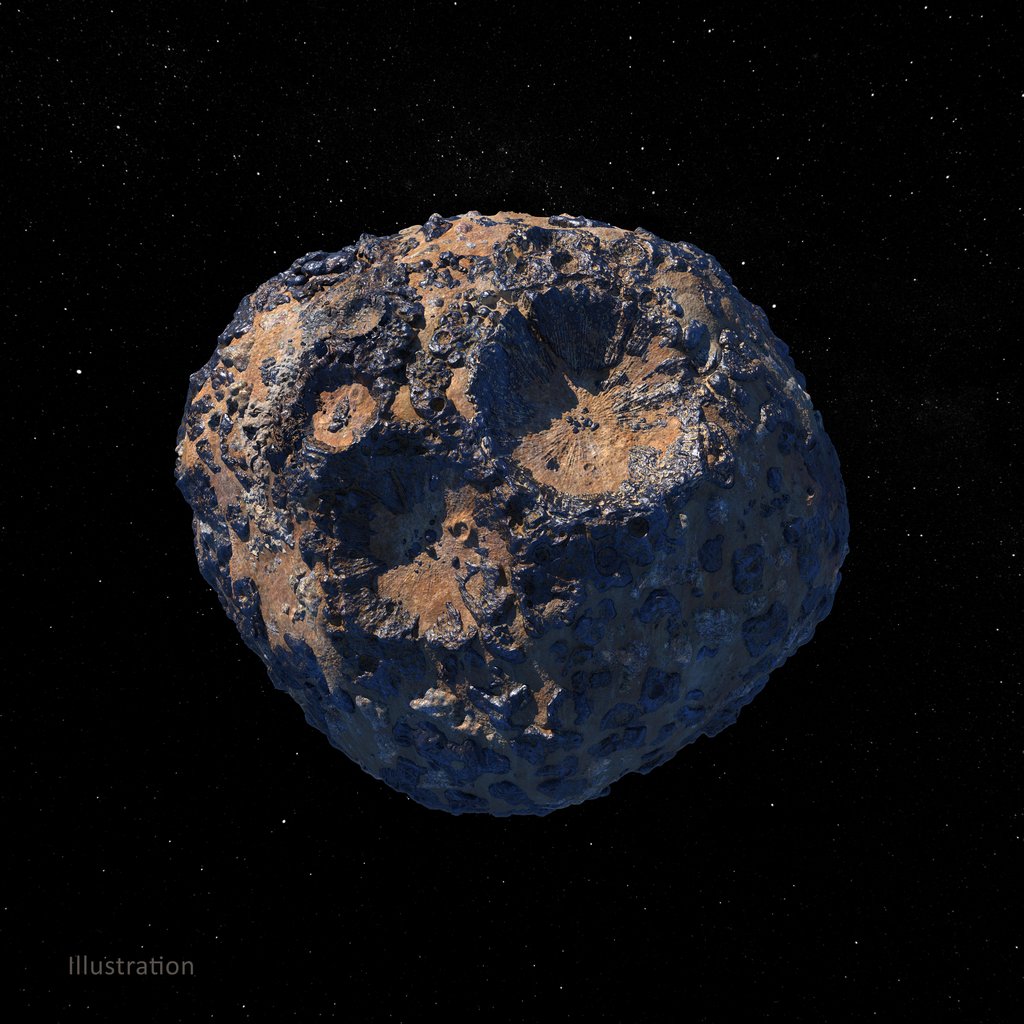
The spacecraft will not reach the metal-rich asteroid Psyche until 2029. It will then orbit the asteroid for about two years collecting data to learn more about an object that astronomers believe may contain clues about the formation of the rocky planets closest to the Sun.
If you missed the Annual International Mars Society Convention last weekend in Arizona, you will soon be able to catch up on all of the presentations.
First, you can find abstracts on all of the convention presentations here, which includes many topics, such as:
Investigating the Effects of Time-Delayed Communications on the Crew Mission Support;
Terraform Earth, then Mars;
Methods for Choosing Government Officials in the Mars Context;
Space and Ocean exploration as the Alternative to World War III;
Agriculture on Mars; and
Advancements in Sustainable Materials for Revolutionizing Mars Exploration.
Next, you can find the recordings of many of the presentations from past conventions on the Society’s YouTube page. I expect you will soon see recordings from the latest convention on this same Youtube page as well.
It’s a great service for interested parties who could not make it to the conventions. I recommend you check it out.
Fashion house Prada has teamed up with commercial space company Axiom Space to create lunar spacesuits for NASA’s Artemis III mission, which will be the first crewed moon landing since 1972.Called Axiom Extravehicular Mobility Unit (AxEMU), the suits will be designed to give astronauts “advanced capabilities for space exploration,” Prada said. They are an evolution of NASA’s Exploration Extravehicular Mobility Unit (xEMU) spacesuit design and will use “innovative technologies and design” to be more flexible and provide more protection against the harsh lunar environment, according to the brand.
On some nights, one of the brightest objects in the sky is neither a planet nor a star. It is a telecommunications satellite called BlueWalker 3, and at times it outshines 99% of the stars visible from a dark location on Earth, according to observations reported today in Nature. BlueWalker 3 is the most brilliant recent addition to a sky that is already swarming with satellites. The spaceflight company SpaceX alone has launched more than 5,000 satellites into orbit, and companies around the globe have collectively proposed launching more than half a million satellites in the coming years — a scenario that astronomers fear could hamper scientific observations of the Universe.
The Russian segment of the International Space Station (ISS) has sprung its third coolant leak in under a year, raising new questions about the reliability of the country’s space programme even as officials said crew members were not in danger. Flakes of frozen coolant spraying into space were seen in an official live feed of the orbital lab provided by Nasa on Monday, and confirmed in radio chatter between US mission control and astronauts. “The Nauka module of the Russian segment of the ISS has suffered a coolant leak from the external (backup) radiator circuit, which was delivered to the station in 2012,” Russian space agency Roscosmos said on Telegram, adding temperatures remained normal in the affected unit.
I recently watched the movie A Million Miles Away after experiencing a summer with no blockbuster films addressing anything interesting related to space travel or alien life. I was happy that this new movie (available on Amazon Prime last month) addressed both, but the “alien” life related to migrant farmers seeking a better life in America.
You will quickly become hooked on the dreams of future astronaut José Hernández as he winds a narrow path to become a NASA flight engineer. You can see a clip of the film here.
The first hour of the film covers the story of his youth, education, and start of a family. After that, you are with him as he is tested by NASA trainers in a way that few of us can imagine. His story intertwines with the Shuttle Columbia disaster, which add another interesting and somber layer to his story.
The film is later interlaced with images of the actors and real persons, including images of José Hernández as he worked on the International Space Station.
Its a great story for the entire family. Yes, it is old story about following your dreams, but it also shows what other may sacrifice along the way to make the dreams of a child or spouse possible.
Rotten Tomatoes shows an Audience Score of 96 percent. I agree with the audience on this one.
Image (Credit): Launch of the Amazon Project Kuiper prototypes from Cape Canaveral. (Amazon)
If you were worried about satellite traffic and its impact on astronomy, then you have one more thing to worry about. Yesterday, two prototype satellites were launched aboard an Atlas V rocket from the Cape Canaveral Space Force Station. They are part of Amazon’s Project Kuiper, which may lead to 3,200 additional satellites orbiting the Earth.
Project Kuiper is an initiative to increase global broadband access through a constellation of 3,236 satellites in low Earth orbit (LEO). Its mission is to bring fast, affordable broadband to unserved and underserved communities around the world.
Sounds a lot like SpaceX’s Starlink, doesn’t it? And plenty more similar projects are being planned by the Chinese and others.
It does make you wonder whether there is a better way. I understand the nationals security complications with satellites, but thousands upon thousands of satellites circling the Earth to provide similar Internet services to customers sounds wasteful, dangerous, and bothersome to astronomy. I liked it better when the wires were running under the seas or underground. This new approach will be a mess.
The Government Accountability Office issued a report last year highlighting some of the risks and mitigation ideas:
Increase in orbital debris. Debris in space can damage or destroy satellites, affecting commercial services, scientific observation, and national security. Better characterizing debris, increasing adherence to operational guidelines, and removing debris are among the possible mitigations, but achieving these is challenging.
Emissions into the upper atmosphere. Rocket launches and satellite reentries produce particles and gases that can affect atmospheric temperatures and deplete the ozone layer. Limiting use of rocket engines that produce certain harmful emissions could mitigate the effects. However, the size and significance of these effects are poorly understood due to a lack of observational data, and it is not yet clear if mitigation is warranted.
Disruption of astronomy. Satellites can reflect sunlight and transmit radio signals that obstruct observations of natural phenomena. Satellite operators and astronomers are beginning to explore ways of mitigating these effects with technologies to darken satellites, and with tools to help astronomers avoid or filter out light reflections or radio transmissions. However, the efficacy of these techniques remains in question, and astronomers need more data about the satellites to improve mitigations.
The report has a lot of good information, but I am not sure Amazon, SpaceX, or the Chinese will be paying any attention until a world body gets involved. National regulation will not be enough.
More likely than not, as with many of these areas in need of regulation, we are just one major accident away from new rules.







 Our Awesome Universe