Image (Credit): Image of Jupiter taken by the Hubble Space Telescope. (Amy A. Simon/NASA/European Space Agency)
“We find them down as small as one Jupiter mass, even half a Jupiter mass, floating freely, not attached to a star…Physics says you can’t even make objects that small. We wanted to see, can we break physics? And I think we have, which is good.”
–Statement by Mark McCaughrean, a senior adviser for science and exploration at the European Space Agency, regarding Jupiter Mass Binary Objects (JuMBO). These objects were spotted by the James Webb Space Telescope in the Orion Nebula. They may be a new astronomical body as they do not fit into the normal star or planet category.
Image (Credit): NGC 1087 as captured by the Hubble Space Telescope. (Space Telescope Science Institute and Gladys Kober, NASA/Catholic University of America)
This week’s image comes from the NASA/ESA Hubble Space Telescope. It is an image of the grainy-textured, colorful barred spiral galaxy NGC 1087, which is about 80 million light-years away.
It has a diameter of 87,000 light-years and a very small nucleus, or center. The galaxy’s dust lanes, seen in dark red, help define its spiral structure. NGC 1087’s stellar bar – the elongated, bright-white structure at the galaxy’s center – is also shorter compared to other barred galaxies. Typically, in barred galaxies, the gravity of the center pulls in large quantities of gas, causing a burst of star formation followed by a slow decay. Uniquely, NGC 1087 shows signs of new star formation, making it of special interest to scientists.
British astronomer William Herschel discovered NGC 1087 in 1785. The galaxy sits just south of the celestial equator, making it visible from both hemispheres. In 1995, astronomers discovered a Type II supernova within this galaxy. Type II supernovae occur when a massive star uses all of its nuclear fuel and its iron core collapses, then explodes. Named 1995V, it is the only supernova ever seen in this galaxy.
In this new ultraviolet, visible, and near-infrared light image from NASA’s Hubble Space Telescope, the dark red streaks are cold molecular gas, the raw material from which stars form. The spots of bright pink signal areas where new stars are forming, characterized by the presence of ionized hydrogen, oxygen, and sulfur. The bluer regions hold hot, young stars formed earlier in the lifetime of this galaxy. Hubble observed NGC 1087 to study the connection between young stars and cold gas, and especially to determine what happens to gaseous regions after stars are formed within them.
Take a look at the image above. Can you determine where this image originated? Take a guess and then check your answer by going to the “Where is This? The Answer Sheet” page.
Things are looking up for the satellite business. That is, things should shortly be coming down from space that no longer need to be there, and that is a good thing. And Starfish Space hopes to be the one to bring down those satellites.
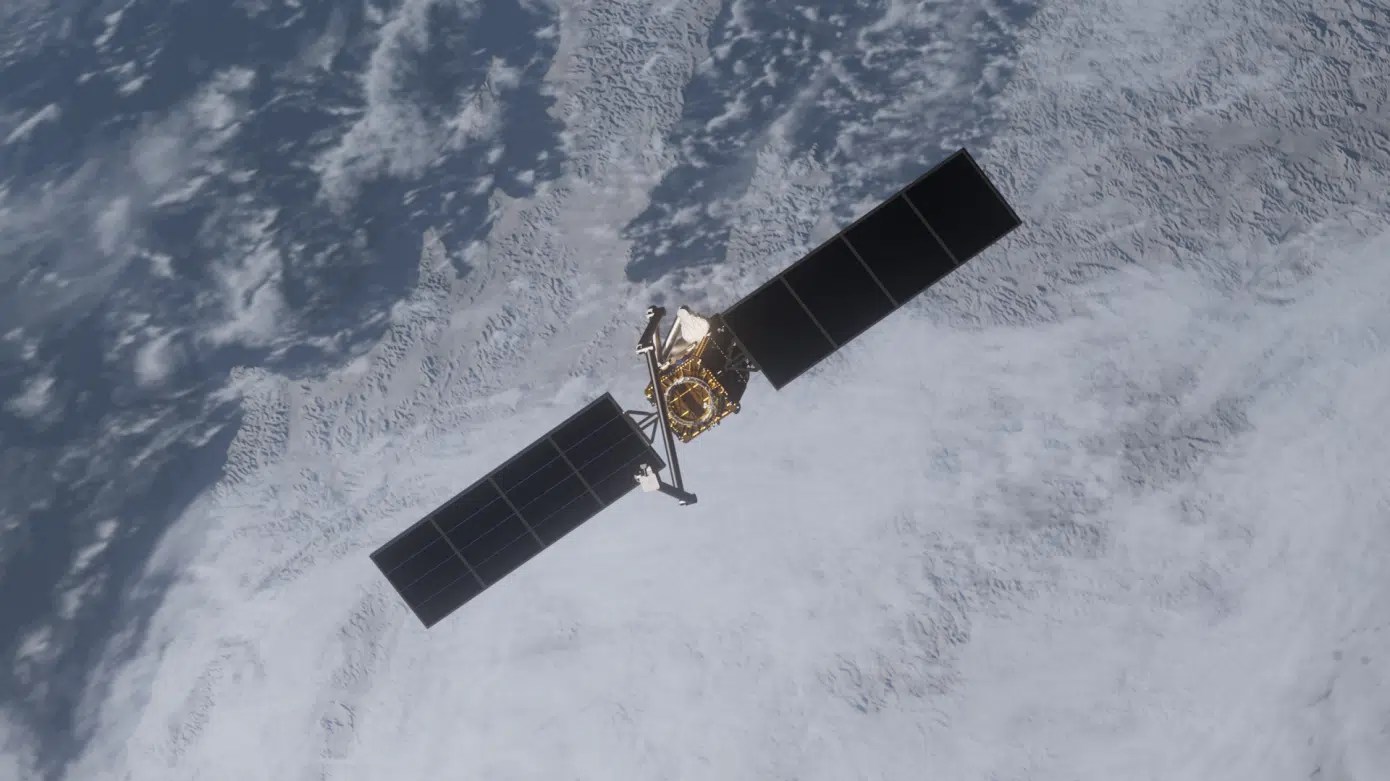
Here is the story. Starfish Space has created the electric-propulsion Otter Pup prototype spacecraft to act as a tug boat in space that can safely nudge old satellites and debris out of orbit. This will be the basis for the commercially-available Otter spacecraft in the near future. The mission of this spacecraft could also be expanded to serve as a “robotic repair crew.”
It sounds so promising that NASA has awarded the company with a contract to expand its work in this area.
This is good news for anyone concerned about the growing amount of traffic and debris in low-Earth orbit. We have no problem tossing things into space, but we have not given enough thought to what happens later. The Otter Pup is a step in the right direction.
Note: You can see a July 2022 Starfish Space presentation to NASA about the Otter spacecraft here.
Image (Credit): The Otter Pup prototype spacecraft . (Starfish Space)
With just under two weeks until its planned launch, NASA’s Psyche mission has been rescheduled. As per a NASA blog post, the agency along with SpaceX are now aiming for liftoff on October 12 at 10:16 A.M. EDT from the Kennedy Space Center in Florida — the first of several NASA science missions that will ride to space on a Falcon Heavy Rocket. The mission was originally set to launch October 5.
A team of astronomers has made an important leap forward in our understanding of the intriguing TRAPPIST-1 exoplanetary system. Not only has their research shed light on the nature of TRAPPIST-1 b, the exoplanet orbiting closest to the system’s star, but it has also shown the importance of parent stars when studying exoplanets. The findings, published today in Astrophysical Journal Letters, shed light on the complex interplay between stellar activity and exoplanet characteristics.
NASA is funding eight new studies aimed at better understanding how the human body reacts to spaceflight. These studies will be done on Earth without the need for samples and data from astronauts. Collectively, these studies will help measure physiological and psychological responses to physical and mental challenges that astronauts may encounter during spaceflight. With this information, NASA may be better able to mitigate risks and protect astronaut health and performance during future long-duration missions to the International Space Station, the Moon, Mars, and beyond.



 Our Awesome Universe