The bottom line is that we should not rush towards permanent settlements at either location until we know more about the human body, the human mind, and human politics (good luck with the last one).
The conversation covers a variety of risks, including the effects of gravity on the human body, the ability to procreate in space, and the effectiveness of treaties as nations plan to settle and mine the Moon and Mars. The authors note that we have not had ample time to study all of these issues even with the International Space Station (ISS) in orbit because this has not been the focus of many space efforts to date. For instance, the ISS does not test the impact of radiation on humans because it is in low Earth orbit within the protection of the planet’s magnetic field.
Overall, the authors advise time and more study before jumping into a settlement. This may mean putting off permanent settlements for a few hundred years.
And what about Elon Musk’s plan to start shipping colonists to Mars in his lifetime? As with many things related to Mr. Musk, he does oversell ideas. His energy in the infrastructure realm is good, but his predictions related to humanity in general are usually unreliable.
Image (Credit): Artist’s rendering of a Martian space city. (SpaceX)
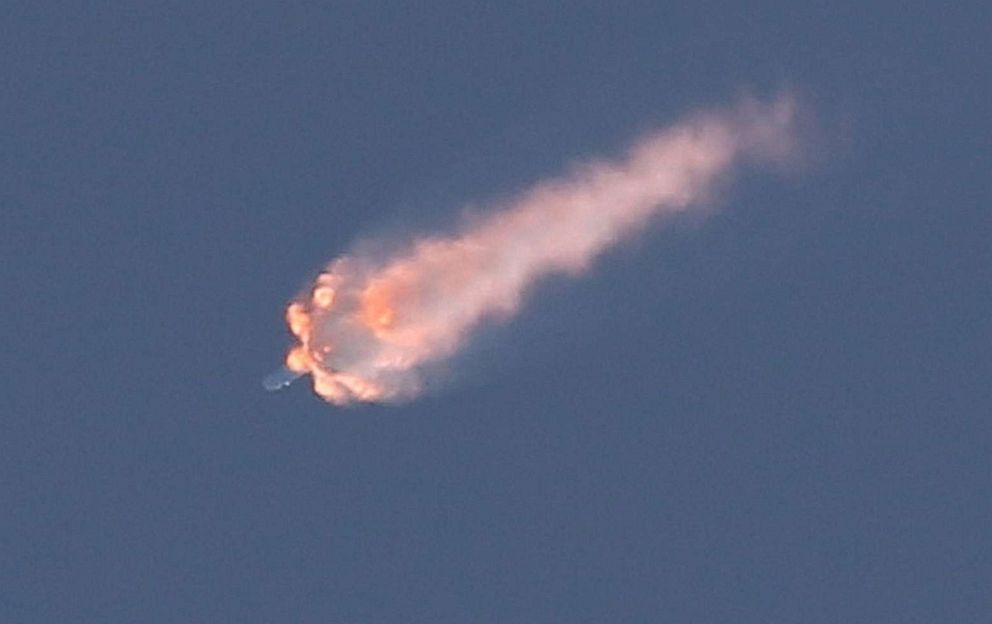
Image (Credit): 2015 explosion of a SpaceX Falcon 9 rocket. (ABC News)
SpaceX may have suffered a rocket loss yesterday, but everyone agrees that this is part of the process when trying something big.
What can we then say about Mr. Musk creating a second loss last week, but in this case it was a loss of confidence in his leadership at Twitter (yes, the site is also oddly called “x” even though the web address is still twitter.com)? Is that also part of the process when trying something big, or is he simply becoming a loss leader that is getting in his own way. And, more importantly to this site, is he squandering his other assets, including SpaceX?
The latest incident involves his support of an earlier post on Twitter that defamed the American Jewish community. It is unclear why Mr. Musk cannot act like an adult and focus on his businesses, but his actions have led to multiple firms pulling their advertising dollars from Twitter.
I agree his irresponsible behavior is nothing new, but it is starting to raise even more eyebrows as his businesses become more entangled with US Government missions. He is not just pushing a declining social app and electric cars, but rather he is also launching critical military satellites, bringing astronauts to the International Space Station, and planning to heavily support our return to the Moon.
Exhibit A – Kelsey D. Atherton, Chief Editor at the Center for International Policy, had this to say recently about Mr. Musk and SpaceX:
In the immediate term, Congress needs to investigate whether Musk’s public comments present a breach of contract on ethical or reliability grounds. Congress could require that any company that receives launch contracts must go public, ensuring at least some mechanism for shareholders to oust a CEO should they become a public or security liability.
I recommend reading the entire article. It is one voice at the moment, but the evidence is growing that Mr. Musk may be the wrong person to rely on in these times when he clearly cannot control himself. His “Rapid Unscheduled Disassembly” is painful to watch and something we need to guard against.
Earlier today, SpaceX lost contact with its Starship rocket about 10 minutes into the launch. This happened after the second-stage separation, so while a successful landing of the rocket did not occur, the rocket had more success than the launch earlier this year.
After what appeared to be a self-detonation of the Starship rocket, the Federal Aviation Administration stated, “The anomaly resulted in a loss of the vehicle. No injuries or public property damage have been reported.” That includes the launchpad, which was basically destroyed during the last launch.
Baby steps.
It is not clear if this latest incident will lead to another long delay before another attempt is possible. And such tests are increasingly expensive when your reusable parts continue to blow up rather than land.
A lot is riding on these launches, as well as the reusable feature, given that NASA is estimating that as many as 20 Starship launches will be necessary under the Artemis III moon mission. Of course, if someone asked NASA to schedule 20 Space Launch System launches in this way, I doubt we would even be talking about an Artemis program.
Mr. Musk has promised a lot to the US space program. We need his full attention on this project.
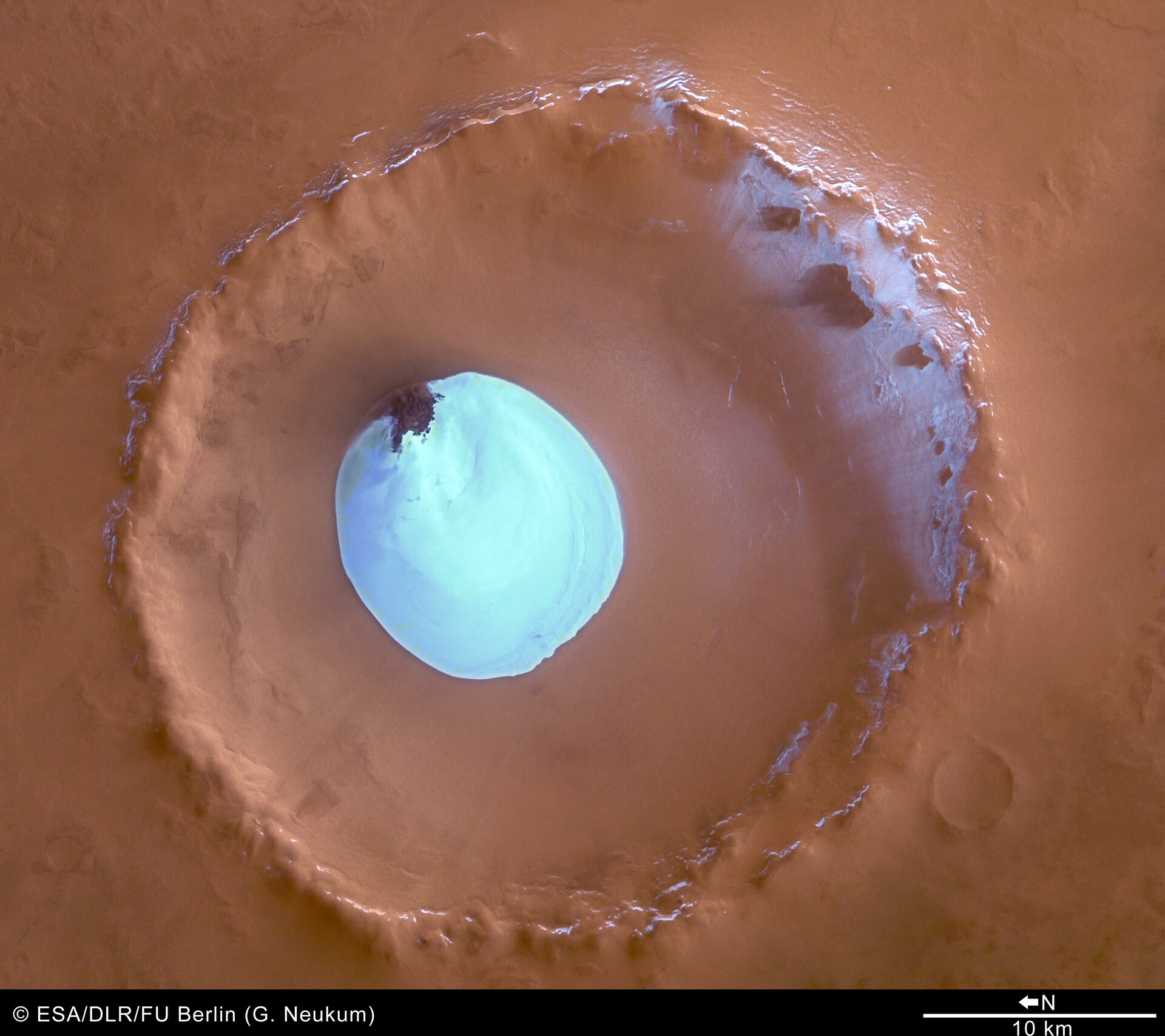
Image (Credit): Martian impact crater located on Vastitas Borealis with residual water ice. (ESA/DLR/FU Berlin (G. Neukum))
While the media is continually writing about artificial intelligence (AI) doing a kid’s homework and then destroying the world, maybe AI does have some utility in preparing us for a second world.
A study published in Nature Synthesis found that AI may be useful in finding ways to extract oxygen from water on Mars. Scientists from China used AI to analyze about 3.7 million formulae to identify a chemical that could break down water. A single researcher would have needed about 2,000 years to perform similar analysis.
While other programs are also looking at ways to extract oxygen from the Martian surface or atmosphere (such as NASA’s MOXIE), this study demonstrates the power of AI and its ability to potentially produce other needed material for survival on Mars.
Mr. Musk may not like AI, but he may want to have it on hand if he ever finds himself on Mars.
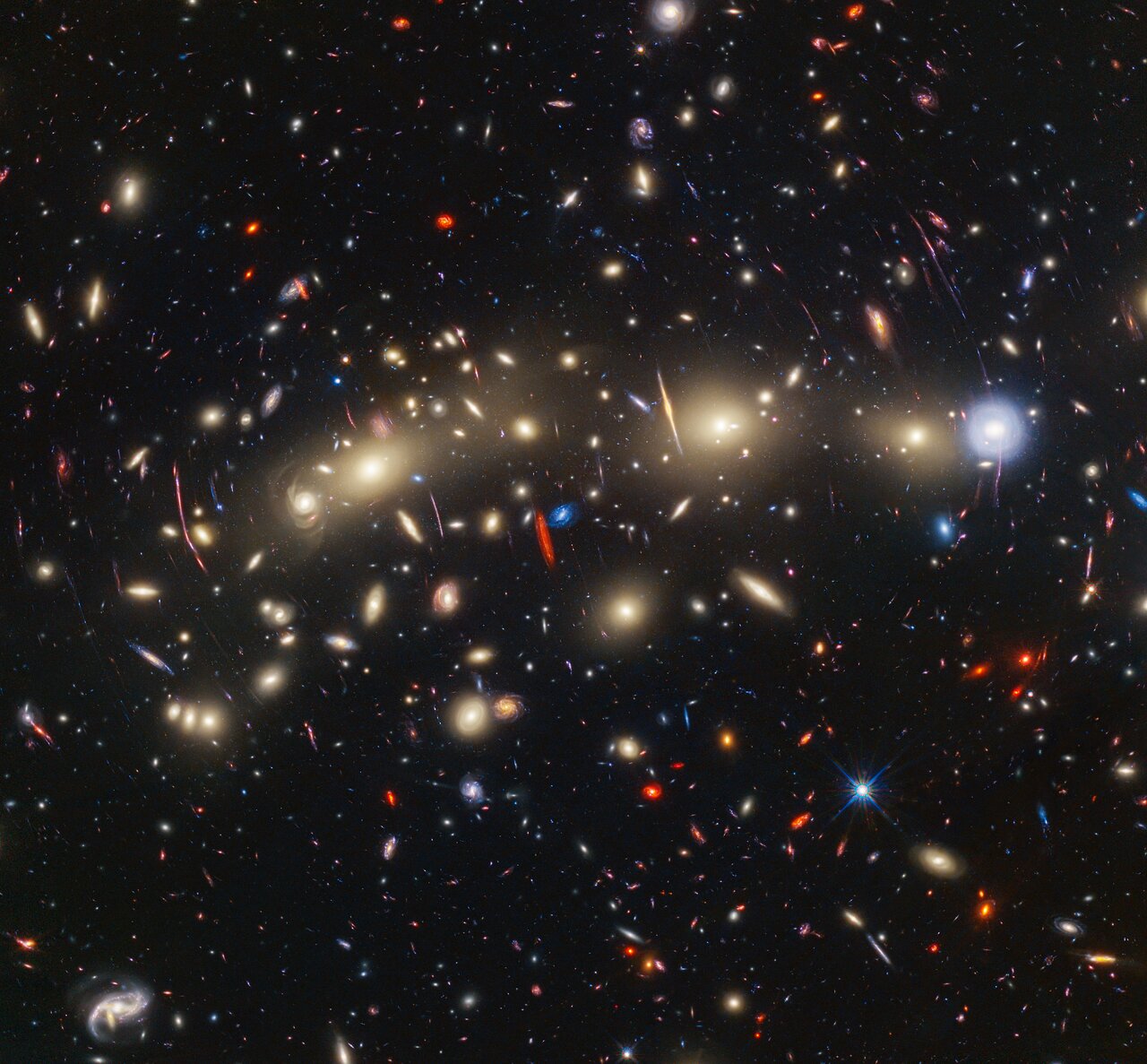
Image (Credit): Galaxy cluster MACS0416. (NASA, ESA, CSA, STScI, J. Diego (Instituto de Física de Cantabria, Spain), J. D’Silva (U. Western Australia), A. Koekemoer (STScI), J. Summers & R. Windhorst (ASU), and H. Yan (U. Missouri))
This week’s image combines the talents of the Hubble Space Telescope and the James Webb Space Telescope to create a dazzling show of light. The galaxy cluster, known as MACS0416, is about 4.3 billion light-years from Earth.
The image reveals a wealth of details that are only possible by combining the power of both space telescopes. It includes a bounty of galaxies outside the cluster and a sprinkling of sources that vary over time, likely due to gravitational lensing — the distortion and amplification of light from distant background sources.
This cluster was the first of a set of unprecedented, super-deep views of the Universe from an ambitious, collaborative Hubble programme called the Frontier Fields, inaugurated in 2014. Hubble pioneered the search for some of the intrinsically faintest and youngest galaxies ever detected. Webb’s infrared view significantly bolsters this deep look by going even farther into the early Universe with its infrared vision.
To make the image, in general the shortest wavelengths of light were colour-coded blue, the longest wavelengths red, and intermediate wavelengths green. The broad range of wavelengths, from 0.4 to 5 microns, yields a particularly vivid landscape of galaxies.
Those colours give clues to galaxy distances: the bluest galaxies are relatively nearby and often show intense star formation, as best detected by Hubble, while the redder galaxies tend to be more distant and are best detected by Webb. Some galaxies also appear very red because they contain copious amounts of cosmic dust that tends to absorb bluer colours of starlight.
While the new Webb observations contribute to this aesthetic view, they were taken for a specific scientific purpose. The research team combined their three epochs of observations, each taken weeks apart, with a fourth epoch from the CANUCS (CAnadian NIRISS Unbiased Cluster Survey) research team. The goal was to search for objects varying in observed brightness over time, known as transients.
They identified 14 such transients across the field of view. Twelve of them were located in three galaxies that are highly magnified by gravitational lensing, and they are likely to be individual stars or multiple-star systems that are briefly very highly magnified. The remaining two transients are within more moderately magnified background galaxies and are likely to be supernovae.
The finding of so many transients with observations spanning a relatively short timeframe suggests that astronomers could find many more transients in this cluster and others like it through regular monitoring with Webb.
Among the transients the team identified, one stood out in particular. Located in a galaxy that existed about 3 billion years after the Big Bang, it is magnified by a factor of at least 4000. The team nicknamed the star system Mothra in a nod to its ‘monster nature’, being both extremely bright and extremely magnified. It joins another lensed star that the researchers previously identified and that they nicknamed Godzilla. Both Godzilla and Mothra are giant monsters known as kaiju in Japanese cinema.
Interestingly, Mothra is also visible in the Hubble observations that were taken nine years earlier. This is unusual, because a very specific alignment between the foreground galaxy cluster and the background star is needed to magnify a star so greatly. The mutual motions of the star and the cluster should have eventually eliminated that alignment.
The most likely explanation is that there is an additional object within the foreground cluster that is adding more magnification. The team was able to constrain its mass to be between 10 000 and 1 million times the mass of our Sun. The exact nature of this ‘milli-lens’, however, remains unknown. It is possible that the object is a globular star cluster that’s too faint for Webb to observe directly.




 Our Awesome Universe