
If you have any questions about the reason January 1 is the start to the year, Earthsky has a good explanation of the holiday’s Roman roots. Enjoy yourself, but please do not sacrifice any rams. You will understand after you read the Earthsky piece.

If you have any questions about the reason January 1 is the start to the year, Earthsky has a good explanation of the holiday’s Roman roots. Enjoy yourself, but please do not sacrifice any rams. You will understand after you read the Earthsky piece.
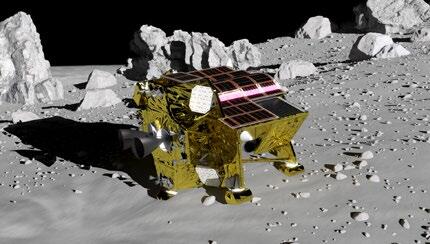
Japan is determined to get onto the moon as soon as possible. An attempt to land on the Moon earlier this year by a private Japanese company ended in failure, but things are looking good so far with the latest mission.
Launched on September 6th, the Japan Aerospace Exploration Agency (JAXA) spacecraft, called the Smart Lander for Investigating Moon (SLIM) and nicknamed the “Moon Sniper” lander, is now in orbit around the Moon. The plan is to place a robotic explorer on the lunar surface by mid-January.
The stated purpose of SLIM is to:
In terms of the upcoming events, JAXA stated the following in a press release:
From now until mid-January 2024, the apolune point will be lowered, and the orbit adjusted to a circular orbit at an altitude of approximately 600km. The perilune point will then lower and preparations for landing will begin. On January 19, the perilune point will be lowered to an altitude of 15km, and the descent towards the Moon will start at around 0:00am (JST) on January 20. Landing on the lunar surface is scheduled for around 0:20am (JST) on January 20.
The race to the Moon continues.
Best wishes to Japan for a successful landing.

Nature Astronomy abstract of the study findings:
The conventional observables to identify a habitable or inhabited environment in exoplanets, such as an ocean glint or abundant atmospheric O2, will be challenging to detect with present or upcoming observatories. Here we suggest a new signature. A low carbon abundance in the atmosphere of a temperate rock`y planet, relative to other planets of the same system, traces the presence of a substantial amount of liquid water, plate tectonics and/or biomass. Here we show that JWST can already perform such a search in some selected systems such as TRAPPIST-1 via the CO2 band at 4.3 μm, which falls in a spectral sweet spot where the overall noise budget and the effect of cloud and/or hazes are optimal. We propose a three-step strategy for transiting exoplanets: detection of an atmosphere around temperate terrestrial planets in about 10 transits for the most favourable systems; assessment of atmospheric carbon depletion in about 40 transits; and measurements of O3 abundance to disentangle between a water- versus biomass-supported carbon depletion in about 100 transits. The concept of carbon depletion as a signature for habitability is also applicable for next-generation direct-imaging telescopes.
Citation: Triaud, A.H.M.J., de Wit, J., Klein, F. et al. Atmospheric carbon depletion as a tracer of water oceans and biomass on temperate terrestrial exoplanets. Nat Astron (2023).
https://doi.org/10.1038/s41550-023-02157-9
Study-related stories:

This week’s image is a little more than an hour old. It shows the SpaceX Falcon Heavy’s launch of the USSF-52 mission from NASA’s Kennedy Space Center in Florida earlier today. The mission involves the Air Force’s top secret X-37B, which will stay in orbit for an undisclosed period of time doing whatever it does up there.

United Launch Alliance (ULA), a space rocket partnership between Boeing and Lockheed Martin, is now being offered for sale. Both Blue Origin and Cerberus are showing interest, which could upset the space business as Blue Origin takes a big step forward or Cerberus gets into the space business.
ULA, formed in 2006, has both a wealth of experience as well as the confidence of the US military, even though SpaceX has been eating into that business. ULA also has ready commercial customers, including a partnership with Amazon to launch 47 rockets to bring the Kuiper broadband constellation into orbit.
The ties to Mr. Bezos, owner of Amazon, go even deeper than that. The ULA’s new rocket, the Vulcan Centaur, will use engines built by Blue Origin, another one of Mr. Bezos’ companies. This may make a Blue Origin a natural new owner to ULA.
The potential buyers may want to wait until the test launch of the Vulcan on January 8th. At that time, the Vulcan rocket will be used to launch the Astrobotic Peregrine commercial lunar lander, the first of NASA’s Commercial Lunar Payload Services initiative designed to deliver science and technology experiments to the lunar surface.
None of this means Boeing or Lockheed Martin are moving away from space altogether. Boeing is still working on its Starliner to bring individuals and cargo to low-Earth orbit as well as its Space Launch System, which serves as the backbone of the Artemis program. Lockheed Martin will be busy as well with its Orion capsule and human landing system (with Blue Origin and Boeing as well), additional key components of the Artemis program.
Any reshuffling is okay as long as it adds to the array of commercial options for NASA. A new player like Cerberus might be welcome, but I also see some value to pushing an experienced and involved Blue Origin to the top of its game a little quicker so it can go head-to-head with SpaceX.
This should be interesting. Stay tuned.
 Our Awesome Universe