
Here are some recent stories of interest.
—Planetary Science Institute: “Vast, Potential Ice-Rich Deposit Found in Martian Equatorial Region“
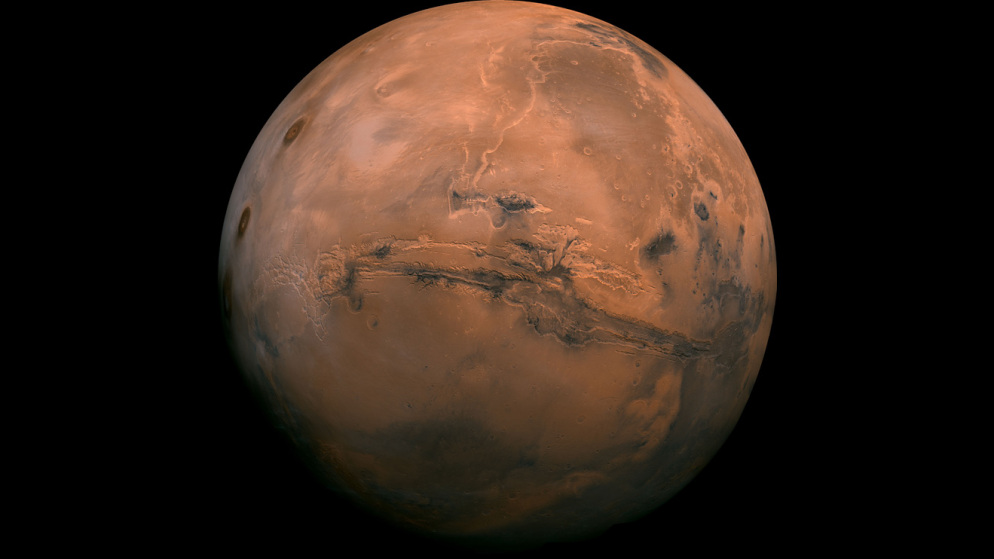
A potential ice-rich portion of the Medusae Fossae Formation deposits may contain the largest volume of water in the equatorial region of Mars. Data from the Mars Advanced Radar for Subsurface and Ionospheric Sounding (MARSIS) – a subsurface radar sounder on the Mars Express orbiter searching for water and studying the Martian atmosphere – reveals layering in the Medusae Fossae Formation (MFF) deposits. These layers are likely due to transitions between mixtures of ice-rich and ice-poor dust, analogous to those in Polar Layered Deposits, according to the paper “Evidence of Ice-Rich Layered Deposits in the Medusae Fossae Formation of Mars” in Geophysical Research Letters.
—University of California: “Small Solar Sails Could be the Next ‘Giant Leap’ for Interplanetary Space Exploration“
Nearly 70 years after the launch of the first satellite, we still have more questions than answers about space. But a team of Berkeley researchers is on a mission to change this with a proposal to build a fleet of low-cost, autonomous spacecraft, each weighing only 10 grams and propelled by nothing more than the pressure of solar radiation. These miniaturized solar sails could potentially visit thousands of near-Earth asteroids and comets, capturing high-resolution images and collecting samples.
—NASA: “NASA’s GUSTO Prepares to Map Space Between the Stars“
On a vast ice sheet in Antarctica, scientists and engineers are preparing a NASA experiment called GUSTO to explore the universe on a balloon. GUSTO will launch from the Ross Ice Shelf, near the U.S. National Science Foundation’s McMurdo Station research base, no earlier than Dec. 21. GUSTO, which stands for Galactic/Extragalactic ULDB Spectroscopic Terahertz Observatory, will peer into the space between stars called the interstellar medium. The balloon-borne telescope will help scientists make a 3D map of a large part of the Milky Way in extremely high-frequency radio waves. Examining a 100-square-degree area, GUSTO will explore the many phases of the interstellar medium and the abundances of key chemical elements in the galaxy.
 Our Awesome Universe