Image (Credit): Japan’s SLIM moon lander, as viewed by small rover LEV-2. (JAXA/Takara Tomy/Sony Group Corporation/Doshisha University)
If you were wondering about the status of the latest Japanese Moon mission, you can rest assured that the Smart Lander for Investigation Moon (SLIM) lander is now safe on the surface of the moon. It also had time to release two small Lunar Excursion Vehicle (LEV) rovers on the lunar surface.
Above is an image from one of those LEV rover’s showing a precariously placed lander. It appears to be standing on its head. Unfortunately, the solar panels are facing west rather than east, as planned.
As noted earlier, it is possible that the SLIM lander could get enough sunlight in the next few days to reactivate for a short period, but after that the lunar evening will drop to -200°F. The lander and rovers are not built for such temperatures.
Update: Good news! As of earlier today (January 29), SLIM has power again and it is back online.
Image (Credit): Shadow of the Ingenuity helicopter’s rotor blade on the surface of Mars. (NASA, JPL-Caltech)
This week’s image shows the shadow of little helicopter that could and continued to do so for 72 flights on Mars. The photo taken by NASA’s Ingenuity Mars helicopter shows one of its rotor blades after it finished its last flight on January 18, 2024. During the landing, one of the blades was damaged, permanently grounded the helicopter forever more.
The amazing little helicopter surpassed all expectations and became a very helpful buddy to the Perseverance rover. It may be the end of Ingenuity, but it should also be seen as the start of more missions that pair rovers and helicopters on Mars.
NASA Administrator Bill Nelson has some final words regarding this unique helicopter in a video that you can watch here.
In addition, Teddy Tzanetos, Ingenuity’s project manager at NASA JPL, had this to say:
It’s humbling Ingenuity not only carries onboard a swatch from the original Wright Flyer, but also this helicopter followed in its footsteps and proved flight is possible on another world.
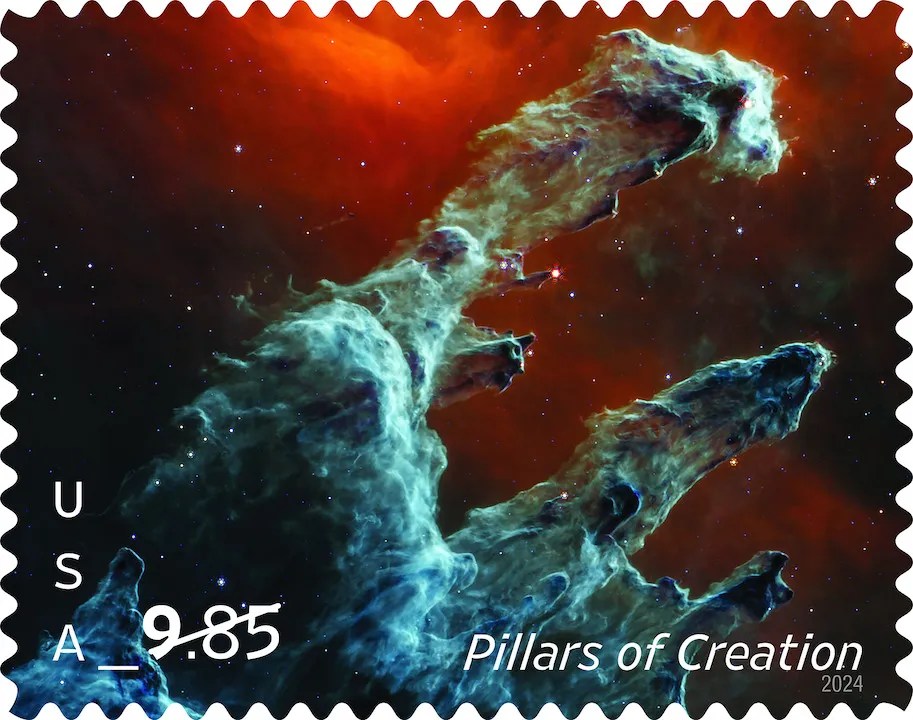
Image (Credit): One of the new USPS Priority Mail JWST postage stamps. (U.S. Postal Service)
If you are in the market for a stamp to mail your Priority Mail package, then look no further than the two new James Webb Space Telescope (JWST) stamps recently issued by the U.S. Postal Service.
You can enjoy the “Pillars of Creation” or “Cosmic Cliffs” stamps, both of which demonstrate some of the most amazing images captured by the telescope.
Image (Credit): The second new USPS Priority Mail JWST postage stamps. (U.S. Postal Service)
A potential ice-rich portion of the Medusae Fossae Formation deposits may contain the largest volume of water in the equatorial region of Mars. Data from the Mars Advanced Radar for Subsurface and Ionospheric Sounding (MARSIS) – a subsurface radar sounder on the Mars Express orbiter searching for water and studying the Martian atmosphere – reveals layering in the Medusae Fossae Formation (MFF) deposits. These layers are likely due to transitions between mixtures of ice-rich and ice-poor dust, analogous to those in Polar Layered Deposits, according to the paper “Evidence of Ice-Rich Layered Deposits in the Medusae Fossae Formation of Mars” in Geophysical Research Letters.
Nearly 70 years after the launch of the first satellite, we still have more questions than answers about space. But a team of Berkeley researchers is on a mission to change this with a proposal to build a fleet of low-cost, autonomous spacecraft, each weighing only 10 grams and propelled by nothing more than the pressure of solar radiation. These miniaturized solar sails could potentially visit thousands of near-Earth asteroids and comets, capturing high-resolution images and collecting samples.
On a vast ice sheet in Antarctica, scientists and engineers are preparing a NASA experiment called GUSTO to explore the universe on a balloon. GUSTO will launch from the Ross Ice Shelf, near the U.S. National Science Foundation’s McMurdo Station research base, no earlier than Dec. 21. GUSTO, which stands for Galactic/Extragalactic ULDB Spectroscopic Terahertz Observatory, will peer into the space between stars called the interstellar medium. The balloon-borne telescope will help scientists make a 3D map of a large part of the Milky Way in extremely high-frequency radio waves. Examining a 100-square-degree area, GUSTO will explore the many phases of the interstellar medium and the abundances of key chemical elements in the galaxy.
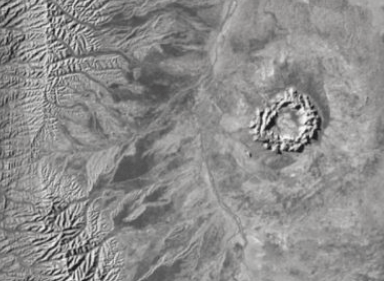
Take a look at the image above. Can you determine where this image originated? Take a guess and then check your answer by going to the “Where is This? The Answer Sheet” page.



 Our Awesome Universe