Movie: I.S.S.

Credit: Bleecker Street

Speaking of the crowded International Space Station (ISS), it appears things could be much worse if you had a chance to watch the newly release film I.S.S. This trailer is all you need to see. I am not sure watching the movie will be at all helpful to your mindset.

Don’t be fooled by the subtle description on the official movie page:

Tensions flare aboard the International Space Station between US and Russian astronauts in this high-stakes space thriller.

In the trailer, these people are going at each other with kitchen knives. This is not “tensions flare,” it is “Oh my God, it’s the end of the world!”

We have seen this before, and not so long ago. Remember The Midnight Sky in 2020 with George Clooney trying to warn an exploratory spacecraft away from a dying Earth? Or how about Rubikon in 2022 about a space station orbiting above a dying Earth?

In these earlier movies, the dying Earth was a mystery. In the case of this new film, it appears it is just trigger-happy governments wanting to end the human experiment once and for all. 

I am not sure this stuff is worth the price of a movie ticket. I would rather watch NASA TV for now as it shows the events related to the real ISS and wait for the online release of this latest film if I truly run out of things to do with my day.
The ISS is Getting Pretty Crowded

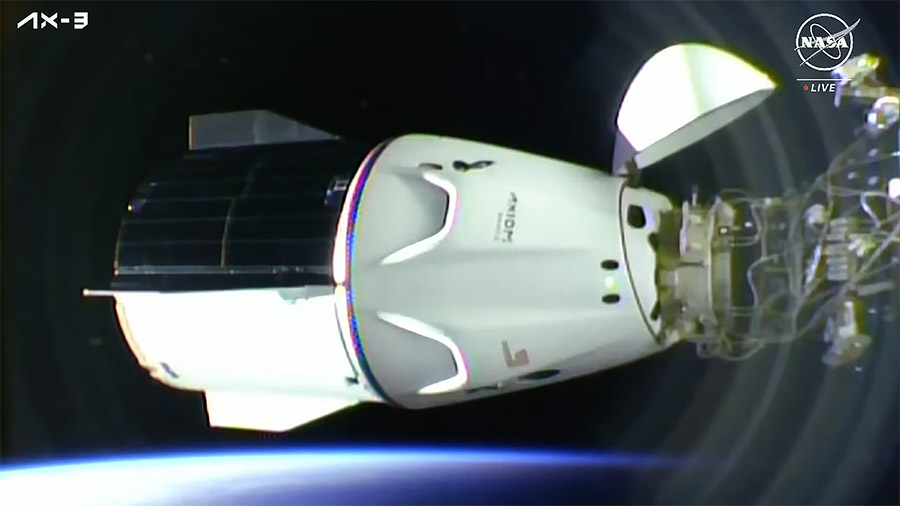
Image (Credit): The SpaceX Dragon Freedom spacecraft, which is carrying four Axiom Mission 3 crew members, docking to the space station shortly after an orbital sunrise. (NASA TV)

The seven real astronauts on the International Space Station (ISS) are now playing host to four visitors for the next two weeks after the Axiom Mission 3 crew came aboard the station earlier today.

Unlike the last two Axiom missions, all three paying members of the Axiom Mission crew are being supported by various European governments:

  • Marcus Wandt, member of the European Space Agency’s (ESA) astronaut reserve (ticket paid by ESA and the Swedish National Space Agency);
  • Walter Villadei, a member of the Italian air force (ticket paid by the Italian air force); and
  • Alper Gezeravcı, a fighter pilot with the Turkish air force (ticket paid by the Turkish government).

At the price of $55 million per seat, I am hoping the governments and space agencies feel they are getting their money’s worth versus being part of the normal 6-month astronaut rotation.

Supposedly, the extra hands will be working on 30 experiments that the normal crew did not have time for, though I would imagine they would be the less important experiments if they would otherwise not be performed at all.

If all of this is truly important work, then I expect such demand will justify the need for commercial space stations down the line to continue the work of the ISS. However, I expect a good chuck of future space interest will come from the tourist side.

In the meantime, I just hope the toilets on board the ISS can deal with the extra passengers.

Note: So as not to give all the attention to the visitors, the current Expedition 70 crew members aboard station are:

  • NASA astronauts Jasmin Moghbeli and Loral O’Hara;
  • ESA astronaut Andreas Mogensen;
  • JAXA (Japan Aerospace Exploration Agency) astronaut Furukawa Satoshi; and
  • Roscosmos cosmonauts Konstantin Borisov, Oleg Kononenko, and Nikolai Chub.

The End of Two Moon Missions?

Image (Credit): Artist’s rendering of Japan’s SLIM mission over the Moon. (JAXA)

Within a two day period, we saw one Moon lander become a burning wreck plummeting towards Earth and another land on the Moon with an immediate problem that threatened its mission. The Moon may be closer, but it is becoming a hazardous place for space missions, similar to Mars.

First, the NASA-contracted Astrobotic Peregrine lander mission ended yesterday as the spacecraft entered the Earth’s atmosphere and burned up. The $108 Moon mission burned up with its cargo, including NASA’s scientific instruments, various rovers, and the DNA remains of humans whose families hoped would be at rest on the Moon’s surface. I expect a few Native Americans may be saying “I told you so” to themselves.

It was almost comical reading a Scientific American article trying to put a good spin on the lost cargo:

In addition, all nine of the payloads that were designed to communicate with Peregrine successfully returned data to Earth. Iris, a rover built by Carnegie Mellon University, sent back a “Hello Earth!” message. COLMENA, a set of five small rovers built by the Mexican Space Agency, also succeeded in sending data back—making it the first Mexican scientific instrument to operate in the moon’s vicinity.

I expect “Hello Earth!” fell far below the ground crew’s expectations, but I guess you take what you can get. And Mexico will probably hold off on any celebrations for the moment.

The second set of bad news related to the latest Japanese Moon mission. The good news is that the Smart Lander for Investigation Moon (SLIM) spacecraft was a success in terms of a soft landing on the Moon. The problem is that the solar array is not getting sufficient solar power for the lander to remain operational for more than a few hours. It is possible that the situation may correct itself as the sunshine shifts over time, but this is not a good start to the mission.

Whatever happens, Japan can still claim to be the fifth nation to successfully land on the Moon. It is not perfect, but the Japanese have more reason to celebrate than the Mexicans at this point.

Pic of the Week: Surfboards in Space

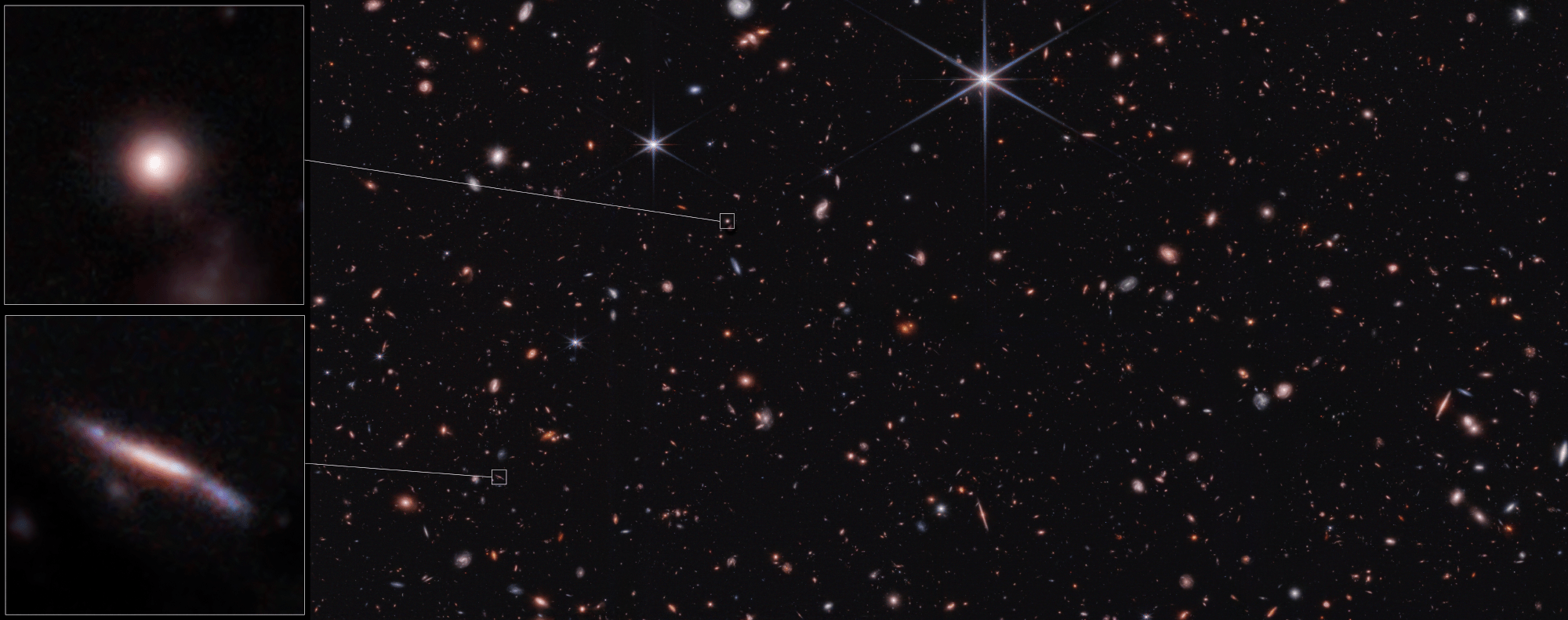
Image (Credit): JWST image showing an array of odd shapes when the universe was only 600 million to 6 billion years old. The elongated shape in the left bottom part of the image is one of the most common identified shapes so far in Webb’s survey. (NASA, ESA, CSA, Steve Finkelstein (UT Austin), Micaela Bagley (UT Austin), Rebecca Larson (UT Austin))

This week’s image is one from the James Webb Space Telescope (JWST) showing galaxies from long ago. Many of these galaxies have an elongated shape similar to a surfboard. Again, JWST is opening our eyes everyday to the wonder and weirdness of the universe.

Here is more about the image from NASA:

Researchers analyzing images from NASA’s James Webb Space Telescope have found that galaxies in the early universe are often flat and elongated, like surfboards and pool noodles – and are rarely round, like volleyballs or frisbees. “Roughly 50 to 80% of the galaxies we studied appear to be flattened in two dimensions,” explained lead author Viraj Pandya, a NASA Hubble Fellow at Columbia University in New York. “Galaxies that look like pool noodles or surfboards seem to be very common in the early universe, which is surprising, since they are uncommon nearby.”

The team focused on a vast field of near-infrared images delivered by Webb, known as the Cosmic Evolution Early Release Science (CEERS) Survey, plucking out galaxies that are estimated to exist when the universe was 600 million to 6 billion years old.

Tap Into an Upcoming Mars Discussion

The Mars Society’s President and founder Dr. Robert Zubrin is in Europe this week to meet with fellow Mars enthusiasts. You can tap into one of those discussions tomorrow if you are interested.

On January 18, Dr. Zubrin will hold a discussion with UK Astronomer Royal Lord Martin Rees on the topic “How to Explore Mars.” You may remember Dr. Rees from some of his books, including Gravity’s Fatal Attraction: Black Holes in the Universe and The End of Astronauts.

You can go here to get your online spot at the London discussion. Just keep in mind the time difference.

Hopefully, a recorded version will be available shortly after the event.