Video: A Tale About the End of Time

Image (Credit): Image from the video Outlasting the Universe. (Cool Worlds)

If you are interested in a fascinating tale about the end of the universe, I recommend you watch a recent Cool Worlds Lab video where Professor David Kipping narrates a version of the deep future where mankind is replaced by machines as they slowly expand into and consume the known universe.

The episode, titled Outlasting the Universe, is told via images from sci-fi television series and movies that you will immediately recognize. They are weaved together into a story about one possible future where the almost endless existence of our modified intelligence continues until the very end.

It is a mesmerizing video that may shift your thinking somewhat in terms of the role of humans versus our creations in the future.

Here are some comments from others who viewed the video:

  • This might be the best sci-fi story I’ve ever seen. And it’s even rooted in true physics as we understand it right now. Amazing and powerful.
  • As sad as the ending is, am I crazy for thinking the ending of all life will be actually beautiful? I wish these videos were hours long. So meditative, relaxing and informative.
  • Beautifully written & eloquently spoken, to a backdrop of some of my favourite sci-fi movies! Thank you for this poignant & thought provoking video.

If you have 20 minutes, I suggest you sit back and watch the universe unwind.
Space Stories: Old Stars Harboring Exoplanets, a Hot “Earth” Located, and the Role of Exomoons

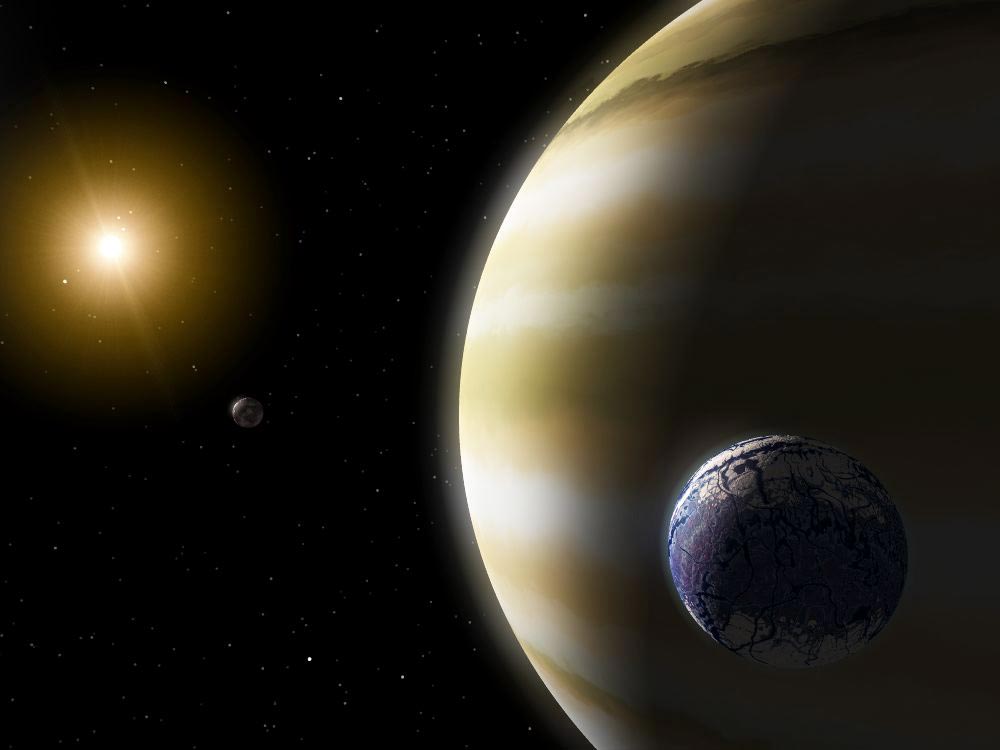
Image (Credit): Artist’s rendering of an Earth-like exomoon orbiting a gas giant planet in a star’s habitable zone. (NASA/JPL-Caltech)

Here are some recent stories of interest related to exoplanets.

Phys.org: “Old Stars May Be the Best Places to Search for Life

Once upon a cosmic time, scientists assumed that stars apply an eternal magnetic brake, causing an endless slowdown of their rotation. With new observations and sophisticated methods, they have now peeked into a star’s magnetic secrets and found that they are not what they expected. The cosmic hotspots for finding alien neighbors might be around stars hitting their midlife crisis and beyond. This groundbreaking study, shedding light on magnetic phenomena and habitable environments, has been published in The Astrophysical Journal Letters.

NASA: “Earth-sized Planet Has a ‘Lava Hemisphere’

In a system with two known planets, astronomers spotted something new: a small object transiting across the Sun-sized star. This turned out to be another planet: extra hot and Earth-sized…The newly-spotted planet, called HD 63433 d, is tidally locked, meaning there is a dayside which always faces its star and a side that is constantly in darkness. This exoplanet, or planet outside of our solar system, orbits around the star HD 63433 (TOI 1726) in the HD 63433 planetary system. This scorching world is the smallest confirmed exoplanet younger than 500 million years old. It’s also the closest discovered Earth-sized planet this young, at about 400 million years old.

UniverseToday: “Big Planets Don’t Necessarily Mean Big Moons’”

Does the size of an exomoon help determine if life could form on an exoplanet it’s orbiting? This is something a February 2022 study published in Nature Communications hopes to address as a team of researchers investigated the potential for large exomoons to form around large exoplanets (Earth-sized and larger) like how our Moon was formed around the Earth. Despite this study being published almost two years ago, its findings still hold strong regarding the search for exomoons, as astronomers have yet to confirm the existence of any exomoons anywhere in the cosmos. But why is it so important to better understand the potential for large exomoons orbiting large exoplanets?

Will China Beat Us to the Moon?

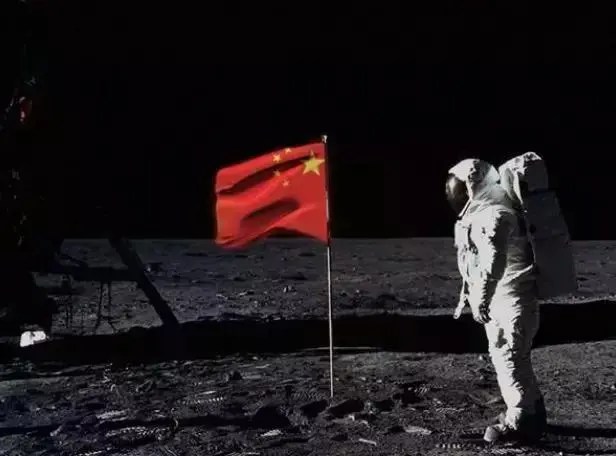
Image (Credit): A manufactured image, but it may be a reality soon enough. (Asia Times)

With the newly announced delays related to the Artemis lunar program, it is fair to ask whether the U.S. might fall behind the Chinese when it comes to a crewed lunar mission (of course, we won that battle 50 years ago, but you know that I mean).

All reports indicate that the Chinese wants to place humans on the Moon by 2030, but they are not expected to beat the Artemis timetable of a lunar landing in 2026. Of course, it is important that NASA stick to this timetable.

NASA Administrator Bill Nelson recently stated:

I do not have a concern that China is going to land before us…I think that China has a very aggressive plan. I think they would like to land before us, because that might give them some PR coup. But the fact is that I don’t think they will. I think it is true that their date that they announced keeps getting earlier. But specifically, with us landing in September of ’26, that will be the first landing.

Obstacles remain on what will prove to be a difficult mission even if it is a repeat. We already saw Russia’s failed attempt to simply land on the Moon last year, and the problems with last week’s NASA-funded commercial launch towards the Moon was worrying.

Nothing can be taken for granted in this new space race.

Space Quote: Another View of Elon and Drugs

“If we’re going to link performance to attitudes about drugs, maybe Musk should be setting the tone for NASA. Perhaps a microdosing schedule would get federal employees out of their ruts and set their creative juices flowing.”

-Statement by J.D. Tuccille in his Reason magazine article, “Let Elon Musk Enjoy Drugs.” The libertarian magazine has some strong views on drug laws and government operations, as the quote indicates. The article does note that Mr. Musk would be violating federal rules as the head of SpaceX if the reports of drug use are true, but also notes that only SpaceX can get Americans to the International Space Station. I guess Reason is all in favor of situational morality, something that seems to be gaining favor these days with those who deem themselves above the law.

Sample Return: NASA Just Needed the Right Tool

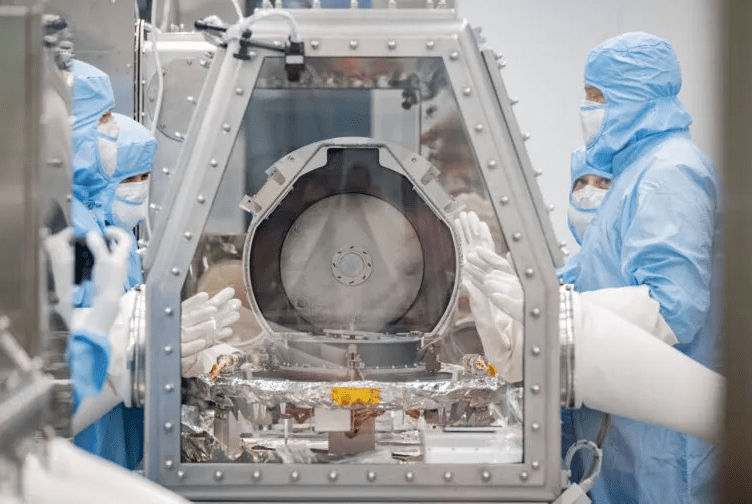
Image (Credit): The NASA and Lockheed Martin team observing the sample return canister. (NASA/Robert Markowitz)

It is amazing that we have the ability to launch a spacecraft that can chase an asteroid millions of miles away, but we lack a wrench here on Earth to open the sample container when some of that asteroid is sent home.

You may remember the problems NASA had last year opening the lid on the sample canister that Origins, Spectral Interpretation, Resource Identification, and Security–Regolith Explorer (OSIRIS-REx) returned from its encounter with the asteroid Bennu. Well, NASA finally opened up the canister.

NASA stated:

Curation processors paused disassembly of the TAGSAM head hardware in mid-October after they discovered that two of the 35 fasteners could not be removed with the tools approved for use inside the OSIRIS-REx glovebox. In response, two new multi-part tools were designed and fabricated to support further disassembly of the TAGSAM head. These tools include newly custom-fabricated bits made from a specific grade of surgical, non-magnetic stainless steel; the hardest metal approved for use in the pristine curation gloveboxes.

That’s a lengthy way to simply say we found the right tool. Now the rest of the asteroid sample can be cataloged and shared with the scientific community.

I am just glad the capsule did not contain an astronaut.