The US Aims to be Back on the Moon Next Month

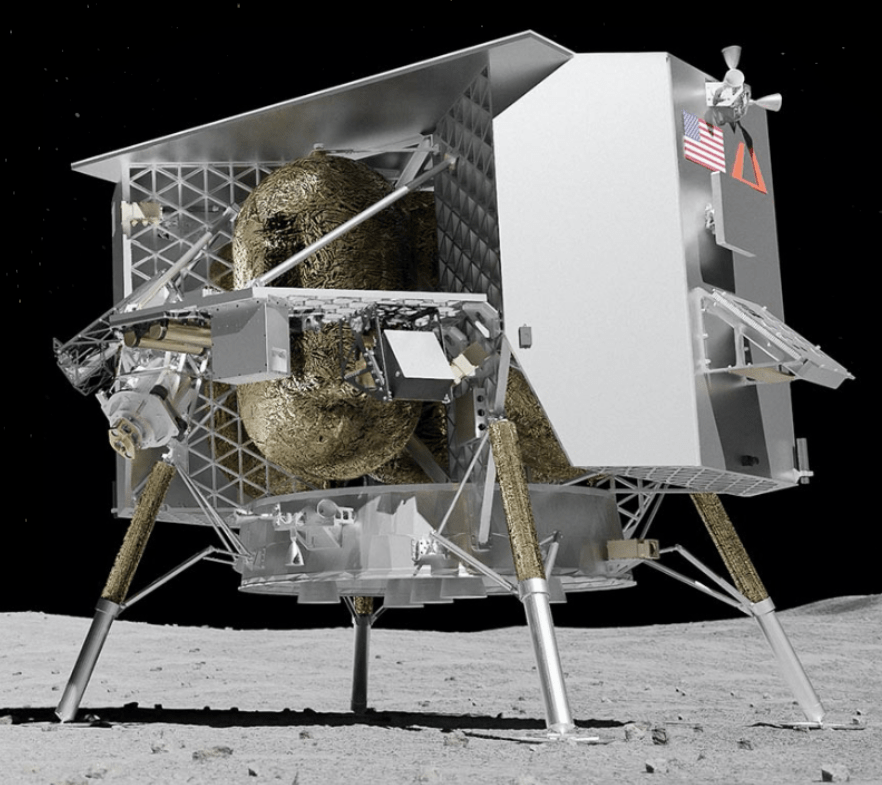
Image (Credit): Astrobotic’s Peregrine lunar lander. (Astrobotic)

After ending launches to the Moon’s surface more than 50 years, NASA is funding a lunar mission that launches tomorrow morning. United Launch Alliance (ULA) will be using its new Vulcan rocket to launch the Astrobotic mission towards the Moon. ULA, as noted earlier, has a lot riding on this new rocket as it seeks a buyer. Blue Origin will also be watching events closely as the manufacturer of the Vulcan rocket engines.

This is a milestone for the U.S. as well as Astrobotic, which will be the first private company to reach the Moon’s surface if everything goes without a hitch. The Pittsburgh-based company plans to place its Peregrine lunar lander on the Moon’s surface at Sinus Viscositatis (Bay of Stickiness). The company notes that the Peregrine Mission One (PM1) “…is carrying 20 payloads (cargo) from governments, companies, universities, and NASA’s Commercial Lunar Payload Services (CLPS) initiative.” The NASA payloads are shown below.

The Peregrine lunar lander is not expected to land on the Moon’s surface until February 23rd. The delay will allow sufficient sunlight to be present at the landing site.

Fingers crossed that all goes well tomorrow morning.

Looking for Canadian Space News?

This site generally covers space news from a US perspective, but there are plenty of other perspectives to consider as well. I will try to point out more of them as I go along.

On viewpoint is that of the Canadians. I found a nice website that covers the space news for that country. I recommend you visit Spaceq for an update on what the Canadian are up to. Some of the stories posted on the site now include:

Of course, Canada is a key partner in the Artemis program, including providing one of the astronauts for the Artemis II mission. Canada is also working on its own space missions as well, including plans to place a rover on the Moon.

Space Quote: No One Owns the Moon

Image (Credit): The Moon as seen from the International Space Station. (NASA)

“No one, and no religion, owns the moon, and, were the beliefs of the world’s multitude of religions considered, it’s quite likely that no missions would ever be approved…Simply, we do not and never have let religious beliefs dictate humanity’s space efforts — there is not and should not be a religious test.”

-Statement by Celestis CEO and co-founder Charles Chafer in an email to Space.com regarding Native American concerns about a NASA -funded rocket taking human remains to the Moon next week. A second company, Elysium Space, will also be placing human remains on the Moon as part of this same mission. NASA separately noted in response to the Native American concerns, “We don’t have the framework for telling [private companies] what they can and can’t fly.”

Pic of the Week: The Last Full Moon of 2023

Image (Credit): The last full Moon of 2023. (Gianni Tumino from Ragusa, Sicily, Italy)

This week’s image is from Astronomy magazine’s Picture of the Day, labeled “The year’s last Full Moon.”

Here is what the caption states:

The last Full Moon of 2023 rises over the Mediterranean as seen from Aci Castello on Dec. 26. The ten frames in this composite image ranged from 1/800 to 1/100 second at ISO 400 with a zoom lens at 200 mm and f/13.

AstroForge Readies Secret Asteroid Mission

If you were the operator of an airline yet you refused to share the planned destination of your planes, I can assure you that the Federal Aviation Administration would have issues. Yet AstroForge is planning to do just that – set off into the wild blue (or black) yonder in a spacecraft named Odin towards an asteroid that it refuses to name. Needless to say, but I will say it, some people are not very happy.

The New York Times had a story on this adventure, which quoted Jonathan McDowell, an astronomer at the Harvard-Smithsonian Center for Astrophysics in Massachusetts:

I’m very much not in favor of having stuff swirling around the inner solar system without anyone knowing where it is…It seems like a bad precedent to set.

The Odin spacecraft’s goal is to observe the satellite(s) in question so that AstroForge can identify those worth revisiting as part of a mining mission. Here is the plan in the words of AstroForge:

get to deep space, perform a flyby of the asteroid target, and take high resolution images of the surface. It’s important to note that meeting just one of these objectives would be a groundbreaking achievement not just for AstroForge but for commercial space at-large.

While asteroid visits are not new, nor the idea of mining them, AstroForge would be the first commercial company to do so. The economics of such ventures are still being determined, but the company appears to have enough believers to fund such missions for now.

No specific date for the Odin launch has been set, but it is expected to occur in 2024.