Pic of the Week: A Rough Moon Landing

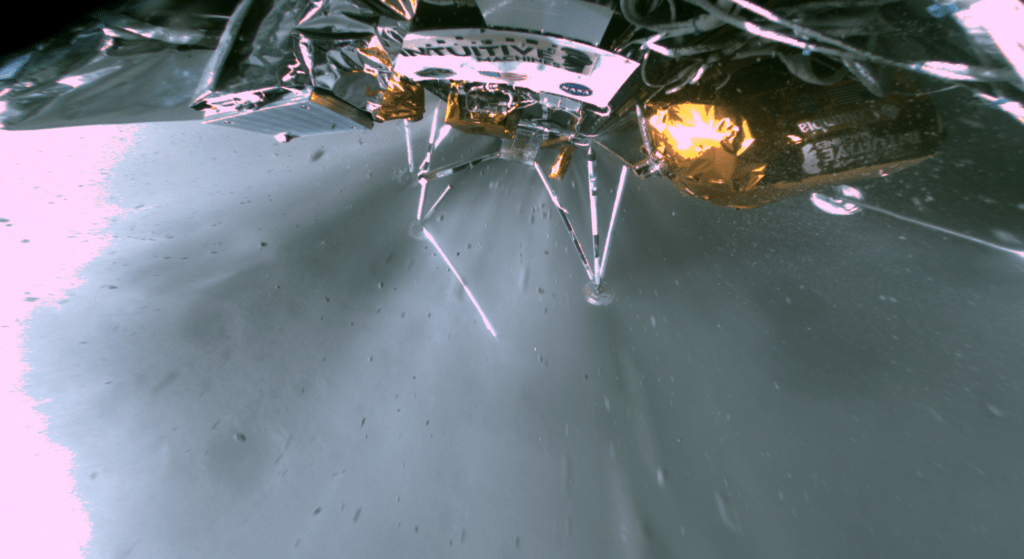
Image (Credit): An image showing the Odysseus lunar lander making first contact with the Moon. (Intuitive Machines)

This week’s image shows the Odysseus lunar lander as it is about to touch the Moon’s surface. It tipped over upon landing.

Here is the statement about the image from Initiative Machines:

This image retrieved from the lander on February 27 captures Odysseus’ landing strut during landing on February 22nd performing its primary task, absorbing first contact with the lunar surface. Meanwhile, the lander’s liquid methane and liquid oxygen engine is still throttling, which provided stability. The Company believes the two insights captured in this image enabled Odysseus to gently lean into the lunar surface, preserving the ability to return scientific data.

NASA tried to put its best spin on the science coming out of the tilted lander, which suffered solar array and communication issues related to its tilted position, stating:

Mission challenges and successes were discussed during the briefing including more than 350 megabits of science data downloaded ready for analysis. During transit, all powered NASA payloads operated and received data. During descent and landing, guidance and navigation data was collected that will help improve landing precision in the future, and all three payloads that were designed to operate on the surface have received data.

What is left unsaid is whether the data received during this landing was close to what was anticipated and necessary for future safe missions. Saying some data was received does not tell us much. Only complete and useful data really matters here. I expect more information will be shared shortly.

I have not read too much about the fate of the other commercial cargoes. I doubt they fared much better.

Fortunately, the lunar lander communicated with Earth until early this morning, outlasting earlier expectations.

Could it come alive again like the Japanese lander? We shall see. As Intuitive Machines said earlier today, “Goodnight, Odie. We hope to hear from you again.”

Space Stories: DART Damage, India Plans for Orbiting Crew, and SLIM Awakes on the Moon

Image (Credit): Illustration of how DART’s impact altered the orbit of Dimorphos about Didymos. (https://dart.jhuapl.edu/)

Here are some recent stories of interest.

NDTV: NASA’s Mission Not Only Altered Asteroid’s Path, But Its Shape Too, Says New Study

A recent study suggests NASA’s DART mission, designed to test asteroid deflection methods, may have revealed more than planned. While successfully altering the target asteroid’s trajectory, scientists now believe the impact also significantly changed its shape, hinting at a surprising composition. Previously thought to be a solid rock, Dimorphos, the impacted asteroid, may actually be a loose collection of debris. This conclusion stems from the unexpected level of deformation observed after the collision. Unlike a typical crater, the impact appears to have caused a broader, flatter dent, resembling an M&M candy.

Reuters: India Announces Four-member Crew for ‘Gaganyaan’ Space Mission

India on Tuesday introduced four crew members for its maiden ‘Gaganyaan’ space voyage, as it aims to become the world’s fourth country to send a crewed mission into space just months after a historic landing on the south pole of the moon. Gaganyaan, or “sky craft” in Hindi, is the first mission of its kind for India and will cost about 90.23 billion rupees ($1.1 billion). It involves the launch of a habitable space capsule over the next year to an orbit of 400 km (250 miles) and its return via a landing in the Indian Ocean.

SpaceNews.com: “Japan’s SLIM Moon Lander Stages Unexpected Revival After Lunar Night

Japan’s space agency made contact with its SLIM moon lander Sunday, despite the spacecraft not being expected to function after lunar night. Contact with the Smart Lander for Investigating Moon (SLIM) spacecraft was reestablished on Sunday, Feb. 25, the Japan Aerospace Exploration Agency (JAXA) announced via its dedicated SLIM account on X, formerly known as Twitter, early Feb. 26.

Second US Moon Mission Expected to End Today

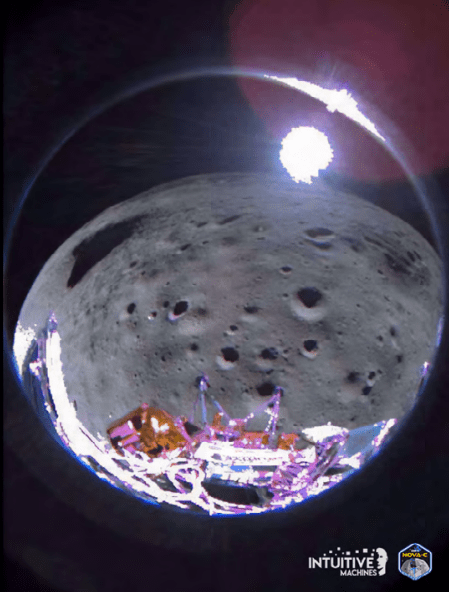
Image (Credit): Odysseus captured this image approximately 35 seconds after pitching over during its approach to the landing site. The camera is on the starboard aft-side of the lander in this phase. (Intuitive Machines)

Well, that was quick. Odysseus may run out of power today given its rough landing, prematurely ending the second US mission to the Moon this year, both of which had problems. It is really amazing that we landed humans on the Moon multiple times for days at a time when you consider the wreckage added to the Moon since then. I know the south pole is a different scenario, but this is where we want to be next. It is looking more and more difficult to do.

Intuitive Machines issued its latest update yesterday:

Odysseus continues to communicate with flight controllers in Nova Control from the lunar surface. After understanding the end-to-end communication requirements, Odysseus sent images from the lunar surface of its vertical descent to its Malapert A landing site, representing the furthest south any vehicle has been able to land on the Moon and establish communication with ground controllersFlight controllers intend to collect data until the lander’s solar panels are no longer exposed to light. Based on Earth and Moon positioning, we believe flight controllers will continue to communicate with Odysseus until Tuesday morning.

It also appears that human error was at the center of the rough landing. Reuters reported yesterday that problems with the range finders related to Intuitive Machine’s decision not to conduct a test firing of the laser system. We learned that the range finders were “…inoperable because company engineers neglected to unlock the lasers’ safety switch before launch.” This may have saved some time and money, but we now see the results.

Mike Hansen, the company’s head of navigation systems, told Reuters:

There were certainly things we could’ve done to test it and actually fire it. They would’ve been very time-consuming and very costly…So that was a risk as a company that we acknowledged and took that risk.

The company made that decision with NASA funds on the line as well. I am not sure NASA would have been so cavalier about final testing. Human error is one thing. Commercial hubris is another. The company’s shortcut is already being reflected in its stock price.

One can certainly argue that progress is being made given that the first lander, Peregrine, never even made it to the Moon’s surface. Such trials and tribulations are to be expected. Yet I wonder if that is how all of the commercial partners see it. Both Moon missions were partially funded by private sector parties who saw their cargoes either burn up in the Earth’s atmosphere and stranded in the wrong position on the Moon. Will they continue to fund such ventures given the risks? Commercial involvement is a key part of the Artemis lunar program and it could be threatened by continuing problems.

The other question is whether these Artemis-related flights will delay the upcoming crewed missions. We should know more shortly, but you can be certain all of this is being factored into timelines being prepared by NASA.

Note: NASA had a press conference the other day on the Intuitive Machines Moon mission that can be found here.

Television: Spaceman Premiering on Netflix

When I hear the name Adam Sandler, I do not think of a serious movie, particularly one about a space. And yet that is what Netflix is throwing our way, or at least it might have been a serious movie until they threw in a giant talking spider.

That’s right, Adam and a spider are coming to Netflix on March 1 in Spaceman to entertain you.

Here is the Netflix pitch (and the trailer):

Six months into a solitary research mission to the edge of the solar system, an astronaut, Jakub (Sandler), realizes that the marriage he left behind might not be waiting for him when he returns to Earth. Desperate to fix things with his wife, Lenka (Carey Mulligan), he is helped by a mysterious creature from the beginning of time he finds hiding in the bowels of his ship. Hanuš (voiced by Dano) works with Jakub to make sense of what went wrong before it is too late.

Should you want to bypass the movie and go straight to the book, you can look for the novel Spaceman of Bohemia by Jaroslav Kalfař.

Like the new series Constellation on Apple TV+, space has become a big canvas to tell the more mundane story about lonely humans. The spaceship and other hardware are simply furnishings in such tales.

All I know is that NASA is recruiting volunteers for its own long-term isolation Mars program and I just hope the agency have sprayed the facility for spiders.

A Day in Astronomy: The Mariner 6 Heads to Mars

Image (Credit): The Mariner 6 spacecraft. (NASA)

On this day in 1969, NASA’s Mariner 6 was launched from Cape Canaveral using the Atlas-Centaur AC-20 rocket. The mission of Mariner 6 was to conduct a flyby of Mars and analyze the Martian atmosphere and surface with remote sensors.

This mission, as well as the Mariner 7 launch the following month, provided solid evidence that the dark features on the planet’s surface were not canals (as astronomer Percival Lowell and other had proposed).

You can find NASA’s Mariner information here.

Image (Credit): Close up of Mars taken by Mariner 6. (NASA)